These kindergarten addition and patterns of one more worksheets give teachers a focused, printable resource for one of the earliest formal addition strategies children encounter. Each worksheet targets the plus-one rule — that adding one to any number lands on the next number in the counting sequence — through visual formats matched to where five- and six-year-olds actually are cognitively. The set moves from concrete representations toward written equations, which is the progression most students need before plus-one becomes automatic.
What Students Practice Across the Set
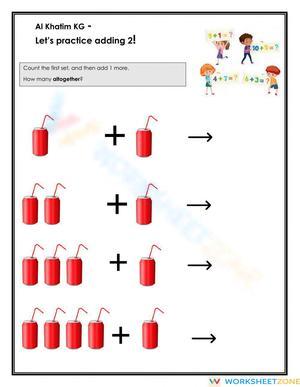
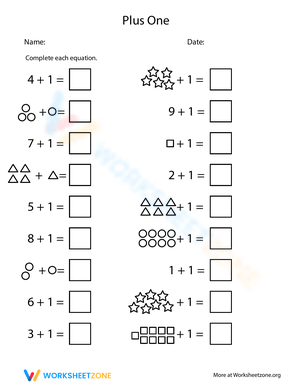
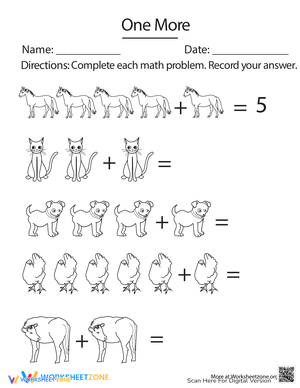
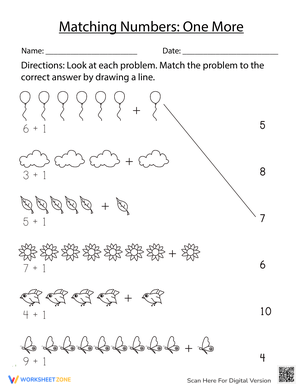
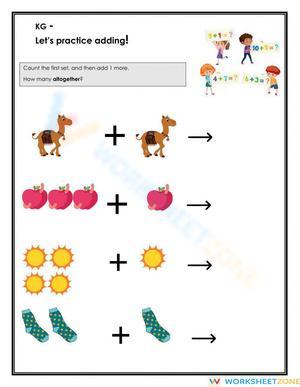
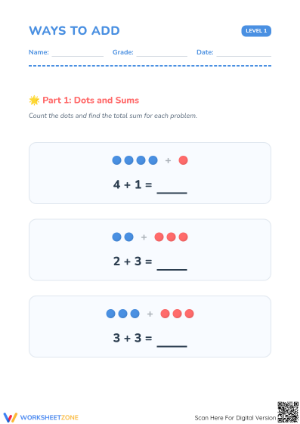
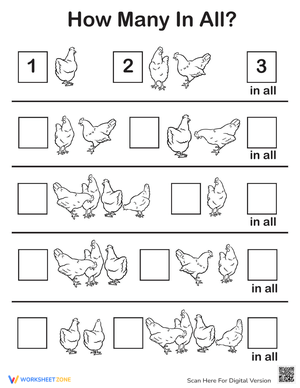
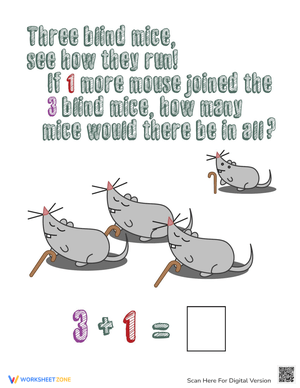
The worksheets put students to work in several concrete ways. Ten-frame activities ask children to fill in one more counter and write the resulting total. Number line hops have students draw a single jump forward and record where they land. Picture sequences show a group of objects alongside a prompt to draw one more, then write the matching addition equation. Fill-in rows present a starting number and ask for the one that follows it in the counting sequence. Some worksheets pair two of these formats together — a ten-frame illustration alongside a matching equation, for example — so students connect the visual representation to the symbolic one without flipping between separate materials.
That pairing matters more than it might look. The leap from seeing four dots and one more dot to writing 4 + 1 = 5 is not automatic for most kindergartners. Putting both representations on one worksheet makes the connection explicit and gives teachers something concrete to point to during whole-class discussion.
Why Plus-One Comes Before Other Addition Facts
Children arrive at kindergarten able to recite numbers in order, but they do not yet treat the counting sequence as a mathematical tool. The one-more pattern is the first time that sequence becomes arithmetic. When a student realizes that adding one always means moving to the next number — not drawing more marks, not recounting everything from one — they shift from counting all to counting on. That shift is cognitive, not just procedural. Kindergarten addition and patterns of one more worksheets arrive at exactly this developmental hinge point, after students have established cardinality but before instruction moves to plus-two or plus-zero patterns, making them the right entry point for written addition practice.
Mistakes Students Make That Are Worth Catching Early
The most common error is counting all, and it is easy to miss because it produces the right answer. A student given the problem 6 + 1 draws six marks, adds one more, and counts all seven from the beginning: one, two, three, four, five, six, seven. The answer is correct. The process shows the pattern was not internalized. This appears in student work as slow, heavily marked-up equations where the student's page ends up covered in tally marks even on the simplest problems. More repetition alone will not fix it — what actually helps is a hide-and-peek activity where blocks are placed under a cup, the count is stated aloud, one more block is added on top, and the student must name the total without seeing the hidden group. The absence of visible objects forces them to rely on the sequence rather than a recount.
A second error shows up specifically on number line worksheets: students draw their hop in the wrong direction, landing on 4 instead of 6 when starting at 5. This is a number line orientation issue as much as an addition one. Marking it as a wrong answer without explaining the directionality confusion leaves the student unsure what they did wrong. Naming the specific error — "the jump goes this way because more means we move right" — redirects attention to the right concept.
Smart Ways to Fit These Worksheets Into Your Weekly Plan
The daily calendar is the most underused instructional tool for this concept. Well before any written practice, ask the class each morning: "We have been in school nineteen days. If we come back tomorrow, how many days will that be?" That daily, low-stakes question builds the intuition that adding one always moves the count forward by one step. By the time students sit down with a worksheet, the logic is already familiar — the worksheet is where they practice applying it to equations rather than learning the concept from scratch.
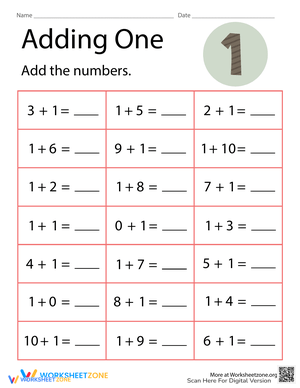
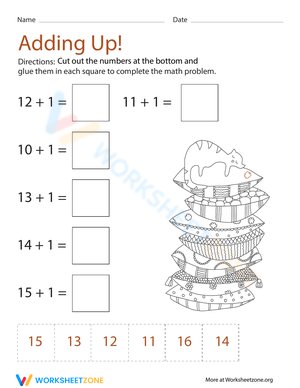
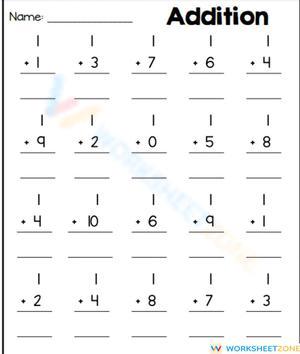
For math center rotations, the picture-based and ten-frame activities work well early in the week, when students are fresh enough to process visual information carefully. Save the purely symbolic equation formats — rows of ___ + 1 = ___ — for Thursday or Friday, after several days of practice have accumulated. Kindergarten addition and patterns of one more worksheets are short enough that most students finish within a standard center block, which means fewer incomplete papers and cleaner formative data. A second worksheet from the set can serve as a quick exit check at the end of the rotation, giving teachers two data points rather than one.
Standard Alignment
These worksheets address K.OA.A.1 and K.OA.A.5 from the Common Core State Standards for Mathematics. K.OA.A.1 asks students to represent addition using objects, drawings, verbal explanations, and equations. K.OA.A.5 addresses fluency with addition within five. In classroom terms, the plus-one format is where students first encounter a written equation — 3 + 1 = ___ — attached to a visual they can reason about, which is precisely the representational bridge K.OA.A.1 describes. Most kindergarten pacing guides introduce this work in the first trimester, after one-to-one correspondence is solid and before instruction shifts to combinations that don't follow a single predictable rule.
Adjusting the Set for a Range of Learners
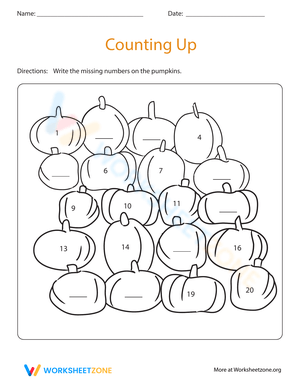
For students who are still building number recognition, narrow the range first. Problems that stay within five — adding one to numbers one through four — let students focus on the pattern without the added load of reading larger numerals. A number line taped to the desk gives those students a physical reference: they point to the starting number, hop one space right, and read the answer. Repeating that physical action across several problems builds the same understanding that counters provide, without requiring the teacher to distribute and collect manipulatives during independent work time.
Students who catch on quickly get restless with straightforward fill-in equations, and restlessness in math centers creates management problems faster than academic difficulty does. Give these students kindergarten addition and patterns of one more worksheets that include missing addend formats — ___ + 1 = 8 — or extend the number range into the teens. Fast finishers can also write their own plus-one equations on the back of each worksheet and swap with a partner to check, which takes thirty seconds to introduce and keeps them genuinely engaged rather than pretending to be finished.
Frequently Asked Questions
At what point in the year do most kindergarten teachers introduce plus-one addition?
Most pacing guides place this in the first trimester, typically after students can identify numerals to at least ten and demonstrate solid one-to-one correspondence. In practice, that lands somewhere between weeks six and twelve depending on the class. Many teachers introduce the concept informally through the morning calendar much earlier, then formalize it with written practice once numeral recognition is secure enough that the equation format itself isn't the obstacle.
How many problems per worksheet is realistic for a five-year-old working independently?
Eight to twelve problems is a workable range. More than that and attention drifts — the last few responses become rushed, which produces data that doesn't reflect what a student actually knows. Fewer than six makes it hard to see a reliable pattern. If a worksheet has more problems than a given group can handle, assign the first eight and treat the rest as optional for students who finish early.
Can these worksheets go home as homework, or are they better used in school?
They work in both settings. The picture-based and ten-frame formats are clear enough that most families can support a child through them without much background explanation. Number line hop activities occasionally confuse parents who weren't taught that way — a brief written note clarifying that the student should start at the given number and move one space to the right prevents the "we worked on it together and it's still marked wrong" conversation.
How do I know when a student is ready to move past plus-one?
Watch for automatic, unhesitating responses. When a student hears "seven plus one" and says "eight" immediately — without drawing, counting, or glancing at a reference — the pattern is internalized. If they still reach for a tool or pause to count up, they need more spaced encounters with the concept across several days, not necessarily more practice in a single sitting. Massed repetition in one session is far less effective than returning to the concept across a week.













 Interactive Worksheet Maker
 Quiz Maker
 Word Search Maker
 Crossword Puzzle Maker
 Word Scramble Generator
 Sentence Scramble Generator
 Handwriting Worksheet Generator
 Name Tracing Generator
 Fill In The Blank Generator