


























Views
Downloads

Bug Addition Worksheet | Essential Grade K Math
Paste this activity's link or code into your existing LMS (Google Classroom, Canvas, Teams, Schoology, Moodle, etc.).
Students can open and work on the activity right away, with no student login required.
You'll still be able to track student progress and results from your teacher account.
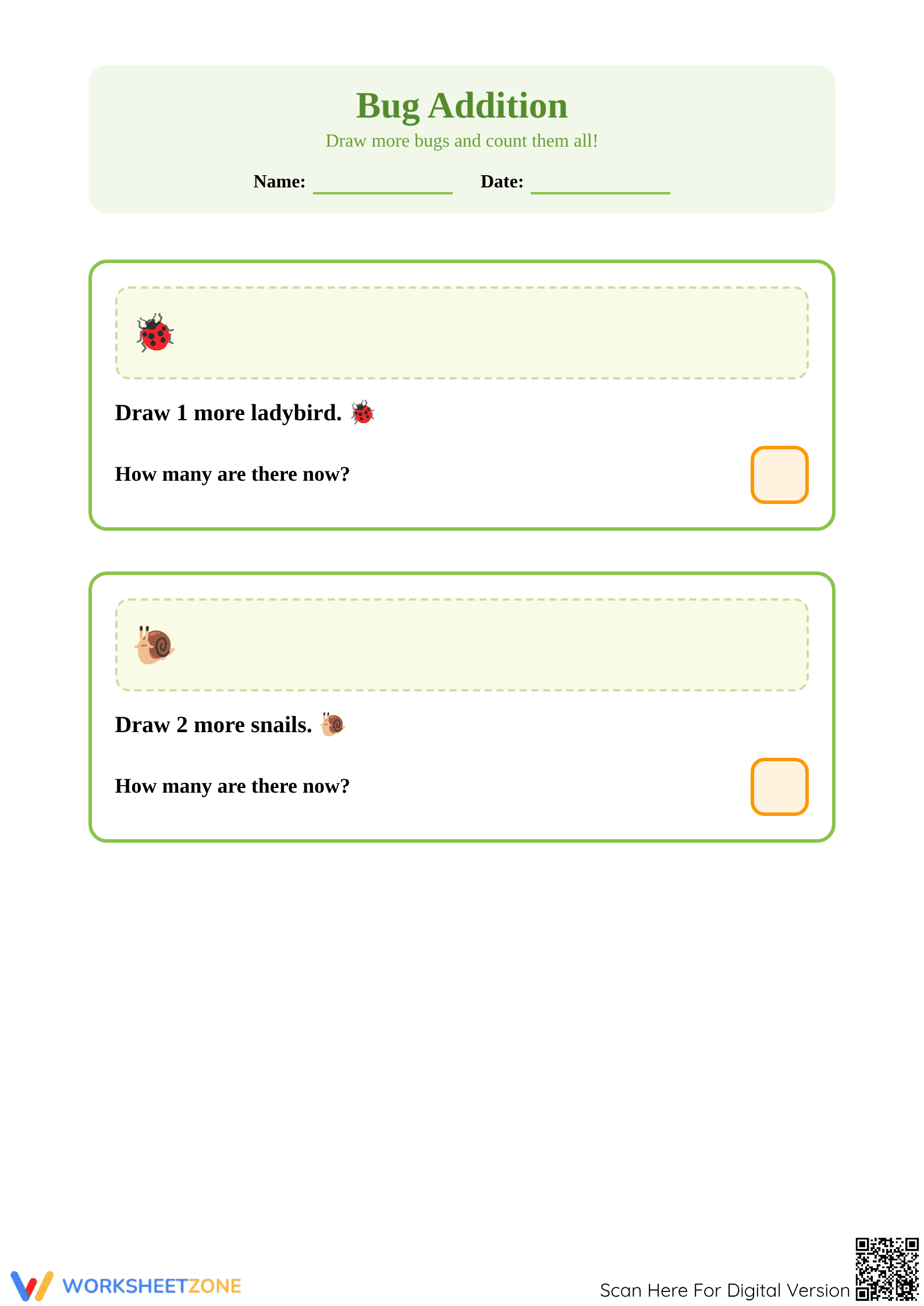
This Kindergarten addition worksheet uses engaging insect illustrations to help young learners master basic sums. By drawing additional bugs and counting the total, students develop a concrete understanding of the adding to concept. It provides a tactile and visual approach to early numeracy, ensuring students build confidence with numbers 1 through 10 before moving to abstract equations.
At a Glance
- Grade: Kindergarten · Subject: Math
- Standard:
CCSS.MATH.CONTENT.K.OA.A.2— Solve addition problems within 10 using objects or drawings to represent the problem- Skill Focus: Visual Addition & Counting On
- Format: 3 pages · 6 problems · Answer key included · PDF
- Best For: Independent practice or small group centers
- Time: 15–20 minutes
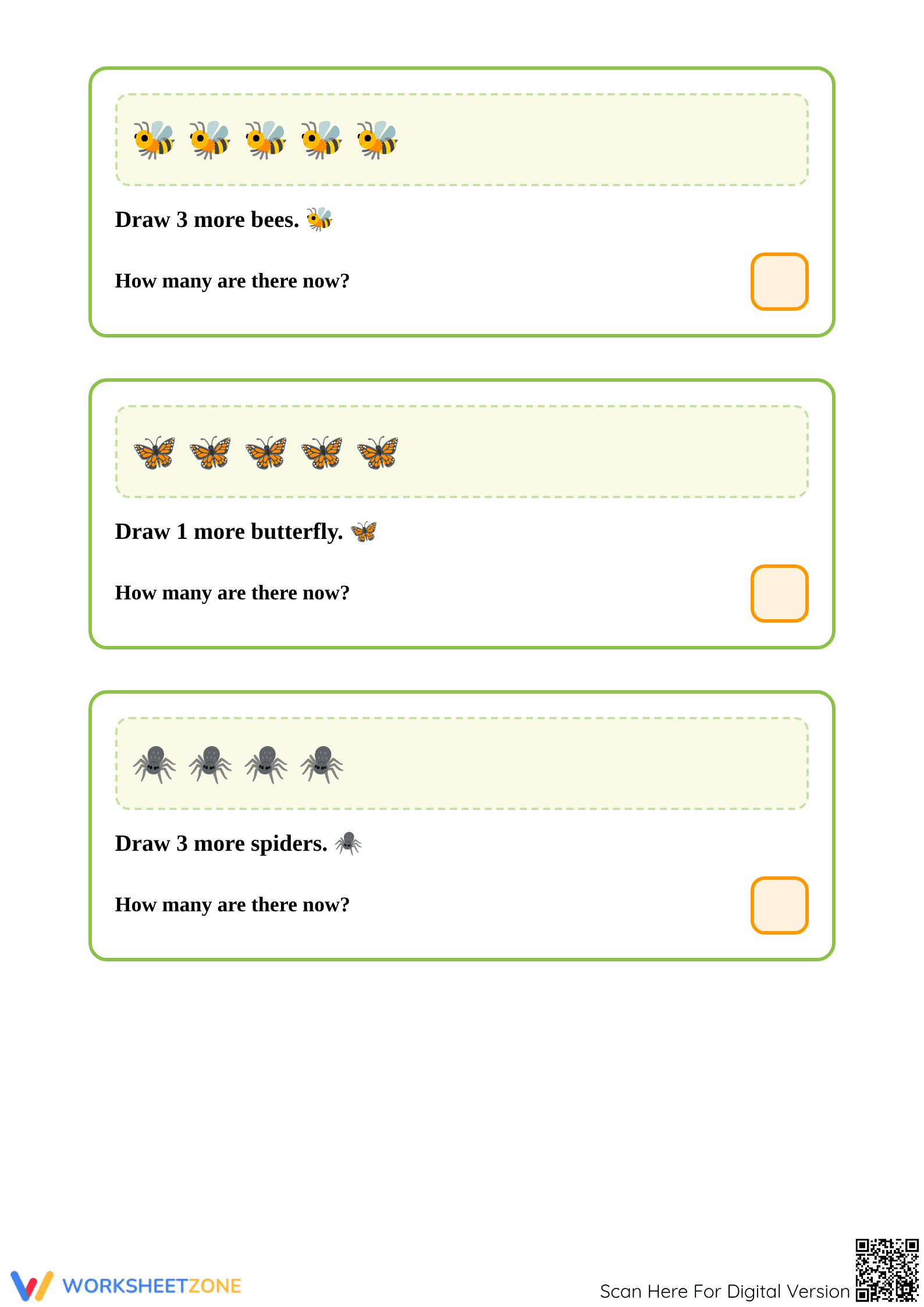
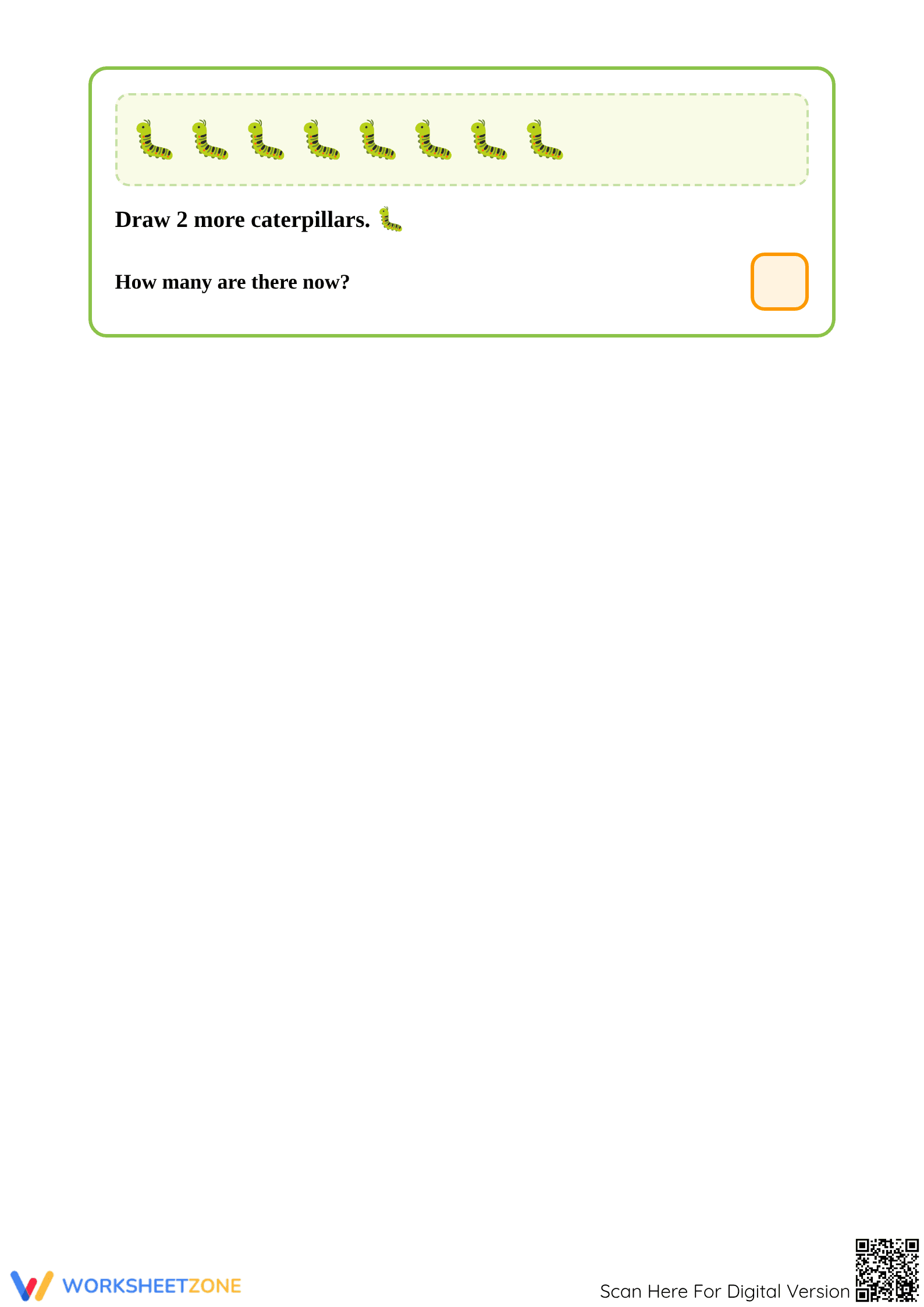
The resource consists of three high-quality PDF pages featuring six distinct addition scenarios. Each problem provides a starting set of insects—such as ladybirds, bees, or caterpillars—and a clear prompt to draw a specific number more. Large response boxes allow students to write their final totals clearly. A full answer key is included for quick grading or student self-correction.
Teachers can integrate this resource into their morning routine in under two minutes. Simply print the three-page set, distribute to students with crayons or pencils, and review the visual models together. Because the instructions are self-explanatory, this worksheet serves as an ideal emergency sub plan or a quiet-time activity that requires no prior setup or complex manipulatives. The workflow is designed for maximum efficiency in busy classrooms.
This worksheet is directly aligned with CCSS.MATH.CONTENT.K.OA.A.2, which requires students to solve addition word problems and add within 10 using drawings to represent the problem. It also supports CCSS.MATH.CONTENT.K.CC.B.4 by reinforcing the relationship between numbers and quantities. Both standard codes can be copied directly into lesson plans, IEP goals, or district curriculum mapping tools to ensure compliance with state frameworks.
Use this worksheet during the independent practice phase of a gradual release lesson on addition. It is particularly effective after a whole-class demonstration using physical counters. For a formative assessment, observe if students are counting every bug individually or if they are beginning to count on from the initial group. Expect completion in 15 to 20 minutes depending on the student's fine motor drawing speed.
This resource is designed for Kindergarten students and Grade 1 learners needing remedial support. The visual nature makes it excellent for English Language Learners (ELLs) and students with IEPs who benefit from concrete representations of abstract math concepts. Pair this with a bug-themed counting book or a set of plastic insect manipulatives for a cohesive unit that appeals to kinesthetic and visual learners alike.
According to the RAND AIRS 2024 report, the use of visual representations in early mathematics significantly improves long-term retention of arithmetic facts. This worksheet leverages that research by requiring students to physically draw and count objects, bridging the gap between concrete and abstract thinking. By aligning with CCSS.MATH.CONTENT.K.OA.A.2, the resource ensures that students are practicing the exact skills identified by national standards as foundational for algebraic thinking. The 6 structured tasks provide enough repetition to build procedural fluency without overwhelming young learners. Educators can rely on this evidence-based approach to support diverse classroom needs while maintaining high academic expectations. This specific bug-themed intervention is designed to reduce math anxiety by framing addition as a creative drawing task, a method supported by Fisher & Frey (2014) for increasing student engagement in primary grades.


