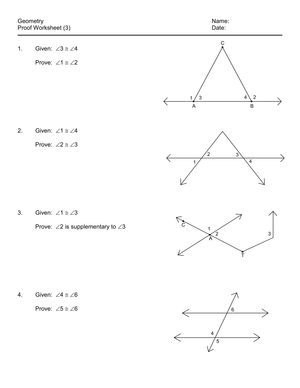
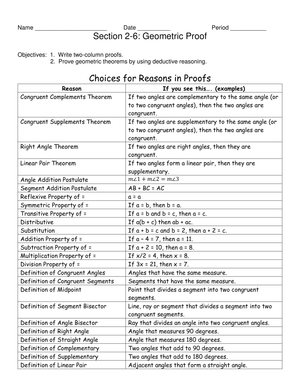
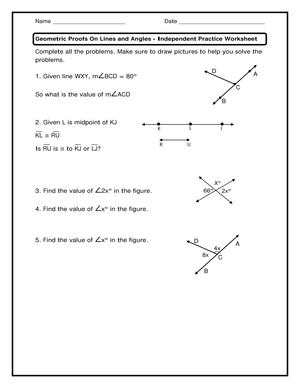
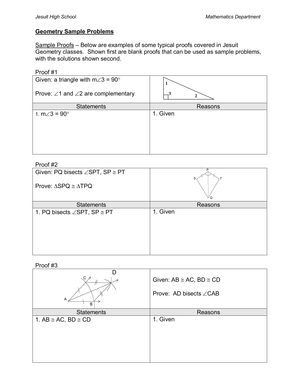
These geometric proofs pdf worksheets for 9th grade give teachers a complete practice sequence that moves from introductory two-column proofs built around algebraic properties through triangle congruence theorems and CPCTC arguments. The set tracks closely with the order most geometry courses follow, so there is no resequencing needed before distributing them.
The Specific Skills Each Worksheet Builds
Early worksheets establish the reasoning apparatus students use throughout the year: the Reflexive, Symmetric, and Transitive Properties of Equality, along with the Addition, Subtraction, Multiplication, and Division Properties. Grounding the first proofs in algebra — proving that if 2x + 5 = 11, then x = 3, using one property per step — lets students focus entirely on the Statement/Reason format before geometric content is added.
Later worksheets address the core of the 9th-grade proof curriculum:
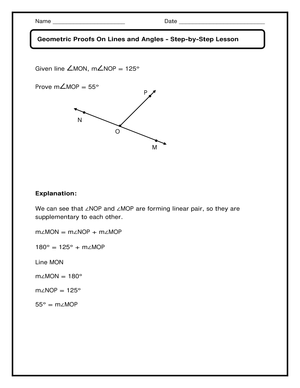
- Segment and Angle Addition Postulates, including proofs built around midpoints and angle bisectors
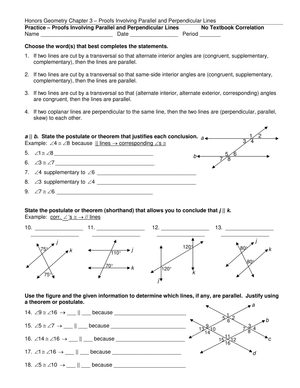
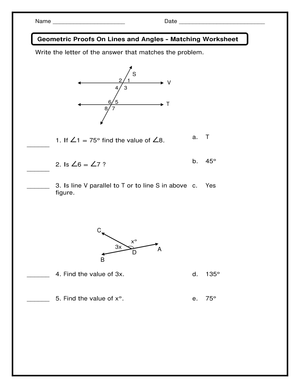
- Vertical Angles Theorem and the properties of parallel lines cut by a transversal — Alternate Interior Angles, Corresponding Angles, Co-Interior Angles
- Triangle congruence via SSS, SAS, ASA, AAS, and HL, with diagrams that increase in complexity across worksheets
- CPCTC arguments requiring students to establish congruence first, then use that established fact to prove something about specific segments or angles
- Fill-in-the-blank formats for introductory problems, partial proofs for mid-unit practice, and blank two-column frames for independent work
Student Error Patterns Worth Catching Early
The most persistent problem in 9th-grade proof work is students writing "Given" as a reason for something that was never stated in the Given section. They mark congruent segments on a diagram — which the teacher told them to do — and then cite "Given" for that congruence in the proof, even when it was implied by a definition. A student who correctly identifies that segment BD is shared by two triangles will still write "Given: BD = BD" rather than "Reflexive Property of Congruence." These worksheets include diagrams with shared sides that carry no explicit labeling, which forces students to recognize when the Reflexive Property is doing the work rather than assuming the diagram marking is the same thing as a given statement.
A second error cluster shows up around SAS specifically. Students see two tick marks on one side pair and one tick mark on an angle and reach for SAS — but SAS requires the angle to be between the two sides. When the marked angle is not the included angle, the configuration is SSA, which is not a valid congruence theorem. Because the diagrams here are drawn without exaggerated geometric cues, students cannot guess the correct theorem from how the picture looks; they have to reason through angle placement deliberately.
How to Sequence These Worksheets Into Your Unit Plan
Opening the proof unit with algebraic two-column proofs — before the first geometric theorem appears — removes a layer of cognitive demand at the most critical moment. Students who freeze on proofs are often managing two unfamiliar things simultaneously: the logical format and the geometry vocabulary. Separating those challenges even for two or three class periods makes a measurable difference in how quickly the class moves through triangle congruence.
The fill-in-the-blank worksheets work well as the first whole-class exposure after a direct instruction lesson. Partial proofs — where statements are provided but reasons are blank, or vice versa — make a strong exit ticket because they take roughly six to eight minutes and reveal exactly which justifications students are faking their way through. The blank two-column frames are better saved for end-of-unit assessment or the day before a test rather than assigned as early homework, when students working without support have not yet internalized the logical sequencing.
One classroom move that consistently pays off: before students write a single statement, require them to color-code the diagram. Highlighting given information in one color, marking shared sides with a different color, and circling vertical angle pairs gives students a visual roadmap. The proof steps then follow almost directly from the marked diagram, and students stop staring at a blank two-column frame with no starting point.
Standard Alignment
These geometric proofs pdf worksheets for 9th grade align with CCSS.MATH.CONTENT.HSG.CO.C.9 and CCSS.MATH.CONTENT.HSG.CO.C.10, which require students to prove theorems about lines, angles, and triangles using formal deductive arguments. In classroom terms, these standards appear mid-year in most 9th-grade courses — after students have built vocabulary around angle relationships and triangle classification but before the curriculum shifts to similarity and trigonometry. The CPCTC worksheets also address HSG.CO.B.8, which covers criteria for triangle congruence.
Adjusting the Worksheets for a Range of Student Levels
For students who need more support early in the unit, pairing each worksheet with a reference card — listing the most common reasons with brief descriptions — reduces the vocabulary burden without removing the logical challenge. Students who cannot retrieve "Alternate Interior Angles Theorem" on demand stop dead at that step; a reference card lets them keep reasoning about the structure of the argument instead of hunting for a term.
For students who move through the fill-in-the-blank and partial proof formats quickly, removing the diagram or the Given information and asking them to reconstruct a proof from a written description adds real difficulty. The most demanding version of a CPCTC worksheet is one where students must identify which congruence theorem to use before any steps are provided — no hints, no partially completed statement column. Students who are ready for additional challenge can also be asked to write proofs in paragraph form rather than two-column format, which requires them to connect logical steps with explicit transitional language rather than letting the table structure carry the organization.
Frequently Asked Questions
What is the best order to assign these worksheets?
Start with the algebraic proof worksheets before introducing any geometric theorems. Follow those with segment and angle relationship proofs — midpoints, bisectors, vertical angles, parallel lines — then move into triangle congruence. Assign CPCTC worksheets only after students have independently written at least three or four triangle congruence proofs. Pushing CPCTC too early, before the congruence step feels automatic, produces proofs where students write CPCTC as their second step without ever establishing that the triangles are congruent.
Do these work for students who are repeating geometry?
They tend to work especially well for that group. Students repeating the course often have surface familiarity with the theorems — they recognize SSS and SAS as terms — but their original instruction may have moved too fast through the two-column format itself. The fill-in-the-blank worksheets rebuild procedural fluency without feeling remedial, because the problems are grade-level in content. The geometric proofs pdf worksheets for 9th grade in this set are rigorous enough that students who already know the theorem names still benefit from the structured practice of applying them step by step.
How do I handle students who get the right answer but write incomplete justifications?
This is one of the most common tension points in a proof unit. A student who writes "congruent because they look the same" instead of "Reflexive Property of Congruence" understands the geometry but hasn't internalized the formal reasoning expectation. The most direct fix is to establish a non-negotiable list of acceptable reason formats at the start of the unit and return any step that uses informal language. The answer keys for these worksheets use precise reason language throughout, which makes it easier to hold that standard consistently across the class.
Can these be used as a review resource for students entering a more advanced course?
The triangle congruence and CPCTC worksheets work well as a summer bridge or course-entry review for students who completed geometry the previous year. The geometric proofs pdf worksheets for 9th grade in this collection cover the proof structures that appear as assumed background knowledge in Pre-Calculus and advanced geometry electives, so using one or two as a diagnostic at the start of a new course quickly surfaces which students need a refresher on formal justification before new content begins.














 Interactive Worksheet Maker
 Quiz Maker
 Word Search Maker
 Crossword Puzzle Maker
 Word Scramble Generator
 Sentence Scramble Generator
 Handwriting Worksheet Generator
 Name Tracing Generator
 Fill In The Blank Generator




 BACK TOSCHOOL