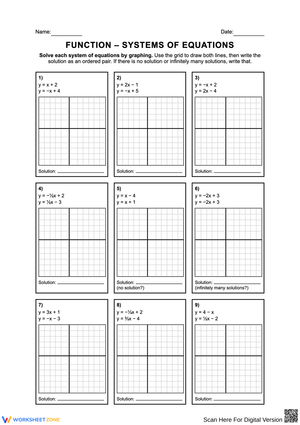
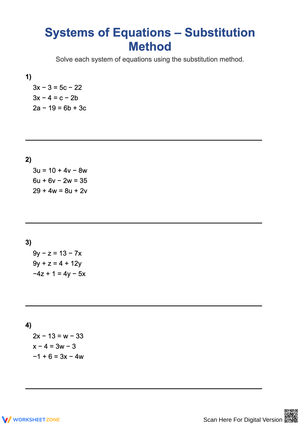
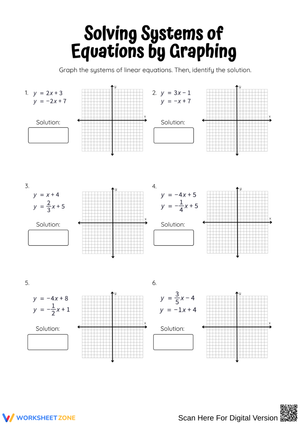
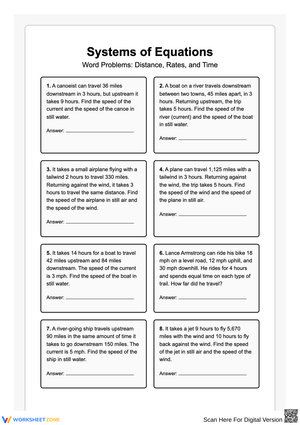
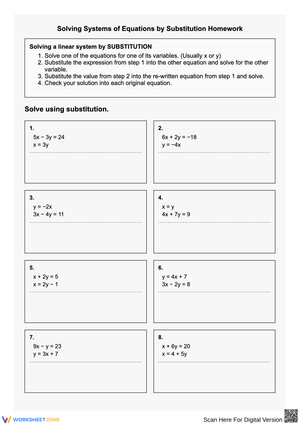
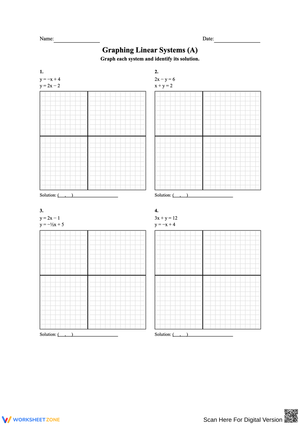
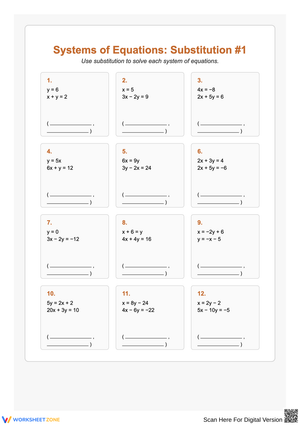
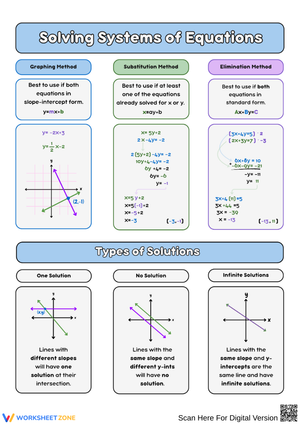
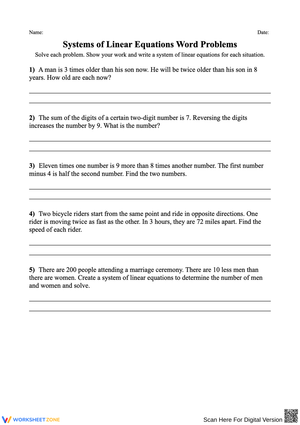
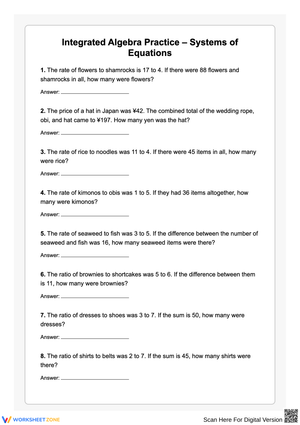
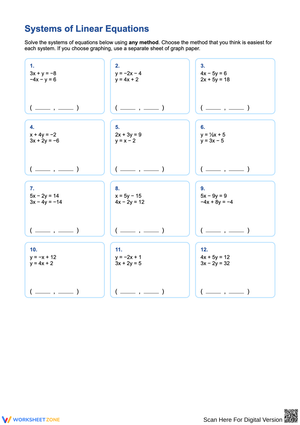
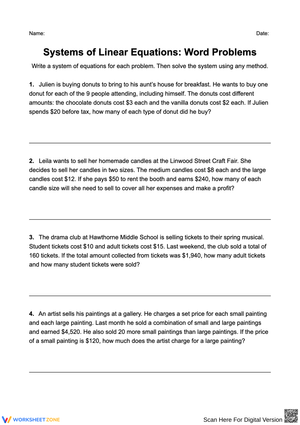
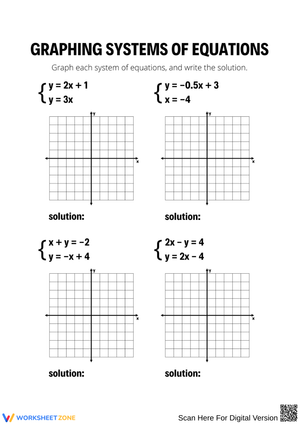
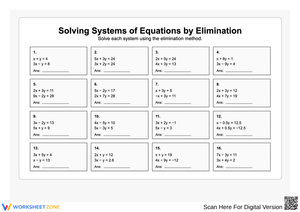
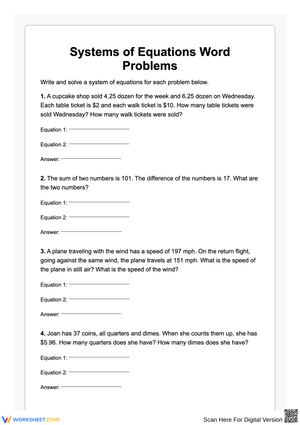
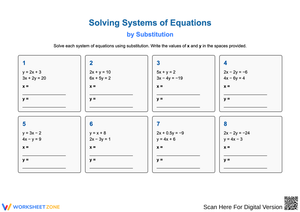
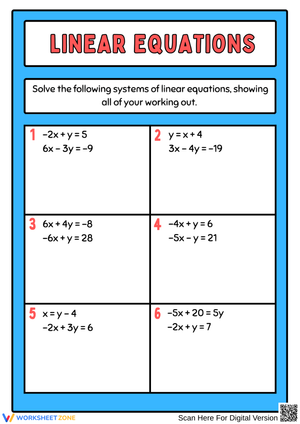
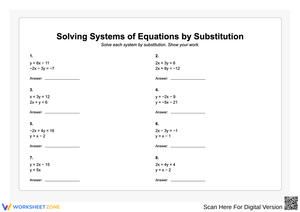
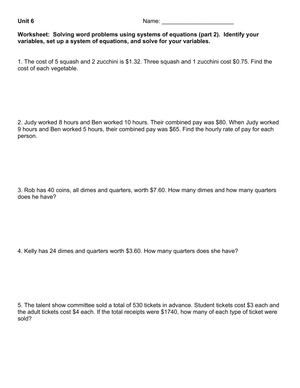
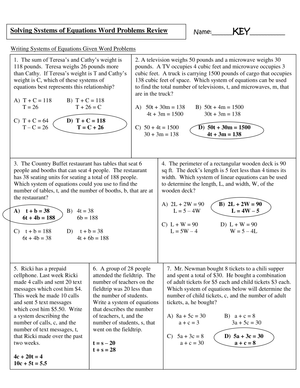
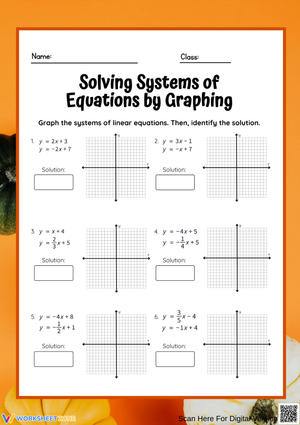
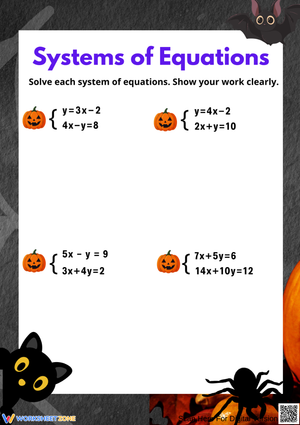
These 9th grade systems of equations printable worksheets give Algebra 1 teachers targeted practice for every phase of the unit — graphing and substitution for early concept-building, elimination and mixed-method review as the unit deepens, and word problems alongside special-case systems to close things out. Each worksheet isolates one skill clearly enough that teachers can place it exactly where it belongs in a lesson sequence without hunting for problems to cut or supplement.
What's Inside the Set
The worksheets fall into five distinct categories:
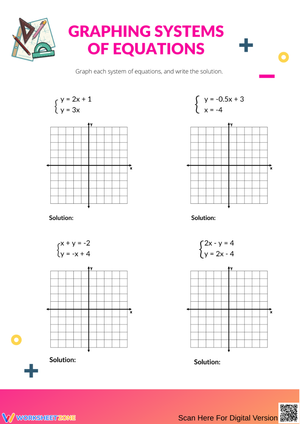
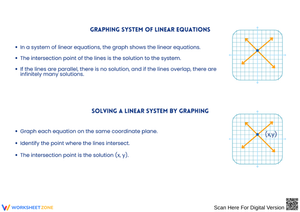
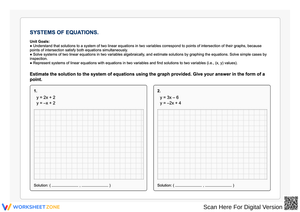
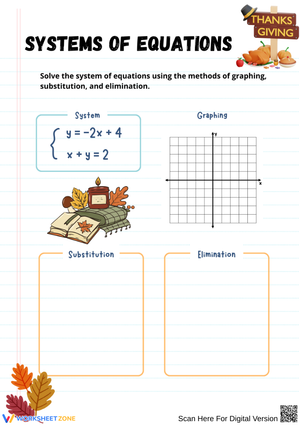
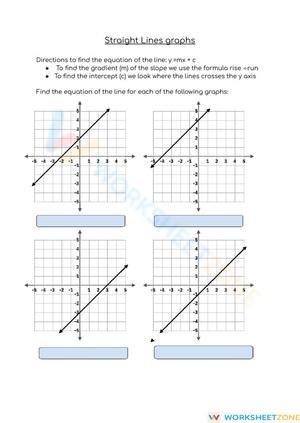
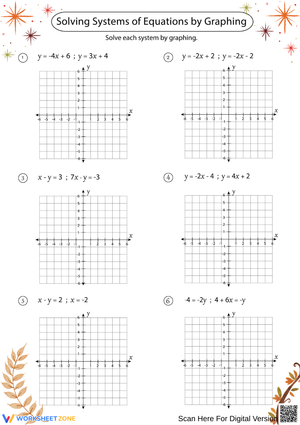
- Graphing worksheets — pre-labeled coordinate planes where students graph two linear equations and mark the intersection as the solution
- Substitution worksheets — tiered from systems where one variable is already isolated to problems that require rearranging first
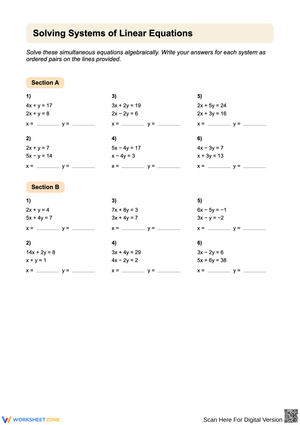
- Elimination worksheets — opening with opposite-coefficient pairs that cancel by direct addition, advancing to systems where multiplying one or both equations by a constant is required
- Special-case worksheets — systems producing no solution or infinitely many solutions, approached both algebraically and graphically
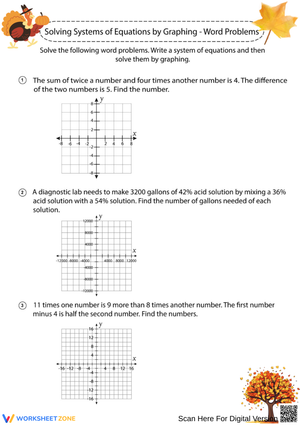
- Word problem worksheets — real-context scenarios where students define variables, write both equations, solve, and interpret the answer within the original situation
One design choice worth noting: the graphing worksheets sequence early problems so their intersection points fall on whole-number grid coordinates, then shift to fractional solutions in later problems. Students discover through experience — not through being told — that graphing is a useful conceptual check but an unreliable solver when answers don't land cleanly on a grid line. That lesson sticks differently than hearing it from the front of the room.
Error Patterns That Surface Reliably in Systems Work
The most consistently damaging error in substitution is a missing set of parentheses. When students substitute an expression like y = 2x − 3 into a second equation, they routinely drop the grouping symbols — writing 4x − 2(2x) − 3 = 10 instead of 4x − 2(2x − 3) = 10. The arithmetic that follows is off by a constant, so the final answer looks plausible and students rarely catch the mistake on their own. Early substitution worksheets include a prompt reminding students to enclose the substituted expression in parentheses; that prompt disappears gradually as the habit solidifies.
Elimination produces its own characteristic mistake. When multiplying an equation by a constant to create opposite coefficients, students frequently multiply only the variable terms and leave the right-hand side unchanged. They'll transform 3x + 4y = 7 into 6x + 8y = 7 instead of 6x + 8y = 14. Having students circle the entire equation — both sides — before they begin multiplying is a simple habit that catches this before they add rows and get a wrong sum.
Special-case systems trip students up in a counterintuitive direction: when all variables cancel and leave something like 0 = 0, a reliable number of students record "no solution." The logic has surface appeal — the variables disappeared and nothing was resolved — but the answer is exactly backward. The special-case worksheets pair each algebraic result with a graph so students can verify whether the lines are parallel or overlapping before they write a conclusion.
Because these error patterns appear so predictably across student work, the 9th grade systems of equations printable worksheets set builds procedural checkpoints into early problems in each category — not as hints toward the answer, but as prompts that slow down the exact misstep most likely to occur at each stage.
Standard Alignment
These worksheets target CCSS.MATH.CONTENT.HSA.REI.C.6, which requires students to solve systems of linear equations exactly and approximately, with focus on pairs of linear equations in two variables. In a standard Algebra 1 course, this standard arrives after students have worked extensively with linear functions — students need to read slope and y-intercept from an equation and graph a line comfortably before the concept of an intersection point makes any sense. The 9th grade systems of equations printable worksheets set fits into that instructional window precisely: it assumes graphing fluency but does not assume any prior exposure to systems. The word problem worksheets additionally support Mathematical Practice Standard MP.4 (Model with mathematics), since students must translate a written real-world scenario into a pair of equations and then interpret their numerical solution in the context of the original problem.
Where These Worksheets Fit in Your Unit Plan
Graphing worksheets are strongest on the first day or two of the unit, when the goal is conceptual grounding rather than procedural speed. One specific move that works: after students graph the first problem, require them to write a single sentence explaining what the intersection point means. That one sentence surfaces more misconceptions than any verbal check-in does. A student who writes "the intersection is where x equals 2" instead of "the intersection is the point that satisfies both equations" reveals exactly where the concept hasn't landed.
For substitution and elimination worksheets, a three-stage release holds up well in practice. Work the first problem together as a class model, assign the next two as partner work, then release students to finish independently. Multi-step algebra worksheets assigned cold — with no model and no partner — tend to generate the flat-out frustration that shuts some students down for the rest of the period. The structured entry prevents that.
Word problem worksheets run more effectively as small-group tasks than as individual practice, at least the first time through. When students must explain to a partner which quantity each variable represents before anyone writes an equation, the group setting enforces the kind of precision that individual silent work often skips. After one or two group sessions with that expectation, most students carry the habit into independent assignments.
In the final review week, set up four stations — one for graphing, one for substitution, one for elimination, one for special cases — and rotate groups every ten to twelve minutes. At that cadence, the class covers the full skill range in a single period, and teachers can observe exactly where individual students' work breaks down. That kind of targeted observation is harder to get from a sit-down end-of-unit test.
Using the Set Across Different Readiness Levels
Students still working to consolidate 8th-grade linear equation skills often hit a wall at the rearrangement step in substitution — the moment right before the actual substitution happens. The early substitution worksheets, where one variable comes pre-isolated, give this group a workable entry point. They practice the core mechanic without simultaneously managing an unfamiliar algebraic step, and most can join the main class sequence within a few lessons once substitution itself is secure.
For students ready to push beyond grade-level expectations, remove the pre-labeled coordinate planes from the graphing worksheets and require students to set up their own axes and choose an appropriate scale. On elimination worksheets, introduce systems with fractional coefficients — these demand more deliberate thinking about which multiplier to choose and which variable is easier to eliminate. The word problem worksheets can prompt richer thinking without any additional preparation: ask students what would change about their solution if one condition in the problem were different.
One honest limitation worth naming: some students become so accustomed to x and y as the default variable names that they freeze when a problem uses different letters. That reaction is worth addressing directly rather than routing around. Showing a system written with a and b and asking students to solve it exactly as they would an x-y system breaks the symbol dependency in a low-stakes setting, before it surfaces on a state assessment where variable names don't always follow convention.
Frequently Asked Questions
Which solving method should come first in the teaching sequence?
Graphing is the strongest starting point because it establishes the core concept before any procedure begins. Students who start directly with substitution or elimination can execute the steps correctly without understanding what the steps are actually finding. Running a graphing worksheet for even a single class period before introducing algebraic methods gives students a visual reference they can return to when the algebra produces an unexpected result — especially when all variables cancel out.
How do I help students who can solve algebraically but fall apart on word problems?
The breakdown almost always happens before any math is written — at the variable definition step. Students who write "let x = cost" rather than "let x = the cost of one adult ticket, in dollars" end up with equations that don't cleanly represent the problem. Requiring a full-sentence definition before any equation is written eliminates most setup errors. The word problem worksheets include a definition-prompt line for exactly this reason. Once the variable is defined with precision, the equation setup usually follows.
What do I do when students get 0 = 0 or 0 = 5 and don't know what to record?
A two-step response works reliably. First, have students quickly graph both equations to see what the lines look like — parallel lines make "no solution" visually obvious, and overlapping lines make "infinitely many solutions" feel intuitive rather than arbitrary. Second, teach a brief verbal rule: a false numeric statement signals no solution; a true numeric statement signals infinitely many solutions. The combination of graphical confirmation and verbal rule prevents the "exact opposite" error that students make when working from abstract algebra alone.
Do these worksheets work for standardized test prep?
The 9th grade systems of equations printable worksheets set aligns closely with what CCSS-based state assessments and the SAT both test on linear systems. The mixed-method worksheets are especially relevant for test prep because they require students to choose their own solving strategy — the same decision-making a test item demands. Students who have practiced exclusively on method-specific worksheets often stall when no approach is specified. Running the mixed-method worksheet a few weeks before the assessment surfaces that hesitation early enough to address it before it costs points.














 Interactive Worksheet Maker
 Quiz Maker
 Word Search Maker
 Crossword Puzzle Maker
 Word Scramble Generator
 Sentence Scramble Generator
 Handwriting Worksheet Generator
 Name Tracing Generator
 Fill In The Blank Generator




 BACK TOSCHOOL