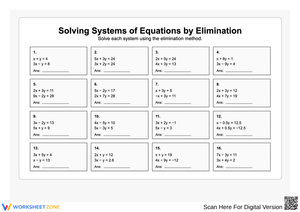
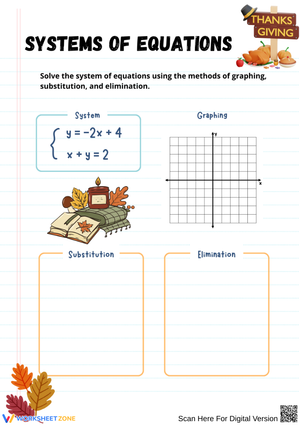
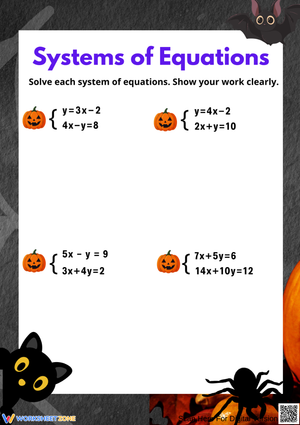
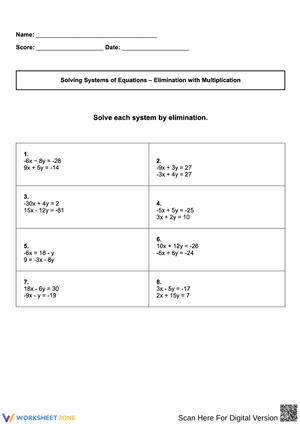
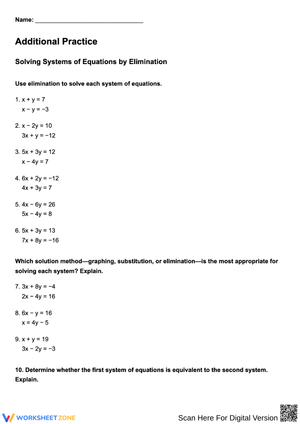
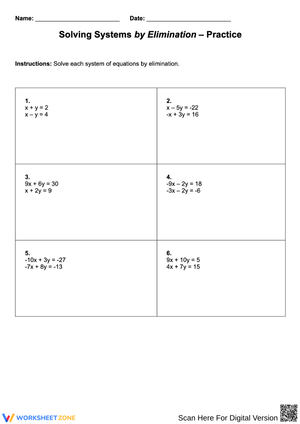
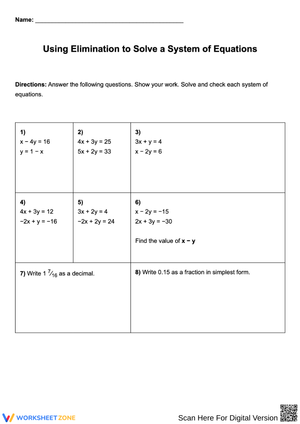
These 9th grade solving systems of equations by elimination worksheet printable worksheets put the emphasis where the algebra demands it: on the decision a student must make before the arithmetic starts. Each worksheet moves students through the full procedure — recognizing whether coefficients are already opposites, multiplying when they are not, combining equations accurately across all terms, solving for one variable, and substituting back to name the ordered pair. That sequence has several breakable points, and the worksheets keep each step visible rather than compressed into mental math.
Skills These Worksheets Build Across the Procedure
Elimination looks like a single method, but it is a sequence of decisions and operations that students can fail at independently. A student who grasps the concept can still lose an entire problem to a sign error; a student with solid arithmetic can still stall at the setup. Each worksheet in this set of 9th grade solving systems of equations by elimination worksheet printable worksheets addresses each step in that sequence:
- Identify the variable to eliminate based on which coefficients are easiest to work with.
- Recognize when coefficients are already opposites and combine immediately without any multiplication step.
- Multiply one equation to create opposite coefficients when direct combination is not possible.
- Multiply both equations by different values when a single multiplication is not enough — using the least common multiple of the coefficients to find the right multipliers.
- Distribute the multiplier to every term, including the constant on the right side of the equation.
- Add the equations and simplify, carrying signs correctly across every term.
- Solve for the remaining variable, then substitute into one of the original equations to find the second.
- State and verify the ordered pair in both original equations before recording the final answer.
The set also includes systems with no solution and infinitely many solutions. Students need to encounter what elimination produces when parallel lines or equivalent equations are involved — a contradiction or an identity — and learn to interpret that result rather than treat it as a calculation error.
Student Errors Worth Watching — and Planning Around
The most predictable error in student work is failing to distribute a negative multiplier to the constant. When a student multiplies 3x − 2y = 7 by −1 to set up elimination, the correct result is −3x + 2y = −7. A large share of students write −3x + 2y = 7 instead, leaving the constant positive. The mistake produces an incorrect combined equation and a wrong ordered pair, with nothing in the arithmetic to signal that anything went wrong — which is exactly what makes it worth anticipating explicitly before students work independently.
The second consistent pattern is stopping after one variable. Students solve for x, write x = 4, and consider the problem complete. Building the habit of treating the ordered pair as the answer — not a single coordinate — requires deliberate repetition across multiple problems. An exit ticket focused exclusively on the back-substitution and checking step, run two or three days after initial instruction, shows quickly who has internalized the full procedure and who still treats one value as the finish line.
A subtler issue emerges when students multiply both equations: they sometimes substitute the solution back into a modified equation rather than one of the originals. If the multiplication step contained an error, this approach to checking will not catch it. Establishing early that verification always uses the original, unmodified equations prevents this from going undetected across an entire assignment.
Building These Worksheets Into Your Algebra Block
A bell ringer with two problems — one where coefficients are already opposites and one requiring multiplication of a single equation — takes about eight minutes and surfaces the class's readiness before instruction continues. Students who solve both correctly are prepared to work independently; students who get the first right but stall on the second need targeted work with the multiplication setup specifically, not with the concept of elimination itself. That distinction matters for how you structure the next ten minutes.
For partner work, assign one student the role of algebraist — responsible for executing each step — and the other the role of sign checker, watching specifically for distribution errors and sign changes during combination. Partners switch roles on the next problem. When the sign checker catches a distribution error, the conversation that follows sticks more reliably than a correction demonstrated at the board, because the error belongs to someone in the room.
Sorting problems by the first decision students must make, rather than only by difficulty, generates cleaner diagnostic data. Keep three groups separate: coefficients ready to combine, one equation requires multiplication, both equations require multiplication. A student who handles the first group accurately and stalls at the second has a gap specifically in the setup step. That narrows your reteaching focus considerably and changes what you address in the next lesson.
Matching the Worksheets to Where Students Are in the Unit
Most 9th grade algebra classes arrive at elimination with a visible spread in readiness. Some students have solid command of integer arithmetic and equation structure and move into multiply-first problems quickly. Others need the procedure broken into more explicit steps before independent work is realistic. A set with multiple versions handles this without pulling different groups into completely different content.
- Guided version: The multiplier is provided or the target variable is labeled, so students practice the arithmetic of elimination without getting stuck in the decision-making that precedes it.
- Standard version: Students choose which variable to eliminate, select their own multiplier, and decide which equation to multiply — making every setup decision independently.
- Extension version: Includes systems with no solution or infinitely many solutions, plus short word problems that require constructing the system before solving it.
In small-group reteach, using the guided version lets you focus direct instruction on the specific step where students are consistently breaking down. For homework, the standard version works well once students have had direct instruction and at least one full guided practice session. Answer keys make either version practical for independent use — students can identify exactly which step produced an incorrect result rather than only knowing that the final answer was wrong.
Standard Alignment
These worksheets address CCSS HSA-REI.C.5 and HSA-REI.C.6. HSA-REI.C.5 establishes the mathematical justification for elimination: replacing one equation in a system with a multiple-adjusted sum produces an equivalent system with the same solution set. HSA-REI.C.6 addresses the applied skill — solving systems of two linear equations in two variables exactly, which is what students practice across the set.
In classroom planning terms, these two standards work together. The procedure is teachable in a single class period, but the understanding of why it works — and what the algebra signals when it produces a contradiction or an identity — develops over the length of the unit. Worksheets that include all three solution types give students repeated contact with the full range of what these standards expect, not just the clean one-solution case that most practice problems default to.
Frequently Asked Questions
What is the elimination method and why does it appear in 9th grade algebra?
Elimination is a method for solving a system of two linear equations by combining them in a way that removes one variable entirely. Students add or subtract the equations — multiplying one or both first when needed — then solve for the remaining variable and substitute back to find the ordered pair. It appears in 9th grade because this is when students move from single-variable equations to systems, and elimination gives them a purely algebraic path to the solution that does not depend on graphing or estimation.
What should students do when coefficients are not already opposites?
Students should multiply one or both equations by a constant so the coefficients of one variable become opposites. If eliminating y and the coefficients are 3 and 4, multiplying the first equation by 4 and the second by −3 creates opposite coefficients before combining. The most important habit is choosing the multiplier before beginning the arithmetic — not discovering it in the middle of the problem when the setup has already gone in a wrong direction.
How do these worksheets fit into a unit on systems of equations?
The 9th grade solving systems of equations by elimination worksheet printable worksheets in this set work well after students have had some exposure to graphing or substitution — not because elimination is more difficult, but because students who have already seen other methods understand more quickly why elimination is efficient, particularly when equations are already in standard form. Teaching the methods in sequence, with explicit comparison built in, helps students choose a strategy rather than defaulting to one approach for every system they encounter.
How can I identify which students need reteaching after one lesson on elimination?
A two-problem exit ticket — one direct elimination problem and one requiring a multiplication step — separates the class into clear groups. Students who miss both likely need more time with the concept itself. Students who solve the direct problem correctly but miss the multiply-first problem have a gap at the setup step. Students who find the correct first variable but record a single coordinate as the answer are missing the ordered-pair habit. Each pattern points to a different instructional priority. A set of 9th grade solving systems of equations by elimination worksheet printable worksheets organized by problem type makes targeted follow-up practical, since teachers can pull exactly the problems that address each gap without building new materials from scratch.














 Interactive Worksheet Maker
 Quiz Maker
 Word Search Maker
 Crossword Puzzle Maker
 Word Scramble Generator
 Sentence Scramble Generator
 Handwriting Worksheet Generator
 Name Tracing Generator
 Fill In The Blank Generator




 BACK TOSCHOOL