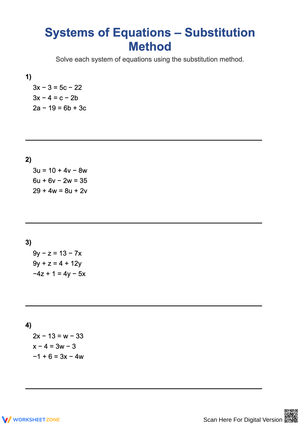
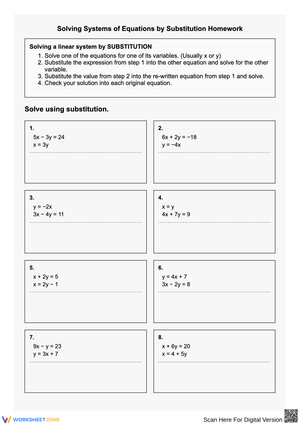
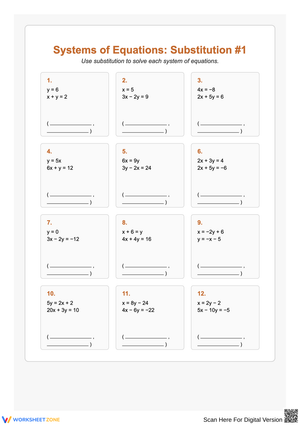
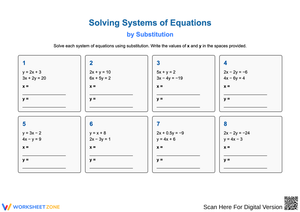
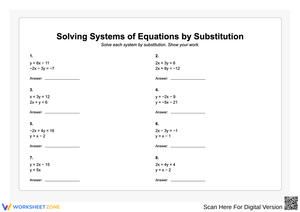
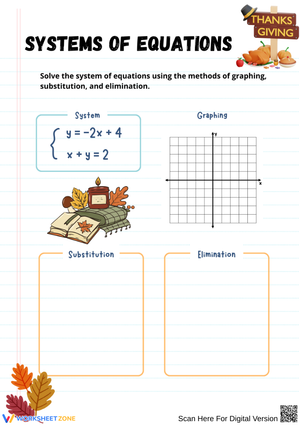
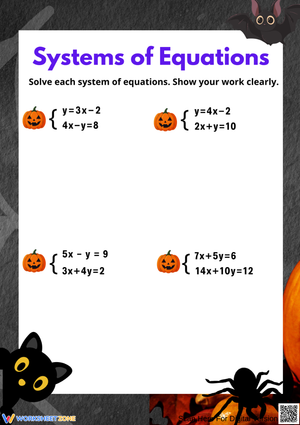
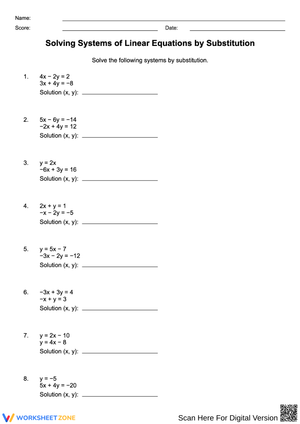
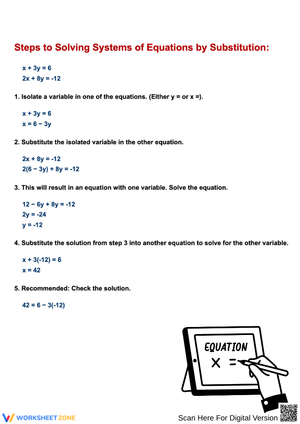
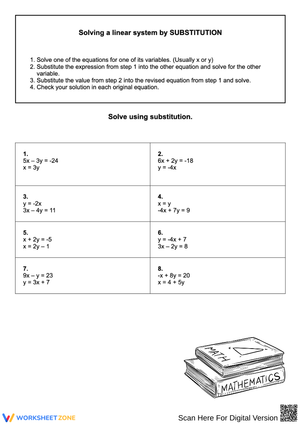
A 9th grade solving systems of equations by substitution worksheet pdf works best when its problem sequence mirrors the actual cognitive load students face — not just the final procedure, but the decisions they must make at each step. These worksheets give Algebra 1 teachers printable practice that covers the full substitution sequence, includes varied system structures, and surfaces exactly where each student's understanding breaks down.
Student Errors That Surface During Substitution Practice
The most persistent substitution mistake at this grade level is not a computation error — it is a procedural one. Students who have just isolated y from the first equation will often substitute that expression back into that same equation rather than the other one. The result is always a true statement like 0 = 0, which students either misread as "infinitely many solutions" or treat as a sign that they did something wrong and start over. Running a full worksheet reveals quickly whether this is an isolated slip or a class-wide pattern.
A second consistent issue: students find the value of x, write it down, and stop. In actual student work, this shows up as "x = 4" circled at the bottom of the problem, no further work, no check. The ordered pair is half-finished. The fix is straightforward once identified — prompt students to label a dedicated step for solving the second variable before they move on — but the worksheet has to include enough workspace and structure to make that step visible rather than optional.
Special-case systems generate their own confusion. When substitution yields 0 = 0, most ninth graders read it as an arithmetic error rather than a signal about the system. When it yields 0 = 7, students may write "no solution" correctly but cannot explain what that means for the two lines. A worksheet that deliberately includes at least one of each outcome type — and asks students to interpret rather than just label — pushes that conceptual layer instead of letting students pattern-match to a vocabulary term.
Skills These Worksheets Build
The practice targets substitution across three levels of structural complexity that track how the method is typically introduced in Algebra 1:
- Directly solvable systems: at least one equation already solved for a variable, so students practice the substitution step without first rearranging — useful for first exposure and for students who need to isolate the core procedure
- Rearrangement-required systems: both equations in standard form, requiring variable isolation before substituting — the format that appears on most Algebra 1 assessments and the one where sign errors multiply
- Special-case systems: problems that produce no solution or infinitely many solutions, with prompts asking students to interpret the algebraic result in terms of the system's behavior
Each worksheet targets the verification step directly. Checking the ordered pair in both original equations is easy to skip under time pressure, but that step is where substitution errors become visible to the student — not just to the teacher reviewing the work later. Problems that require students to show the check treat verification as part of the solution, not a footnote.
How to Build These Worksheets Into Your Lesson Plans
During direct instruction, a reliable approach is to model two problems from the first tier, then release the next two for independent attempts while you circulate. That 10-to-12-minute window of watched independent practice reveals more about where the class stands than almost any warm-up. You can see in real time whether students are substituting into the wrong equation, leaving the ordered pair incomplete, or losing a negative sign when they distribute a parenthetical expression.
For partner work, one structure that holds up well: one student solves the system while the other checks the ordered pair in both original equations independently — without seeing the solving work first. If both get the same pair, they sign off together. If not, they compare steps. This divides the two procedural demands between partners and keeps both students doing algebra rather than one working and one waiting.
Across a typical week, these worksheets fit several slots:
- Entry routine: two or three already-solved systems at the start of class until students build baseline fluency with the substitution step itself
- Guided practice: the first tier immediately after direct instruction, while teacher support is still available
- Independent work block: rearrangement problems once students have the core procedure secured
- Homework: a balanced 10-to-14-problem set weighted toward the standard difficulty tier, with one or two special-case problems once the class has seen them in class
- Reteach station: directly solvable problems only, paired with a worked example so students can compare each step when they get stuck
Standard Alignment
These worksheets align to CCSS HSA-REI.C.6, which requires students to solve systems of linear equations exactly and understand the number of solutions. In classroom terms, this standard lands in the middle of a systems unit — after graphing (which gives approximate solutions and geometric intuition) and before elimination (which handles cases where substitution is less efficient). Substitution earns its place because it produces exact solutions and makes algebraic reasoning explicit at each step. A 9th grade solving systems of equations by substitution worksheet pdf that includes special-case systems addresses the full scope of REI.C.6, not just the common one-solution case, and helps students understand that the algebra tells them something real about the equations — not just how to produce an answer.
Differentiating the Set Across Student Readiness Levels
The most workable differentiation strategy keeps the same algebraic target — substitution — while adjusting the structure of the systems. Students who are still uncertain about isolating a variable benefit from systems where one equation is already solved, so the cognitive demand stays on substitution and solving rather than on rearranging first. Students who have the core procedure down need standard-form systems that require isolation, as well as problems that end in special cases. A 9th grade solving systems of equations by substitution worksheet pdf organized into labeled tiers makes this classroom sorting fast — teachers can assign a starting problem number without rewriting or creating separate documents.
For students working above grade level, the most useful extension is not additional problems but a different type of problem: build a system from a word description, then solve it by substitution. That shift from procedural to modeling is where the standard pushes most students by the end of the unit, and it also reveals whether students understand what the variables represent — not just how to manipulate them.
Students who repeatedly drop negative signs during distribution — especially when the isolated variable has a negative coefficient, such as y = −3x + 5 — benefit from a format that includes a dedicated labeled line: "Write the expression you are substituting." That single structural addition catches most of those errors before students commit to wrong arithmetic and then can't find where things went sideways.
Frequently Asked Questions
Why do students keep substituting back into the equation they isolated from?
Because that equation is at the top of their work and is the most visible one when they look back at the problem. Students remember the instruction "substitute" but not the constraint "into the other equation." A prompt written directly on the worksheet — such as "Substitute into Equation ___ (not the one you just isolated)" — removes this error for most students after a few problems. It is a procedural cue, not a conceptual fix, but it works.
How many problems fit one class period or homework assignment?
For a first or second lesson on substitution, 8 to 12 problems is a realistic range. At that stage, each problem takes real time — students write out every step, catch errors mid-process, and often restart. Adding more problems beyond that point typically produces rushing, not more learning. For fluency practice or unit review, 14 to 18 problems is workable. The number matters less than whether the problems vary enough to require genuine decisions rather than mechanical repetition of the same setup.
Should all three system outcome types appear on every worksheet?
Not on the first one. Introducing no-solution and infinitely-many-solutions cases before students are stable in the basic procedure adds confusion at exactly the wrong moment. Reserve special-case problems for the second or third worksheet in a sequence, after students have worked through at least 15 to 20 single-solution problems. By then, hitting 0 = 0 produces useful discussion rather than panic.
Why use a printed worksheet when digital practice tools are available?
For substitution specifically, digital tools often accept only a final answer — the ordered pair. But substitution is almost entirely about intermediate steps: isolating correctly, substituting without losing a sign, solving the single-variable equation that results, back-solving for the second variable, and verifying. A 9th grade solving systems of equations by substitution worksheet pdf with space for each labeled step captures that process in a way that answer-entry formats do not. When a student's final pair is wrong, the worksheet tells you which step failed. A digital right-or-wrong score does not.














 Interactive Worksheet Maker
 Quiz Maker
 Word Search Maker
 Crossword Puzzle Maker
 Word Scramble Generator
 Sentence Scramble Generator
 Handwriting Worksheet Generator
 Name Tracing Generator
 Fill In The Blank Generator




 BACK TOSCHOOL