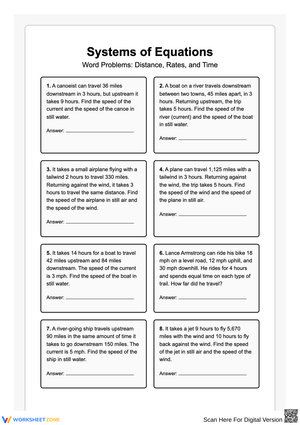
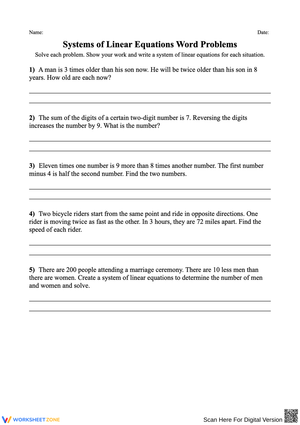
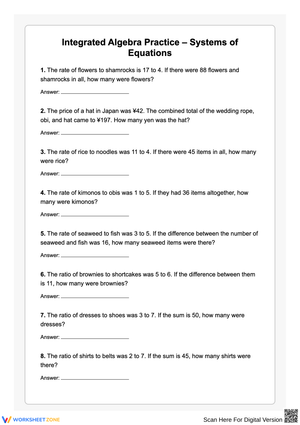
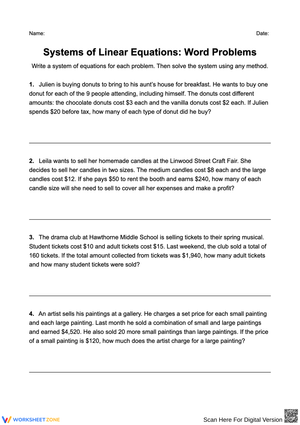
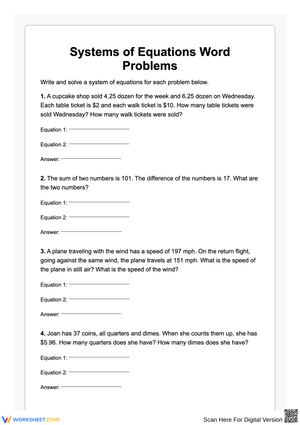
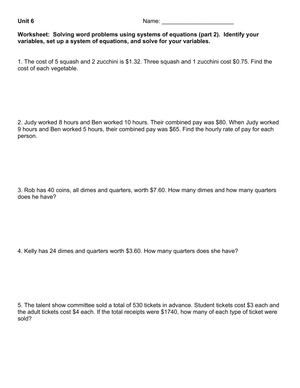
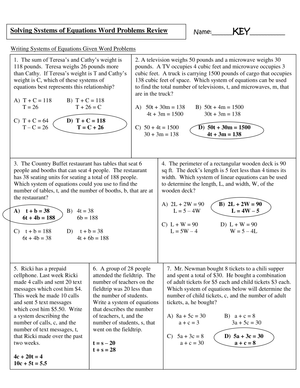
These 9th grade systems of equations word problems worksheets give Algebra 1 teachers something immediately usable: problems drawn from real contexts that require students to identify two unknowns, write two equations, solve the system, and explain what the answer means. That last step — interpreting the solution — is where grade-level rigor actually lives, and it's the step most skill-drill resources skip.
The Problem Categories Students Work Through
Five scenario types cover the range of what Algebra 1 curricula and state assessments typically expect at this level.
- Ticket and pricing: Two item types sold at different prices, with total quantity and total revenue given. Students write one equation for item count and a second for dollar value. The arithmetic tends to be clean, which makes this a strong entry point for the unit.
- Mixture problems: Two solutions or ingredients combined to reach a target concentration. A standard setup: mix a 20% saline solution with a 50% saline solution to produce 300 mL at 30%. Students write one equation for total volume and one for the mass of the active ingredient.
- Distance-rate-time: Two travelers, two directions, or a moving medium such as wind or current. An aircraft flying into a headwind on the outbound leg and returning with a tailwind is the classic form. Students apply d = rt to each leg and solve for the plane's speed and the wind speed separately.
- Number relationships: Two unknowns connected by a sum and a product, or a sum and a difference. Less tied to physical reality than the others, but genuinely useful for students still learning to translate English into algebra without real-world context adding noise.
- Break-even scenarios: Fixed costs plus variable production costs set equal to revenue per unit times quantity. Students find the output level where profit equals zero — a concept that tends to generate real discussion about what the solution means beyond the algebra.
Working through 9th grade systems of equations word problems worksheets across all five categories in a single sitting forces students to actually read each scenario rather than pattern-match from the previous problem.
Translating the Problem Before the Algebra Starts
Most ninth graders who arrive at a wrong answer on a word problem didn't make an algebra error — they built the wrong system to begin with. One strategy that works well is a setup-only pass: before solving anything, students read every problem on the worksheet, define their variables in writing with units attached, and write the two equations. The teacher checks these setups before students proceed to the solving phase. This isolates the translation skill and stops students from spending fifteen minutes correctly solving a system that was misbuilt from line one.
Variable definitions deserve more attention than most lessons give them. "Let x = tickets" is too vague to prevent errors. "Let x = the number of adult tickets sold" is the kind of specificity that prevents the most common setup mistake — attaching the wrong price coefficient to the wrong variable mid-problem.
Mistakes Students Make That Teachers Should Catch Early
The most persistent error in this topic isn't algebraic — it's the value equation. In a ticket problem where adult tickets cost $8 and student tickets cost $5, students who defined their variables correctly will still write 5x + 8y = total revenue because they recall the dollar amounts in the order the problem stated them rather than connecting each coefficient to its actual variable. A brief verbal check — "the $8 goes with adult tickets, so 8 goes with x" — before setting up the equation catches this more reliably than any correction after the fact.
Elimination produces a different stumbling block. When students multiply an equation by a constant to create opposite coefficients, they routinely apply the multiplier to the variable terms and leave the constant on the right side unchanged. The resulting equation is wrong, but the error stays invisible until students substitute back into the original problem — a checking step a lot of ninth graders skip unless the teacher builds it in explicitly.
Working These Worksheets Into Your Weekly Lesson Plans
A fifty-minute period handles one worksheet well when time breaks down roughly like this: ten minutes on a teacher-modeled example that walks through all four steps explicitly (define, write, solve, interpret), thirty minutes of student work — independent first, then paired if students are stuck — and a ten-minute whole-class debrief on one or two problems where setups generated real disagreement. That debrief is often where the most lasting learning happens, because students see that two different correct setups can produce the same answer.
The 9th grade systems of equations word problems worksheets format also works well as a Monday warm-up structure during a unit review week. Projecting one problem at the start of class and having students write the setup on a whiteboard or index card delivers quick formative data before the lesson begins — no grading required, just a fast scan of what's correct and what needs addressing.
Standard Alignment
These worksheets address two specific Common Core State Standards. CCSS HSA-REI.C.6 requires students to solve systems of linear equations exactly and approximately, including through graphing, substitution, and elimination. CCSS HSA-CED.A.3 asks students to represent real-world constraints with systems of equations and to evaluate whether solutions are viable in context. That second standard is the one that separates procedural fluency from genuine mathematical reasoning — a student who solves correctly but reports "−3 tickets were sold" without flagging the result has not fully met its intent.
Differentiating Each Worksheet Across Readiness Levels
The 9th grade systems of equations word problems worksheets format supports tiered use without requiring separate printed materials. Students who need more structured entry benefit from a simple organizer alongside the worksheet — labeled rows for variable definitions, equation 1, equation 2, and the interpretation sentence. Assigning only the problems with integer solutions first gives this group early wins before they encounter messier arithmetic.
Students ready for additional challenge can work the full set, including problems with fractional or decimal answers, and then compare one problem solved two ways — substitution and elimination — with a sentence explaining which approach required fewer steps. That metacognitive reflection is exactly the kind of thinking that transfers into higher-level math courses.
Frequently Asked Questions
What types of word problems appear most often at this level?
The five categories that show up most consistently are ticket and pricing problems, mixture problems, distance-rate-time problems, number relationship problems, and break-even scenarios. Each type gives students practice translating a different kind of real-world constraint into algebra, so the cognitive work stays varied even when the solving method stays the same.
Which method works better for word problems — substitution or elimination?
Neither is universally better. If one of the equations the student writes already isolates a variable, substitution is usually faster. If both equations land in standard form and the coefficients are easy to manipulate, elimination avoids extra steps. Practicing both methods across the set builds the flexibility to choose rather than default to one approach out of habit.
How many problems fit in one class period?
Eight to twelve is the practical range for a fifty-minute period when students show all work and write a contextual sentence with each answer. A set of fewer problems with more complex setups — mixture problems with decimal concentrations, for instance — can be equally rigorous and leaves more room for peer discussion and method comparison.
What helps students who freeze at the translation step?
Start those students on number-relationship problems, which strip away physical context and let them focus purely on the algebraic conditions. Once a student can write two equations for "the sum of two numbers is 24 and their difference is 8" without hesitation, the added layer of units and real-world context in mixture or distance problems becomes much more manageable.














 Interactive Worksheet Maker
 Quiz Maker
 Word Search Maker
 Crossword Puzzle Maker
 Word Scramble Generator
 Sentence Scramble Generator
 Handwriting Worksheet Generator
 Name Tracing Generator
 Fill In The Blank Generator




 BACK TOSCHOOL