MLA Citations Printable Worksheets for 9th Grade
These mla citations printable worksheets for 9th grade give ELA teachers a direct tool for building Works Cited fluency without converting every research unit into an extended citation mini-course. The set targets three source types freshman writers use most often — books, websites, and periodical articles — and moves students through tasks that range from labeling citation elements to building complete entries from raw source information. Teachers who download the set get resources that fit into bell ringers, guided practice, and independent review without requiring additional materials.
What Each Worksheet Targets
Each worksheet isolates a specific citation skill so students build one competency before layering in the next. That narrow focus matters in 9th grade, where many students encounter formal MLA formatting for the first time and can too easily confuse a genuinely unfamiliar rule with carelessness.
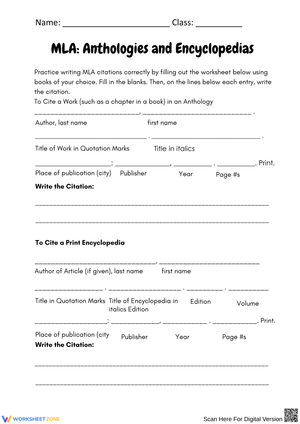
- Element identification: Students read a correctly formatted Works Cited entry and label each component — author, title, container, publisher, date — before constructing one themselves.
- Sequencing tasks: Students receive citation parts in scrambled order and arrange them correctly, reinforcing that MLA has a fixed sequence rather than flexible element placement.
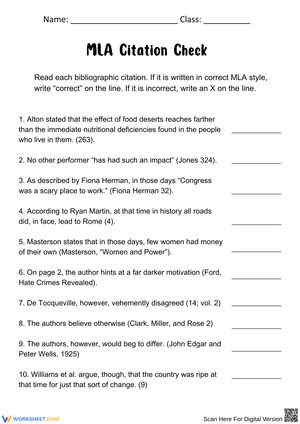
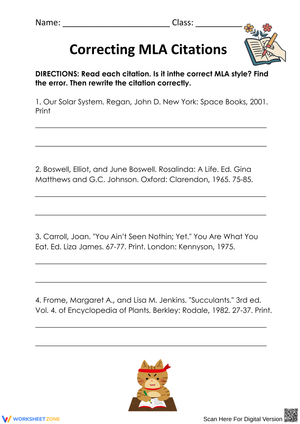
- Error correction: Students revise entries that contain punctuation problems, capitalization errors, or missing fields, then write a brief note explaining what they changed and why.
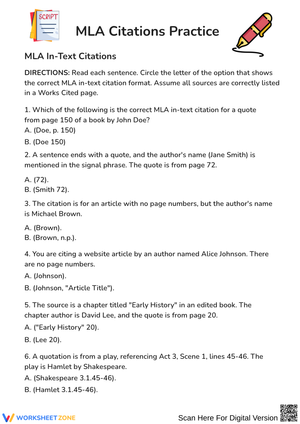
- Source-to-citation matching: Students read a passage or note card and identify which of two or three model entries correctly represents that source.
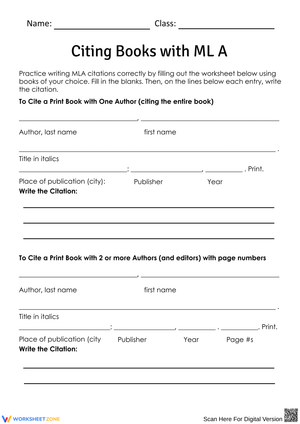
- Independent construction: Students receive raw source information — author name, title, publication details — and write the complete Works Cited entry without a model in front of them.
One worksheet focuses on book citations, another on websites, and a third on periodical articles. A mixed-review worksheet asks students to identify the source type before choosing the right entry format — a step that surfaces a specific weak point: many 9th graders know the book citation structure but apply it to a website without noticing the difference.
Frequent Student Errors That These Worksheets Help You Catch
Three error patterns appear consistently in actual Grade 9 student work. The first is treating the article title and the website or database name as interchangeable — students will italicize the container name correctly but also italicize the article headline inside it, putting both in italics even after direct instruction. The second is omitting the period that closes a Works Cited entry, especially after a URL; students treat it as optional punctuation rather than a required closing mark. The third is reversing author name order only when the last name looks familiar — a student who writes "Obama, Barack" will often write "Chimamanda Adichie" without inverting because the unfamiliar name pattern doesn't trigger the reversal rule automatically.
Title capitalization creates its own separate cluster of confusion. Students who correctly capitalize a novel title will still type "the history of the civil rights movement" when copying a web page heading they found mid-search, apparently because the source itself wasn't in title case. Error-correction worksheets that show exactly this kind of authentic-looking mistake — a lower-case title lifted from a real search result — give teachers the most traction, because students recognize the source type from their own research habits.
Lesson-Planning Strategies to Get the Most From These Worksheets
The most reliable use pattern is a short, predictable cycle. Project one source — ideally a library database article students actually pulled during the research block — and complete the first citation together as a class. Then distribute the corresponding worksheet and give students 10 to 12 minutes to finish two or three similar entries independently. That immediate transfer from modeled example to independent practice produces better retention than worksheets assigned the day after instruction.
For station rotations during research weeks, one station can use the cut-and-sort format where students physically arrange citation parts before writing the entry. Students who move the elements around on the table make fewer sequencing errors on their next written citation than students who only observe correct examples on a projector. A second station pairs students on the error-correction worksheet — partners disagree often enough about what's wrong that the disagreement itself reveals misconceptions worth addressing with the whole class.
- Bell ringer: Project a citation with one deliberate mistake — wrong punctuation after the author name, a title in quotation marks when it should be italicized — and give students three minutes to find and fix it before instruction begins.
- Before a research session: Use the element-identification worksheet to remind students what information they need to record from each source before they start searching.
- After a mini-lesson: Assign the matching source-type worksheet for independent practice the same day, not the next.
- Week before a paper is due: Run the mixed-review worksheet as a formative check before students finalize their Works Cited pages.
- Small-group intervention: Pull the error-correction worksheet for students still reversing author names or misusing italics in their drafts.
Standard Alignment
These mla citations printable worksheets for 9th grade address CCSS.ELA-LITERACY.W.9-10.8, which requires students to gather relevant information from multiple sources, assess source credibility, integrate information while avoiding plagiarism, and follow a standard citation format. Works Cited practice is where that standard becomes visible in student work — a correctly formatted entry demonstrates that a student recorded enough source information to document it responsibly. In most 9th grade ELA classrooms, W.9-10.8 is assessed through the Works Cited page attached to a research essay, which means citation accuracy directly affects the writing grade rather than living as a separate skills check.
Adjusting the Resources for Different Levels of Learners
For students who are still developing basic writing fluency, begin with the fill-in-the-blank template worksheets that label each field and ask students to insert the correct information rather than compose a full entry from an empty line. These students need to internalize the fixed order of citation elements before working without structural cues. Once a student can complete a labeled template accurately on two successive tries, the sequencing tasks are the next reasonable step.
Advanced students often master the three core source types quickly and need more demanding work. The mixed-review worksheet, which requires students to identify the source type before formatting the entry, pushes in a useful direction. A further extension: give these students a correctly formatted citation and ask them to explain in writing why each formatting decision is correct — this tests conceptual understanding rather than pattern recall. At this level, mla citations printable worksheets for 9th grade shift from drill work to analytical review, which is exactly the preparation these students need heading into 10th grade research assignments with more varied and complex source requirements.
For English language learners, the cut-and-sort format removes the production burden and focuses attention on structure alone. Students demonstrate mastery of citation order without simultaneously managing typing, spelling, or unfamiliar punctuation conventions. Pairing ELL students with a native English-speaking partner on the error-correction worksheet tends to work well — the ELL student often catches structural sequence errors while the partner addresses surface-level punctuation, making the collaboration genuinely reciprocal rather than one-sided.
Frequently Asked Questions
Should I teach in-text citations and Works Cited entries at the same time?
Separating them is more effective for most 9th graders. Start with Works Cited entries — they require more components, so building them first gives students a complete picture of a source before reducing it to a parenthetical. Once students can construct a Works Cited entry accurately, connecting it to the shortened in-text form makes logical sense. Running both skills simultaneously in the same week, before either is solid, typically produces confusion about what information belongs where.
What if students do the worksheet correctly but still format their essays wrong?
This gap is common and worth naming explicitly. Worksheet accuracy and essay accuracy are different cognitive demands — each worksheet presents one source type at a time with clear instructions, while the essay requires students to manage multiple sources, hold format rules in memory under time pressure, and track which source provided which information. Use the worksheet to build the rule, then during essay drafting ask students to open their Works Cited page and verify the first entry against a brief checklist before they submit.
Which worksheet type works best for students who have never seen MLA before?
Start with the element-identification format — students examine a correctly formatted entry and label each part. No production from memory on first contact. Students build an accurate mental image of what a finished citation looks like before they're asked to create one. The construction task comes after students can identify all the parts reliably, not before, and certainly not on the same day as initial instruction.
How many worksheets should I plan to use across a research unit?
Three to five across a two- to three-week unit is a reasonable range. One worksheet before research begins to establish what source information students need to record, one or two during drafting as formative checks, and one mixed-review worksheet in the final week. mla citations printable worksheets for 9th grade are most effective when distributed across the research process rather than front-loaded into a single citation day that students largely forget by the time they open their essays. Spaced retrieval — returning to the skill at intervals — is what actually moves citation formatting into durable memory for freshman writers.
Clear All