Reconstruction Era Printable Worksheets for 8th Grade
These reconstruction era printable worksheets for 8th grade put the full arc of 1865–1877 into students' hands through formats built for active reasoning — amendment analysis, vocabulary work, primary source reading, compare-and-contrast organizers, and cause-and-effect charts that trace how federal Reconstruction collapsed into the Compromise of 1877. The set spans political, social, and economic dimensions, so you can pull individual worksheets to anchor specific lessons or sequence several across a multi-week unit.
What's Inside the Set
Each worksheet targets a distinct layer of Reconstruction content, asking students to make interpretive decisions rather than fill blanks mechanically.
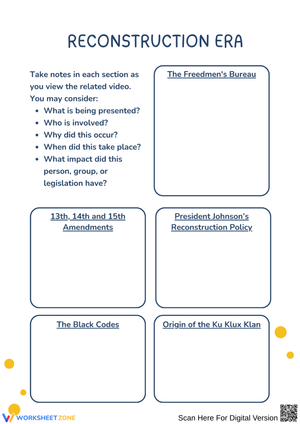
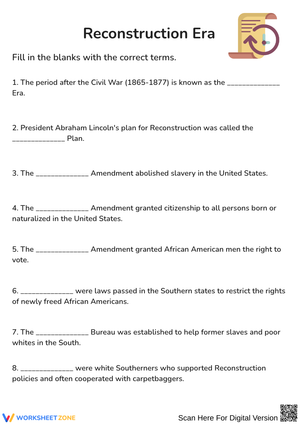
- Constitutional amendment analysis: Students read excerpts from the 13th, 14th, and 15th Amendments, identify what each guaranteed, and explain in writing how citizenship and voting rights changed after the Civil War. The task goes beyond definition — students connect each amendment to the specific political problem it was addressing.
- Presidential vs. Congressional Reconstruction: Compare-and-contrast organizers guide students through Lincoln's Ten Percent Plan, Andrew Johnson's lenient approach, and the Radical Republican program established by the Reconstruction Acts of 1867. Students mark the requirements for readmission and argue which approach held former Confederate states most accountable.
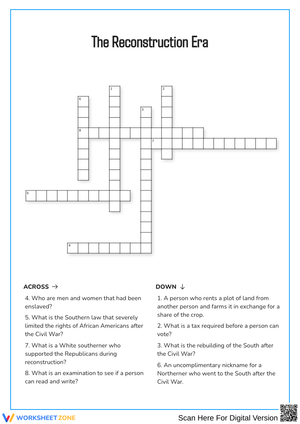
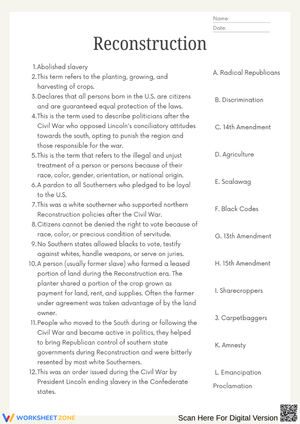
- Key vocabulary: Matching and definition worksheets cover carpetbagger, scalawag, sharecropping, Black Codes, Freedmen's Bureau, and impeachment. These terms appear frequently on state assessments, and repeated low-stakes practice builds the retention that shows up on test day.
- Timeline sequencing: Chronological ordering tasks move students from 1865 to 1877, requiring them to work out cause-and-effect relationships — how Black Codes provoked the Civil Rights Act of 1866, and how that act set the conditions for the 14th Amendment.
- Primary source analysis: Guided reading worksheets use excerpts from Freedmen's Bureau records, Reconstruction Amendments, and congressional testimony. Structured prompts walk students through sourcing, purpose, and historical context — the same analytical moves state assessments and high school history courses expect.
- Cause-and-effect charts: Organizers ask students to trace both the immediate consequences of Reconstruction's end and the long-term effects, including how the withdrawal of federal troops in 1877 created conditions for Jim Crow legislation over the following decades.
Mistakes Students Make That These Worksheets Help You Catch
The most consistent error in 8th grade Reconstruction work is amendment conflation. Students absorb "the Civil War ended slavery" and treat the 13th Amendment as the essential takeaway, flattening the 14th and 15th into vague follow-ups. On document analysis tasks, a student who can correctly state that the 14th Amendment "grants citizenship" will often still struggle to explain why birthright citizenship mattered specifically to freed people, or why a separate amendment addressing voting rights was necessary at all. The amendment analysis worksheets address this directly by asking students to explain each amendment's purpose in response to a specific historical condition — not just define what the text says.
Sharecropping produces a second persistent gap. Students describe it as "working on a farm for part of the crop," which is technically accurate but misses the debt structure that made it function as economic bondage. Left uncorrected, this produces weak cause-and-effect writing where students list sharecropping as a fact of Southern life rather than a mechanism that perpetuated inequality after emancipation. The cause-and-effect charts ask students to trace how sharecropping connected to Black Codes and to the persistence of poverty across Reconstruction, which catches this shallow reading before it solidifies into a fixed misconception.
Vocabulary confusion between carpetbagger and scalawag is predictable enough to be worth calling out the day students first encounter those terms. The matching worksheet makes the distinction clear — Northern newcomers versus Southern Unionists — but students benefit from hearing it explained aloud the same day they first see it on paper. Announcing it as a "likely test question" before assigning the vocabulary worksheet tends to sharpen attention in a way that pointing at a definition on a board does not.
How to Work These Worksheets Into Your Lesson Planning
The vocabulary and timeline worksheets hold up as bell ringers. A vocabulary matching sheet at the start of class activates prior knowledge before a lecture segment, and a short sequencing task helps students reconstruct what they covered the previous day without burning the first ten minutes on reteaching. These retrieval moments accumulate across a unit — students who practice low-stakes recall three or four times before a cumulative test perform noticeably better on questions that require them to sequence events or connect causes to effects.
The compare-and-contrast organizer on Presidential versus Congressional Reconstruction works well as a small-group task for groups of three or four. Have students argue which plan imposed stronger accountability on former Confederate states, then debrief by having groups defend their position before transitioning into how Congress overrode Johnson. This turns the worksheet from individual seatwork into a discussion anchor without requiring a separately designed activity.
One instructional pairing worth building into the unit: run the Reconstruction military districts map worksheet directly before the Freedmen's Bureau primary source worksheet. When students have just located those five military districts on a map and then read a Bureau document that originates from one of them, the political geography sticks in a way it doesn't when the primary source sits alone. Middle schoolers need a concrete visual reference before abstract policy language starts to connect to real geography and real people.
In the days before a unit test, these reconstruction era printable worksheets for 8th grade pull double duty as review tools. Students who completed the vocabulary and timeline worksheets accurately during the unit can use them for self-review; those who made errors earlier benefit from working through them a second time with their notes open. Both uses are low-prep and productive.
Standard Alignment
The C3 Framework for Social Studies (NCSS) centers inquiry-based learning on compelling historical questions, and Reconstruction is one of the richest contexts in the 8th grade curriculum for exactly that approach: Was Reconstruction a success or a failure? Who benefited, and who was left behind? The reconstruction era printable worksheets for 8th grade in this set address the C3's Dimension 2 (applying disciplinary concepts to historical context) and Dimension 3 (gathering and evaluating sources). The primary source analysis worksheets build source evaluation directly; the cause-and-effect charts ask students to construct evidence-based arguments about why Reconstruction ended and what followed across the next century.
Most state standards for 8th grade US History require students to analyze the political, social, and economic effects of Reconstruction. The amendment and Congressional Reconstruction worksheets cover the political layer; the sharecropping and Freedmen's Bureau materials address social and economic dimensions; and the long-term cause-and-effect charts push students to trace consequences across time. For teachers in states using CCSS literacy strands alongside social studies content, the primary source analysis tasks align with RH.8.6 (assessing an author's point of view) and RH.8.8 (evaluating reasoning and evidence in a text).
Adjusting the Set for Your Range of Learners
For students who need more direct support, the completed vocabulary matching worksheet functions as a reference tool during primary source analysis. Allowing those students to keep it face-up while working through a Freedmen's Bureau excerpt keeps the cognitive demand on reading and reasoning rather than on word retrieval. Breaking the cause-and-effect chart into two sessions — identifying causes one day, tracing consequences the next — gives students who need more processing time a foothold in the task before they're asked to connect the full chain.
Students who move through the material quickly can use the primary source analysis worksheets as launching points rather than endpoints. After completing the structured prompts, assign a short constructed response: argue whether the document suggests Reconstruction was succeeding or failing at the moment of writing, and cite specific evidence from the source. This extension lives within the same worksheet and doesn't require designing a separate task for students finishing early.
These reconstruction era printable worksheets for 8th grade also hold up well for structured partner work, particularly for students who struggle with sustained independent tasks. The compare-and-contrast organizer produces stronger thinking when two students talk through criteria before writing — one working through Lincoln's plan while the other works through the Radical Republican program, then comparing before completing their individual organizer. The conversation often surfaces distinctions students miss when working alone.
Frequently Asked Questions
What topics should Reconstruction worksheets cover at the 8th grade level?
At minimum: the 13th, 14th, and 15th Amendments; the Freedmen's Bureau; Black Codes and sharecropping; Presidential versus Congressional Reconstruction; the impeachment of Andrew Johnson; the rise of the KKK; and the Compromise of 1877. Vocabulary exercises, timeline sequencing tasks, primary source analysis guides, and cause-and-effect charts give students practice with both the factual content and the analytical moves state assessments expect.
How do guided primary source worksheets help students work with Reconstruction documents?
Structured prompts move students through the document in stages: establish who wrote it and why, identify the intended audience, locate specific evidence in the text, then connect the document to broader historical context. Without that structure, most 8th graders read a Freedmen's Bureau petition and summarize what it says rather than analyze what it reveals about conditions on the ground. The step-by-step format builds the sourcing habit that state assessments and high school history both require — and that students don't develop by reading passively.
What vocabulary terms do 8th graders most need for the Reconstruction unit?
The terms that appear most often on state assessments and in document-based tasks: carpetbagger, scalawag, sharecropping, Black Codes, Freedmen's Bureau, Radical Republicans, impeachment, military districts, and the specific rights established by each Reconstruction Amendment. Students who have internalized those terms before reaching an essay prompt or a multiple-choice section can direct their energy toward constructing the argument rather than decoding what the question is even asking.
Can these worksheets work in a mixed-ability class?
Yes. The vocabulary and timeline worksheets are accessible across a wide reading range, and the structured prompts on primary source analysis guide students through the document rather than leaving them to read in isolation without direction. For students well below grade level, a brief whole-class read-aloud of the source before independent work gives everyone a foothold in the text. Students reading above grade level can use the same worksheet with the extension move described in the differentiation section — same task, raised demand, no separate materials required.
Clear All