



























Essential Reconstruction Word Search | Grades 7–8 History
Paste this activity's link or code into your existing LMS (Google Classroom, Canvas, Teams, Schoology, Moodle, etc.).
Students can open and work on the activity right away, with no student login required.
You'll still be able to track student progress and results from your teacher account.
This Civil War and Reconstruction word search strengthens Grades 7–8 social studies vocabulary through active clue-based puzzle solving. Learners match 18 essential historical terms—including key constitutional amendments, wartime conditions, and rebuilding policies—to their formal definitions before locating them in the puzzle grid, cementing domain-specific vocabulary retention.
At a Glance
- Grade: Grades 7–8 middle school · Subject: Social Studies
- Standard: Not standards-assessed — targeted vocabulary enrichment and historical term retention
- Skill Focus: Reconstruction Era vocabulary, military terms, and constitutional amendments
- Format: 4 pages · 18 hidden words · Comprehensive answer key included · Printable PDF
- Best For: Cumulative unit vocabulary review, fast finisher enrichment, and sub plans
- Time: 25–35 minutes
What's Inside
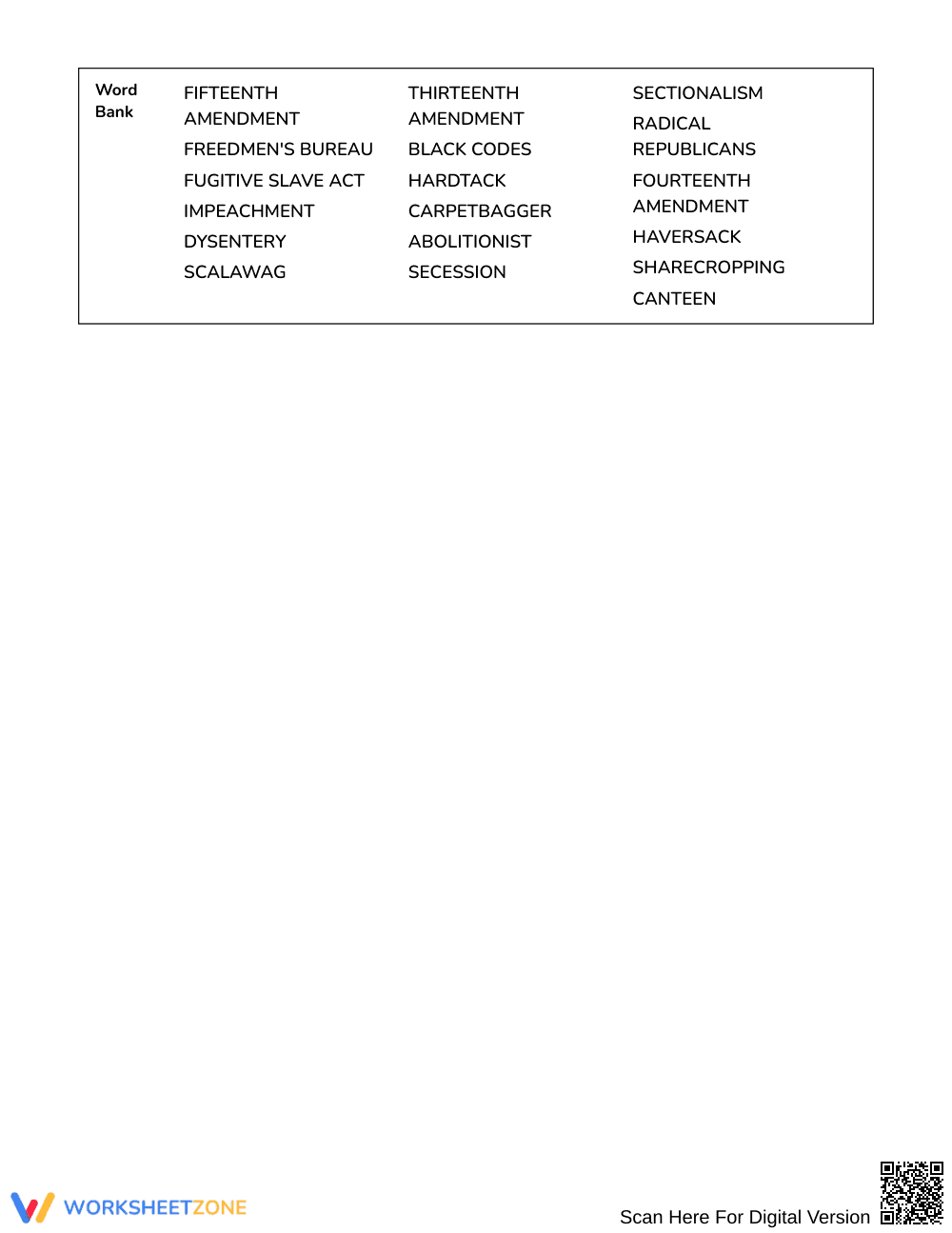
The 4-page activity packet features 18 hidden vocabulary words paired with substantive historical clues. Rather than relying on a passive word search list, the resource provides a shuffled word bank alongside detailed clue sentences that require students to connect terms like Carpetbagger, Secession, and Radical Republicans to their historical context. A matching 4-page answer key provides complete grid solutions for straightforward grading.
Puzzle Structure and Mechanics
Students navigate a dense 20 x 20 letter grid designed to reinforce spatial awareness and letter pattern recognition. The 18 terms run in all eight possible directions: North, Northeast, East, Southeast, South, Southwest, West, and Northwest, including forward, backward, and diagonal orientations. Learners read each historical prompt first, deduce the correct concept from the shuffled word bank, and then locate the term in the grid.
Standards Alignment
This resource serves as supplemental vocabulary enrichment and is not directly aligned to a formal state or national content standard. It reinforces foundational historical literacy by building conceptual familiarity with Reconstruction policies, military rations, and constitutional shifts before formal summative testing.
How to Use It
Use this puzzle after direct instruction on the Reconstruction Era as a collaborative wrap-up activity or as a quiet independent review station. As students work, circulate and check whether they can explain the distinction between the Thirteenth, Fourteenth, and Fifteenth Amendments without looking at their notes. Most middle school classes will complete the puzzle in 25 to 35 minutes.
Who It's For
This worksheet is designed for Grades 7–8 social studies and United States history students. It offers built-in scaffolding through contextual clues, making it accessible for English language learners and students with IEP accommodations. Pair this word search with a primary source reading on the Freedmen's Bureau or Black Codes to deepen historical inquiry.
Vocabulary acquisition in secondary social studies requires repeated exposure to specialized academic language across diverse instructional modalities. When middle school learners identify key historical terms such as sharecropping, secession, and constitutional amendments through clue-driven retrieval, they strengthen the semantic pathways necessary for complex historical analysis. According to Fisher & Frey (2014), intentional word exposure coupled with contextual definitions supports long-term schema building and text comprehension, particularly for students transitioning from narrative recall to analytical social studies texts. Clue-based puzzle formats provide low-stakes retrieval practice that lowers affective filters while demanding cognitive engagement with technical definitions. Rather than memorizing isolated glossary lists, students actively connect conceptual explanations to formal historical nomenclature across 18 specialized terms. This systematic reinforcement ensures that emerging historians build the foundational vocabulary fluency required to interpret primary sources, analyze post-war policy shifts, and articulate historical arguments in subsequent coursework.


