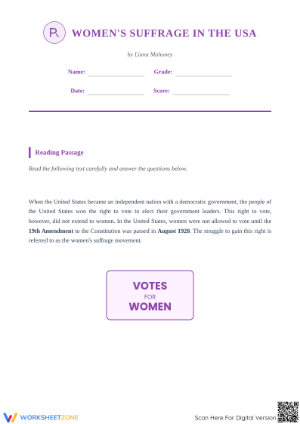
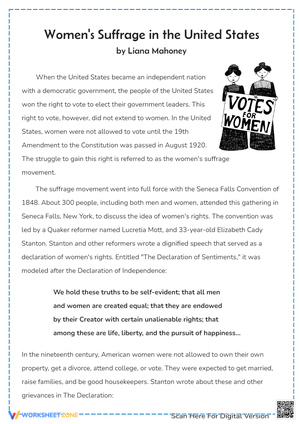
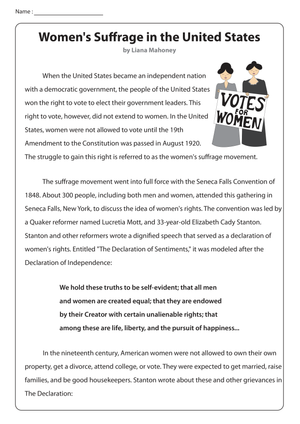
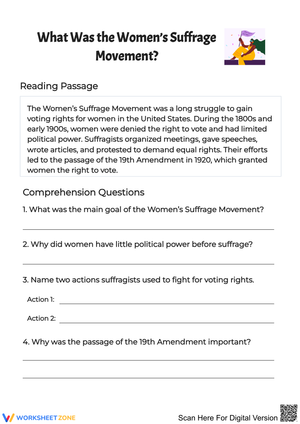
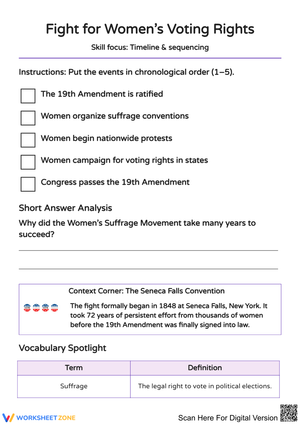
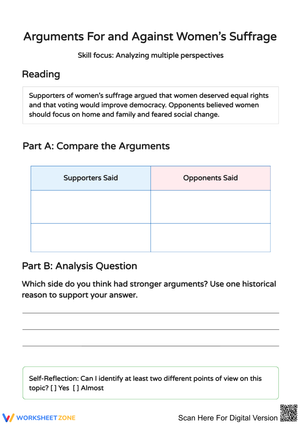
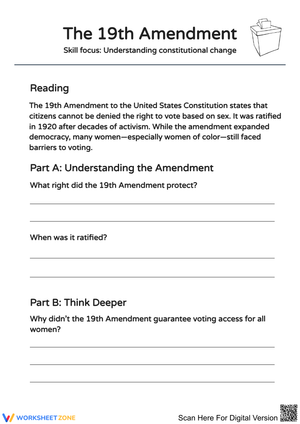
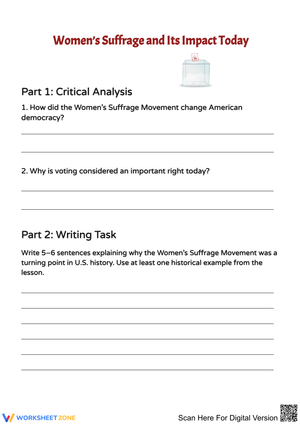
These women's suffrage worksheets for 8th grade cover the full arc of the suffrage movement — from the 1848 Seneca Falls Convention through the ratification of the 19th Amendment and the voting barriers that persisted well beyond 1920. Each worksheet gives students structured practice with primary source analysis, biographical comparison, constitutional close reading, and historical argumentation at the complexity level 8th graders are ready to handle.
The Specific Skills Targeted
The set builds several distinct analytical capacities. Students compare the Declaration of Sentiments to the Declaration of Independence, marking where suffragists borrowed the founding document's language and where they deliberately departed from it — an exercise that sharpens both close reading and rhetorical analysis. Separate worksheets on NAWSA and the National Woman's Party ask students to categorize tactics (legislative lobbying, parades, picketing, hunger strikes) and evaluate which approaches moved public opinion versus which generated backlash. Timeline work helps students see the movement not as a straight march to victory but as a series of advances and retreats across seven decades.
The worksheets also press into the movement's internal fault lines. Students examine why Frederick Douglass and Elizabeth Cady Stanton ended up on opposite sides of the 15th Amendment debate, and they read Ida B. Wells-Barnett's own words about being asked to march at the back of the 1913 Washington parade. These aren't sidebar discussions — they're built into the worksheet tasks so students can't move past them without reckoning with what they mean. That's where the deepest historical thinking happens at this grade level.
Standard Alignment
These worksheets align with CCSS.ELA-LITERACY.RH.6-8.6, which asks students to identify an author's point of view or purpose and distinguish that from evidence presented. That standard shows up directly in the Declaration of Sentiments analysis, where students must separate the document's rhetorical framing from the specific grievances listed. The worksheets also support CCSS.ELA-LITERACY.RH.6-8.9, which addresses comparing primary and secondary sources on the same topic — relevant to any worksheet that puts a suffragist's firsthand account alongside a textbook summary of the same events. In most state frameworks, women's suffrage falls under the larger 8th-grade strand covering constitutional development and the expansion of democratic participation, making this content both a standards requirement and a natural bridge to discussions of civic life that teachers are already expected to facilitate.
Frequent Student Errors Worth Watching For
The most common conceptual error at this level is treating the 19th Amendment as the finish line. Students read "the right of citizens of the United States to vote shall not be denied or abridged... on account of sex" and assume the problem was solved. What they miss is that the amendment's text tracks closely with the 15th Amendment's language — and the 15th Amendment, as students generally know from earlier in the year, did not prevent poll taxes, literacy tests, or white primaries from disenfranchising Black men for another century. The worksheets push students to apply that same interpretive lens to the 19th Amendment, asking them to explain why the constitutional guarantee fell short for many women of color until the Voting Rights Act of 1965.
A second pattern that shows up consistently in student work: collapsing all suffragists into a single unified movement. Students write as if Anthony, Paul, and Wells-Barnett shared the same strategy and the same priorities. The biographical comparison worksheets address this directly, but teachers should expect to see the flattened version in early drafts and use it as a teaching moment rather than just a correction.
How to Build These Worksheets Into Your Lesson Plans
Most teachers find these worksheets work well as the analytical core of a two-to-three week unit rather than as standalone assignments dropped into existing lessons. A strong entry point is using the Declaration of Sentiments comparison worksheet early — ideally the day after students have reviewed the Declaration of Independence — so the rhetorical parallels land with some force. From there, the biographical and tactical comparison worksheets carry students through the movement's mid-century divisions and into the early 20th century organizing push.
The constitutional close reading worksheet pairs well with a brief Socratic discussion: give students 10 minutes to work through the annotation task independently, then open the floor. Students who've done the written work beforehand come to that conversation with something specific to say, which changes the quality of the discussion considerably compared to cold-calling from a textbook. For teachers who use the split-faction debate activity — assigning one group the pro-15th Amendment position and the other the opposition — the worksheets function as reference documents during the debate itself, keeping the argument grounded in actual historical positions rather than students improvising.
Adapting the Set for Mixed-Ability Classrooms
The primary source annotation worksheets can be adjusted by modifying how much contextual framing accompanies the document. Students who struggle with unfamiliar historical prose benefit from a brief glossary and a guiding question that focuses their attention before they read; stronger readers can engage with the same source text without that scaffolding and produce more open-ended written responses. For the tactical categorization worksheet, some students need the categories pre-labeled and simply sort examples into them, while others are ready to build the categories themselves from a list of historical actions — both versions cover the same content at different levels of cognitive demand.
The constitutional comparison worksheet — 15th Amendment alongside the 19th — is the one most likely to frustrate students who are still developing their constitutional literacy. A quick five-minute review of what the 15th Amendment actually did and did not accomplish in practice is worth building into the lesson before distributing that worksheet, regardless of ability level.
Frequently Asked Questions
Are these worksheets usable as stand-alone assignments, or do they require the full unit for context?
Several worksheets — particularly the biographical comparison and the tactical categorization activities — work well as stand-alone assignments for students who already have foundational knowledge of the period. The constitutional close reading worksheet is the exception; students who haven't encountered the 15th Amendment before will need some front-loading before the comparison makes sense. If you're dropping a single worksheet into an existing unit, the Declaration of Sentiments analysis is the most self-contained option.
How do these worksheets handle the racial divisions within the suffrage movement?
That tension is woven into the content rather than treated as a supplementary discussion. Students read about the 1913 parade incident involving Ida B. Wells-Barnett and work through questions that require them to evaluate — not just describe — what the mainstream movement's choices meant for Black women. The goal is for students to leave the unit understanding that the 19th Amendment was simultaneously a genuine democratic advance and an incomplete one, which is historically accurate and appropriate for 8th-grade analytical work.
What's the best way to assess student learning after using these worksheets?
The worksheet tasks themselves generate formative data throughout the unit — annotation quality, the strength of students' tactical evaluations, and how they handle the constitutional comparison all reveal where understanding is solid and where it isn't. For a summative assessment, the most effective prompts ask students to take a position on a historically contested question — such as whether NAWSA or the National Woman's Party was more responsible for the 19th Amendment's passage — using evidence gathered across multiple worksheets. That kind of argument-construction task shows you whether students have built genuine historical understanding or simply absorbed a sequence of facts.












 Interactive Worksheet Maker
 Quiz Maker
 Word Search Maker
 Crossword Puzzle Maker
 Word Scramble Generator
 Sentence Scramble Generator
 Handwriting Worksheet Generator
 Name Tracing Generator
 Fill In The Blank Generator




 BACK TOSCHOOL