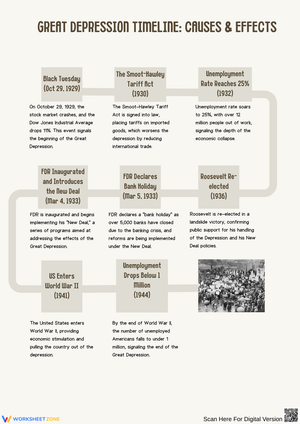
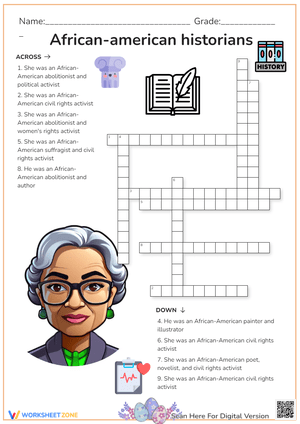
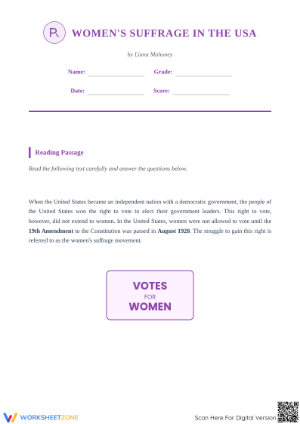
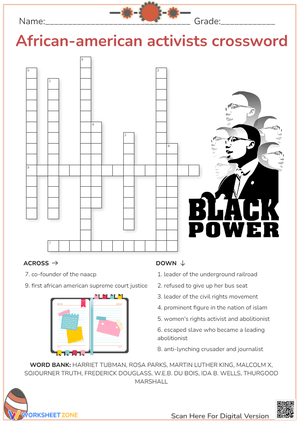
These us history worksheets for 8th grade cover the five major course units — the American Revolution, the Constitution, westward expansion, the Civil War, and Reconstruction — in printable formats teachers can sort by topic and pull the morning of a lesson. Each worksheet targets a specific historical question or skill: a map task on territorial growth, a short reading with text-dependent questions on Reconstruction policy, a cause-and-effect organizer for Revolutionary grievances. The set supports direct-instruction follow-up, independent practice, homework, and sub plans without requiring setup beyond printing.
The Units and Tasks Inside the Set
Grade 8 U.S. history moves at a pace that leaves little room for filler. A course that opens with colonial tensions in September often reaches Reconstruction by March, and students need repeated practice with each unit before the next one builds on it. These worksheets are organized by topic, so teachers can match the resource to the unit on the board rather than sorting through a mixed collection.
The five core units lend themselves to different task types, and the set reflects that:
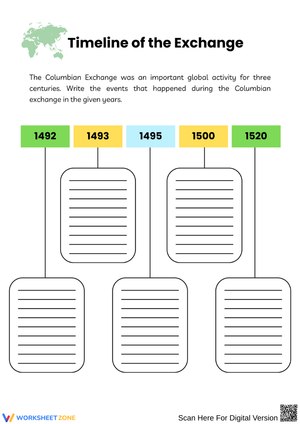
- Revolution era: cause-and-effect chains, colonial grievance identification, timeline tasks, and perspective comparison between colonists and British officials.
- The Constitution: vocabulary matching, government structure diagrams, principle identification, and short written responses tied to civic concepts.
- Westward expansion: map labeling, migration route tracing, territory change tracking, and consequence analysis for different groups affected by expansion.
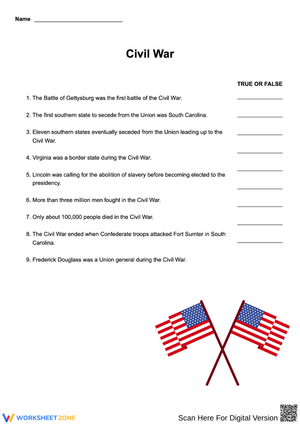
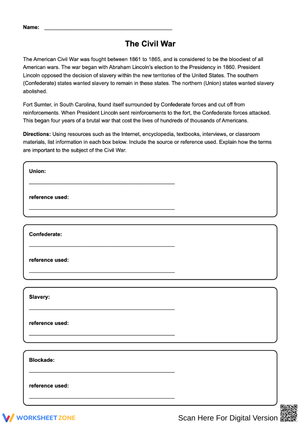
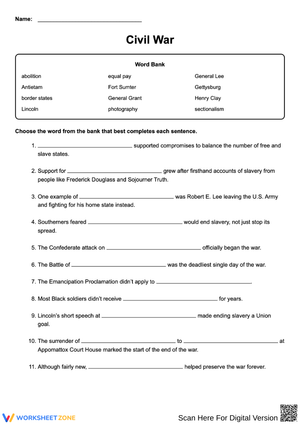
- Civil War: turning-point identification, leader profiles drawn from short texts, regional contrast tasks, and evidence-based written responses.
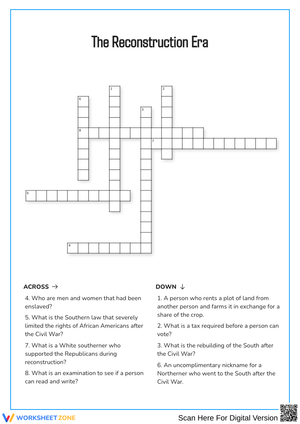
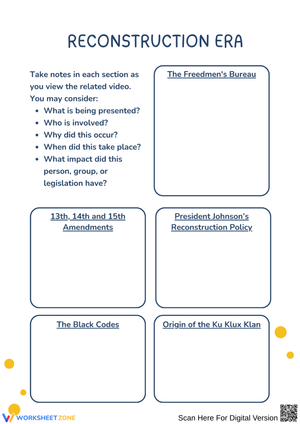
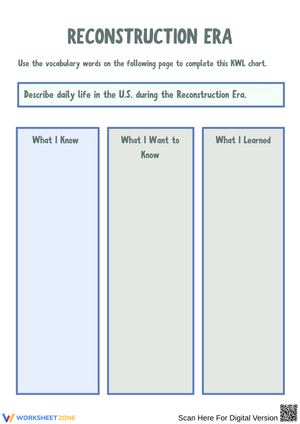
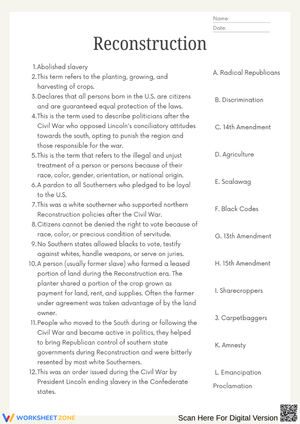
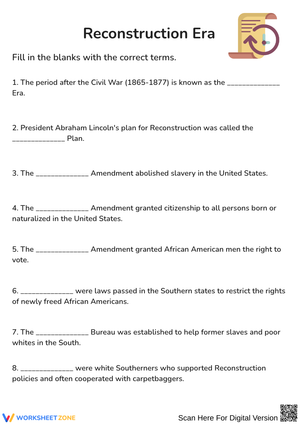
- Reconstruction: amendment reading, policy-debate summaries, and tasks that ask students to analyze shifts in rights and citizenship after the war.
How to Work These Worksheets Into Your Lesson Planning
In a 45-minute middle school period, the transition from direct instruction to student practice is where momentum either holds or collapses. A worksheet with a short reading, five to seven text-dependent questions, and a brief closing prompt fits that window cleanly. Students can estimate the time, track their own progress, and finish before the debrief. That predictability matters more than it might seem — eighth graders who can see the end of a task stay on it longer than those staring at an undifferentiated block of work.
Beyond the standard practice block, these worksheets fit several reliable classroom routines:
- Monday warm-up: Two or three questions from the prior unit settle the class and surface gaps before new instruction begins — this works especially well in the first eight minutes after morning announcements.
- Station rotation: Place a map worksheet, a short reading worksheet, and a source-analysis worksheet at three separate tables. All three skill types move through the room in a single period without any one group waiting on others.
- Post-instruction practice: Assign one worksheet immediately after direct instruction so students apply the concept while it is still fresh — not as homework, but as the independent block before the period ends.
- Pre-assessment spiral: Pull three or four worksheets from earlier in the unit and run a mixed review in the two days before a benchmark or unit test.
- Sub plans: A reading-based worksheet with a visible stopping point and one extension prompt covers a full period without depending on slide decks or online logins.
Pairing Worksheets With Primary Sources
Grade 8 U.S. history is one of the few middle school courses where students regularly encounter genuine primary sources — the Declaration of Independence, Lincoln's Second Inaugural Address, photographs from westward migration, political cartoons about Reconstruction. A worksheet handles that material well when it gives students a visible process: identify the author and moment, pull two pieces of evidence, explain what the source reveals about a larger issue such as liberty, conflict, or citizenship. That sequence keeps the analysis manageable without reducing it to guessing.
Teachers who pair the National Archives Document Analysis framework with a us history worksheets for 8th grade on the same era give students a consistent sourcing method to carry from unit to unit. The Library of Congress Teacher's Guides extend that same logic to maps, photographs, and printed documents. When students practice the same observe-reflect-question routine on a Colonial-era broadside in October and then again on a Reconstruction-era freedmen's bureau record in February, the habit becomes automatic rather than a procedure they have to relearn each time.
Mistakes Students Make That These Worksheets Help You Catch
The most consistent error in 8th grade U.S. history is chronological compression. Students collapse events that built across decades into a single cause-and-effect step. Asked about the causes of the Civil War, they write that the country divided "because of slavery" without distinguishing the economic and political tensions of the 1830s and 1840s from the trigger events of 1860–61. A cause-and-effect organizer worksheet that asks students to place contributing factors in sequence before writing a summary exposes that flattening — and gives the teacher something concrete to address before the essay prompt arrives.
A second pattern surfaces on Constitution worksheets. Students consistently treat the Bill of Rights as part of the original 1787 document. They have heard the two mentioned together often enough that the amendment process becomes invisible to them. Worksheets that ask students to write the ratification year next to each document and explain in one sentence why there was a gap force engagement with the distinction rather than letting it slide by. In actual student work, roughly half the class writes "1787" next to the Bill of Rights the first time they encounter this task — which tells you exactly what to reteach before moving to the Civil War amendments.
Standard Alignment
The worksheets align to the C3 Framework standards most central to Grade 8 history — specifically D2.His.1.6-8, which asks students to analyze connections among events in broader historical contexts, and D2.His.5.6-8, which focuses on explaining how and why perspectives changed over time. Both standards require students to work with evidence rather than recall alone, which is why the set includes short-text response and source analysis alongside matching and vocabulary tasks.
For ELA-literacy alignment, the worksheets address CCSS.ELA-Literacy.RH.6-8.1 (citing textual evidence to support analysis of primary and secondary sources) and RH.6-8.6 (identifying an author's point of view or purpose in a historical text). In practical classroom terms, students practicing those reading moves on a history worksheet are reinforcing the same analytical skills their ELA teacher builds during informational text units — which makes coordination between departments straightforward when teachers are already sharing reading standards.
Differentiating These Worksheets Across Ability Levels
Grade 8 history classes often hold a wide range — students reading two or three years below grade level in the same room as students ready to write document-based essays. The worksheet format helps here because the structure stays consistent while the level of support changes. Students at all levels see the same short reading, the same question sequence, and the same closing prompt, so no group feels marked as different from the others.
For students who need more support, pre-teaching three to five vocabulary terms before the worksheet goes out reduces cognitive demand during reading, and sentence frames for the written response keep the task accessible without removing the thinking. For students ready to go further, the same worksheet becomes a starting point: finish the questions, then write a paragraph connecting the topic to a different era already covered in the year. Teachers can also use the us history worksheets for 8th grade set to create differentiated station work — one group uses the full reading-and-questions format while another works from the same source without the question list, producing written analysis independently.
Frequently Asked Questions
Are the worksheets organized by unit, or mixed across the whole course?
The collection is organized by topic, so teachers can go directly to the unit they are currently teaching — Revolution, Constitution, westward expansion, Civil War, or Reconstruction — and pull the worksheet that fits the current lesson. That organization removes sorting time during planning periods when most decisions happen quickly.
What kinds of tasks appear across the set?
The set includes map labeling, vocabulary matching, cause-and-effect organizers, short readings with text-dependent questions, source analysis, and brief written response tasks. Each worksheet holds one or two task types rather than mixing all of them together, so students can complete the work in a focused block without task-switching halfway through.
How do these worksheets work as sub plans?
Reading-based worksheets with direct prompts and a visible stopping point are the most dependable sub-plan format. A worksheet with a short passage, focused questions, and a closing prompt gives a substitute clear structure without requiring explanation of prior unit content. Teachers who keep the us history worksheets for 8th grade set available often print two or three in advance and file them in a sub folder — precisely because those plans need to work without any context from the regular teacher.
Can these worksheets support primary source analysis alongside regular content practice?
Yes, and that pairing is where the set is most useful for building long-term historical thinking. Each worksheet on a narrowly defined topic — the debates at the Constitutional Convention, freedmen's bureau policies during Reconstruction — pairs directly with a primary source from the same era. The National Archives Document Analysis framework and the Library of Congress Teacher's Guides both give students a consistent method for sourcing, evidence-gathering, and written interpretation that transfers from worksheet to worksheet across the year.












 Interactive Worksheet Maker
 Quiz Maker
 Word Search Maker
 Crossword Puzzle Maker
 Word Scramble Generator
 Sentence Scramble Generator
 Handwriting Worksheet Generator
 Name Tracing Generator
 Fill In The Blank Generator




 BACK TOSCHOOL