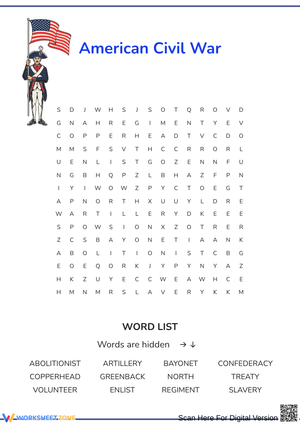
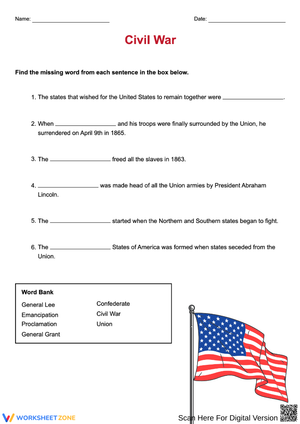
American Civil War worksheets for 8th Grade
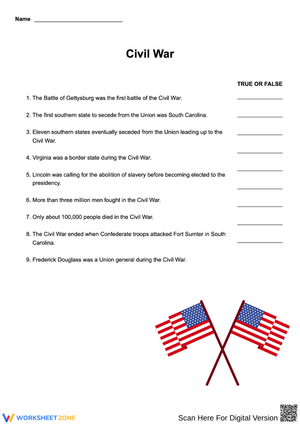
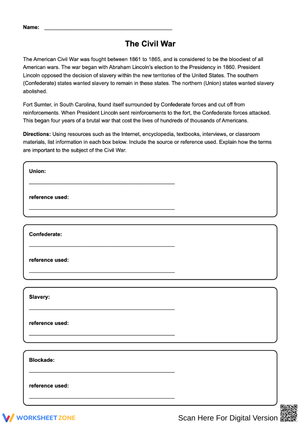
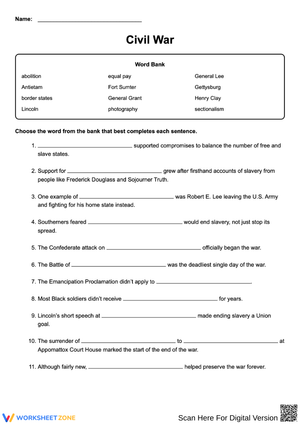
These american civil war worksheets for 8th grade give teachers a ready collection of standalone resources covering the war's causes, major campaigns, and lasting consequences — with enough variety to anchor full lessons or fill targeted gaps without rebuilding the wheel mid-unit. The set includes primary source analysis tasks, geography worksheets, cause-and-effect organizers, and reading passages on key historical figures, each one complete on its own.
What's Inside the Set
The geography worksheets ask students to label Union, Confederate, and border states, then analyze why the border states mattered to both sides strategically. From there, students map major military campaigns and trace the logic of the Union's Anaconda Plan — isolating the Confederacy by controlling the Mississippi River and blockading Southern ports. That spatial reasoning matters: a student who can read a Civil War map understands the war's military logic in a way that a student relying on a textbook paragraph does not.
Primary source worksheets draw from Lincoln's major speeches — the First Inaugural Address, the Gettysburg Address, the Emancipation Proclamation — alongside Confederate documents, soldier diaries, and political cartoons from the era. Each worksheet pairs an excerpt with a structured set of analysis questions: students identify the author, intended audience, historical context, and the core claim being made. The cause-and-effect organizer series traces the chain from the Missouri Compromise through the Kansas-Nebraska Act, Bleeding Kansas, and the Election of 1860 — not as a rote list, but as a sequence of decisions that made later decisions harder to avoid. The biographical reading passages cover Frederick Douglass, Harriet Tubman, Ulysses S. Grant, Robert E. Lee, and Jefferson Davis, with questions that push students to evaluate motivation rather than simply restate what someone did.
Frequent Student Errors Worth Anticipating Before You Teach This Unit
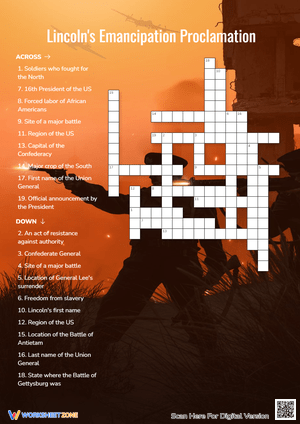
The most consistent misconception we see in eighth-grade Civil War teaching: students write that the Emancipation Proclamation freed all enslaved people in the United States. When pressed, many can recite that it only applied to Confederate states — but they still write "all" in the formal response, because the moral significance of the document crowds out its specific legal limits. Worksheets that ask students to underline exactly which states the Proclamation named, then write a one-sentence explanation of why border states were excluded, force that distinction into active memory rather than passive recognition.
A second error runs deeper. Students routinely list "states' rights" and "slavery" as two separate causes side by side, as though they're unrelated. The cause-and-effect organizers address this directly because they ask students to specify what right Southern states were defending — and that question has one honest answer. Students who try to write "states' rights to self-governance" typically pause when they work through the primary documents and confront what those documents actually say.
Timeline confusion is also predictable. A meaningful portion of eighth graders, when asked to sequence events without a reference, place Antietam before Fort Sumter, or position the Emancipation Proclamation at the war's end rather than in September 1862 following the Union victory at Antietam. The geography and chronology worksheets both include timeline tasks because this particular confusion appears consistently enough to warrant direct address.
Building These Worksheets Into Your Lesson Plans
Primary source worksheets function well as bell ringers — four to eight minutes of focused reading and one annotation task while you take attendance and handle morning logistics. The cause-and-effect organizers anchor longer work periods, especially when different student groups receive different sections of the causal chain and reassemble the full sequence as a class discussion. Map tasks work best mid-unit, once students have a conceptual frame for what each side was trying to accomplish militarily. Cold-starting with a blank battlefield map and no prior instruction produces confusion far more reliably than it produces learning.
For primary sources with dense 19th-century language — the Emancipation Proclamation and the First Inaugural Address in particular — a layered approach works better than sending students directly to the analysis questions. Students first circle vocabulary they cannot paraphrase, then annotate the margin with a plain-language summary of each paragraph's main claim, and then tackle the formal analysis questions. That sequence matters because 14-year-olds processing 1860s political prose for the first time produce surface-level analysis when they're simultaneously decoding unfamiliar syntax. One pass to decode, one pass to analyze.
These american civil war worksheets for 8th grade also pair well with digital resources: a printed battlefield map alongside a virtual tour on a smartboard builds richer spatial understanding than either produces alone. The standalone structure of each worksheet makes the set useful for substitute teacher days as well — any worksheet runs independently without requiring a substitute to explain a multi-day sequence.
Standard Alignment
The worksheets address multiple dimensions of the NCSS C3 Framework for Social Studies. D2.His.1.6-8 and D2.His.5.6-8 require students to analyze how historical context shapes events and evaluate the relevance of source information — both directly targeted in the primary source analysis worksheets. D2.His.9.6-8 asks students to assess how and why historical perspectives change over time, which the biographical reading passages support when students compare how Grant and Lee have been remembered differently in Northern and Southern historical memory. The geography worksheets address D2.Geo.2.6-8, which asks students to explain how geographic factors influence political outcomes. Taken together, american civil war worksheets for 8th grade in this set target the analytical and evidence-based reasoning that the C3 Framework prioritizes over surface recall.
Adjusting the Set for a Range of Learners
Students who struggle with primary source language benefit from the layered annotation sequence described above — it's not a workaround, it's the same analytical process historians use. Pairing those students with a focused glossary of period-specific vocabulary keeps their cognitive effort on historical reasoning rather than dictionary lookups. For the cause-and-effect organizers, partial completion works well: provide the first two events in the chain and have students extend it, rather than starting from a blank box.
Students who need more challenge should move past recall questions into argumentative territory: Was the Compromise of 1850 a genuine resolution or a postponement? Could the war have been avoided after the Election of 1860? The biographical worksheets lend themselves to comparative analysis — students write across two figures simultaneously rather than answering passage-specific questions in sequence. The map worksheets can be extended by asking students to propose an alternative Union military strategy and argue whether it would have shortened or prolonged the conflict.
Frequently Asked Questions
Which Civil War topics deserve the most instructional time in 8th grade?
The long-term causes — sectionalism, the economics of slavery, and the sequence of failed compromises stretching from 1820 to 1860 — deserve more instructional time than they typically receive. Students who understand the decades-long pressure building before Fort Sumter read the war itself with more nuance. Major turning points matter both militarily and politically: Antietam gave Lincoln the moment to issue the Emancipation Proclamation; Vicksburg split the Confederacy geographically in two. The Proclamation itself and the war's gradual transition toward abolition as an explicit Union objective belong inside the unit, not tacked on as a concluding note.
How do the primary source worksheets handle 19th-century language for middle schoolers?
Each primary source worksheet breaks the document into shorter sections with guided questions anchored to specific excerpts, so students work through one section at a time rather than confronting the full document at once. The annotation tasks — circling unfamiliar words, writing margin summaries — come before the formal analysis questions, not after. The goal is to make the language accessible without softening the historical significance of what the document actually says or asks students to think through.
Do the worksheets include answer keys?
Yes. Each worksheet includes an answer key that accounts for the range of acceptable student responses, particularly on primary source analysis questions where phrasing varies. For cause-and-effect organizers, the keys explain the causal connection — not just what the correct answer is, but why that event belongs at that point in the sequence. That makes the keys useful for planning whole-class review discussions, not only for individual grading.
What if some students are reading significantly below grade level?
The reading passages sit at an 8th-grade Lexile level, which is appropriate for the content but demanding for students two or more grade levels behind. The map tasks and cause-and-effect organizers are more accessible since those activities don't rely as heavily on extended text comprehension. Providing vocabulary support before the reading — rather than after students have already stalled — keeps struggling readers' attention on the historical reasoning. The american civil war worksheets for 8th grade in this set also include political cartoons and recruitment posters that give visual learners an entry point into the era before they tackle text-heavy primary source excerpts.
Clear All