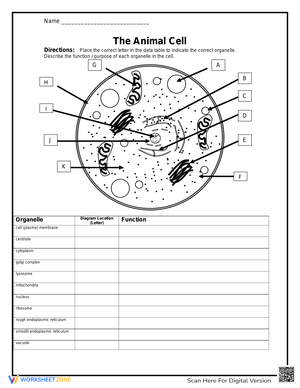
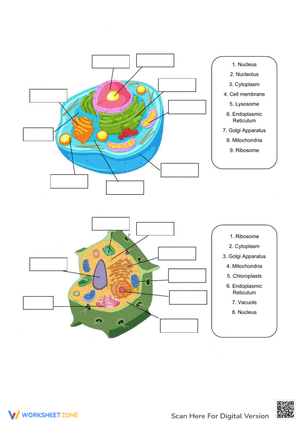
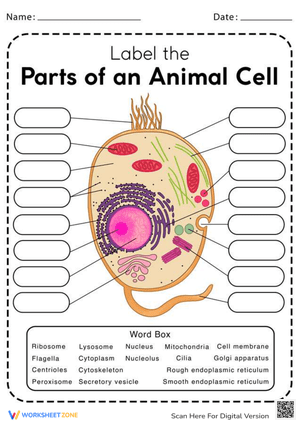
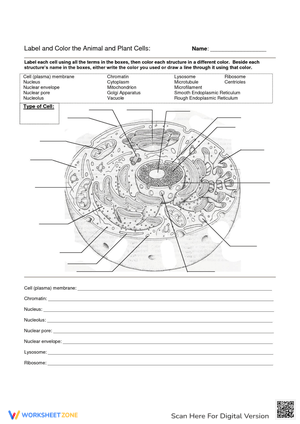
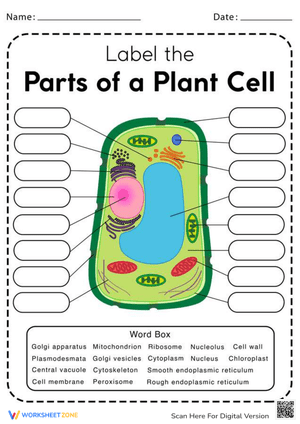
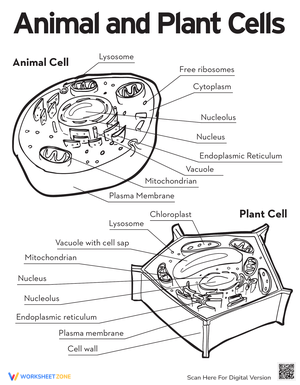
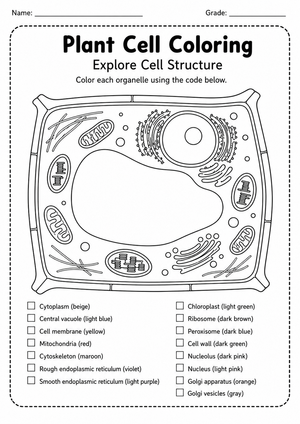
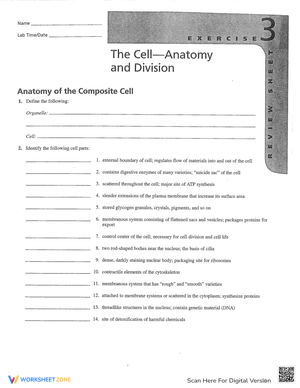
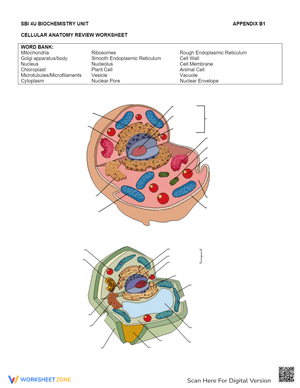
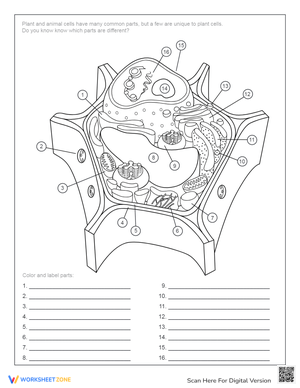
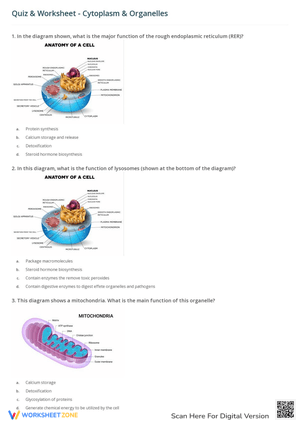
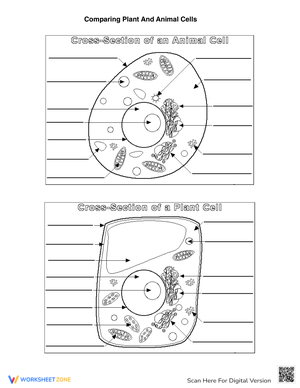
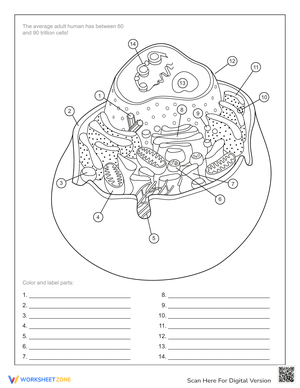
Composite cell worksheets for 8th grade address one of the more persistent gaps in a cells unit: students who recognize organelle names when a word bank is present but cannot produce them independently when the diagram is blank. Each worksheet in this set centers on a composite cell diagram that places major plant and animal cell structures together, so students work through identification, function matching, and comparison in one activity rather than across disconnected exercises.
The Specific Skills Each Worksheet Targets
The fill-in format — no word bank — is the structural choice that makes these worksheets useful for diagnosis. Students who can pick "mitochondria" from a list when they see a specific shape are not always the same students who can recall the term and its function from scratch. The blank-response format exposes that difference in a single pass.
Each worksheet also moves past labeling into explanation. Prompts pair organelle names with function questions and push students to distinguish plant-only structures from shared ones. The composite diagram includes chloroplasts and the cell wall alongside the nucleus, cell membrane, and mitochondria, which means students must actively sort what they see rather than assume every structure applies to both cell types.
- Organelle identification from a composite diagram (nucleus, cell membrane, mitochondria, chloroplasts, cell wall, and additional structures depending on the worksheet)
- Function prompts paired with each labeled structure, requiring brief written responses
- Plant-versus-animal comparison questions that ask students to sort structures, not just list them
- At least one justification prompt asking students to explain a structural role in their own words
Standard Alignment
These composite cell worksheets for 8th grade align to NGSS MS-LS1-2, which asks students to develop and use a model to describe the function of a cell as a whole and the way the parts of cells contribute to that function. The clarification statement for MS-LS1-2 specifically names the nucleus, chloroplasts, mitochondria, cell membrane, and cell wall — exactly the five structures these worksheets prioritize. That direct correspondence gives teachers a clear checkpoint for 8th grade review work.
MS-LS1-2 is a modeling standard, which means correct labels without explanation address only part of the expectation. A student who fills in "mitochondria" accurately but writes "it gives the cell energy" without explaining the conversion of nutrients has recalled a term rather than reasoned from a model. The short-answer prompts in these worksheets push students toward that explanatory step — a distinction that matters for any classroom working within an NGSS-aligned curriculum.
Common Misconceptions to Watch For and Correct
Three mistakes appear consistently in 8th grade cell review work. The first: a student labels chloroplasts correctly on the diagram, then writes in a separate function prompt that "all cells use chloroplasts to make food." That error is specific — it tells you the student has memorized photosynthesis as a general fact about cells rather than as a plant-specific process tied to one organelle. It surfaces most clearly when the worksheet asks students to justify which structures are plant-only and which are shared.
The second predictable confusion is between the cell wall and the cell membrane. Students who can name both structures often cannot explain the functional difference. When a prompt asks what would happen to a plant cell without a cell wall, students who understand the distinction write about structural support collapsing; students who are still fuzzy write something about substances not being able to enter or exit — which is the cell membrane's job. Seeing that specific substitution in student writing points directly to the reteach target.
The third pattern is treating mitochondria as a vocabulary item rather than a process. "Mitochondria make energy" appears frequently in student responses and signals rote recall. A stronger answer explains that mitochondria convert nutrients into a usable form — a small but meaningful distinction for students moving toward more complex cell systems thinking. When you score the worksheets, sorting responses by that depth level gives you a quick picture of who needs oral rehearsal and who is ready for extension work.
How to Build These Worksheets Into Your Lesson Plans Without Losing Time
The most efficient placement for composite cell worksheets for 8th grade is the 7- to 10-minute bell ringer window after you have introduced cell structures through direct instruction or a model-building activity. Students begin independently as class starts, and you collect real data on recall without burning instructional time on transitions or setup. That brief window before the formal lesson is often the clearest look at what students actually retained from the day before.
Station rotation is another strong fit. One group works through the labeling and function prompts while you pull a small reteach group to review plant-versus-animal structures on a projected diagram. Because each worksheet is self-contained, the station group does not need you present to stay on task. Sub plans are the natural extension of that same logic: a content-aligned activity that does not require the substitute to explain context or manage materials.
For formative assessment, a two-pass routine works well. Students complete the labeling and fill-in items independently on the first pass. On the second pass, they respond to one targeted prompt — something like Which two structures in this diagram are plant-specific, and what does each one do that the other cell type manages differently? That follow-up distinguishes students who read the diagram from those who can reason from it. Using three or four items as an exit ticket rather than the full worksheet keeps grading manageable and gives you clean data for the next lesson's planning.
Adjusting the Worksheets Across Ability Levels
Students who need additional support work best when they complete the labeling section first — confirming each answer against an anchor chart or reference card before moving to the function prompts. Keeping those two tasks sequential, rather than working through the worksheet top-to-bottom, helps students build confidence in identification before they shift into explanation. The content expectation stays the same; what changes is the order of operations.
Students working above grade level can annotate the diagram with process connections — marking how the mitochondria and cell membrane interact during energy use, or writing a brief explanation of why a plant cell requires both a cell wall and a cell membrane when an animal cell only has one. That annotation pushes toward the systems-level reasoning that appears in high school biology without requiring a separate resource. One honest limitation of the composite diagram format: students who missed the initial cell instruction day may need a brief whole-class orientation before the worksheet functions as independent practice rather than a guessing task.
Frequently Asked Questions
What is a composite cell worksheet, and why does it combine plant and animal structures?
A composite cell diagram places structures from both plant and animal cells into one model. Students cannot assume they are looking at a single cell type — they must identify, sort, and compare. That comparison task is more demanding than labeling a plant cell and an animal cell separately, and it reflects the kind of structural reasoning MS-LS1-2 expects.
How do these worksheets connect to NGSS MS-LS1-2?
MS-LS1-2 expects students to use a model to explain how cell parts contribute to cell function — not just name parts. These worksheets pair diagram work with short-answer prompts, so students practice both the model-reading and the explanation that the standard requires. Correct labels alone satisfy only part of the expectation.
Can these be used the day before a cell quiz?
Yes — composite cell worksheets for 8th grade work well as same-day review before an assessment because they keep students focused on the highest-priority content: organelle identification, structure-function reasoning, and the plant-versus-animal comparison that appears frequently on middle school cell tests. Assigning the explanation prompts rather than just the labeling items makes the review more complete in the same amount of class time.
Do students need prior instruction before working through these independently?
Students should have at least one prior class period of direct instruction or visual model work with cell structures before using these worksheets for independent practice. For students who need a refresher, a 3- to 5-minute whole-class preview of the diagram before independent work prevents the activity from becoming an exercise in guessing rather than retrieval.












 Interactive Worksheet Maker
 Quiz Maker
 Word Search Maker
 Crossword Puzzle Maker
 Word Scramble Generator
 Sentence Scramble Generator
 Handwriting Worksheet Generator
 Name Tracing Generator
 Fill In The Blank Generator