Printable Frog Dissection Worksheets for 8th Grade Labs and Review
These 8th grade frog dissection printable worksheets give life science teachers a structured path through the entire lab unit — pre-lab vocabulary, external and internal anatomy labeling, observation notes, structure-function prompts, and a post-lab explanation task that moves students past simple identification. Each worksheet handles a discrete stage of the learning sequence so the lab stays anchored in science rather than drifting into a 50-minute novelty session students remember but cannot explain.
What Each Worksheet Asks Students to Do
The set covers the full range of tasks a frog dissection unit demands, from recognition to reasoning. Students don't just mark organ names — they record what they observe and explain why those structures matter to the organism's survival.
- Pre-lab vocabulary: Students match terms, write definitions in their own words, and identify structures from diagrams before any specimen is distributed. Seeing "tympanic membrane" on paper before seeing it on the frog cuts confusion when lab directions are given.
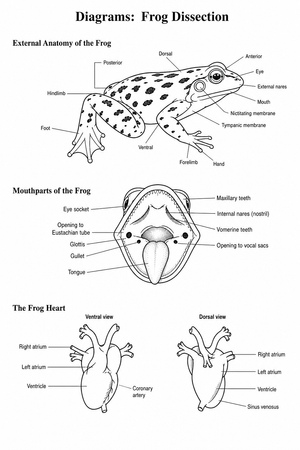
- External anatomy labeling: Students mark and name external features — nares, tympanic membrane, cloaca, digit count — before any incision. This step also reveals students who are still confusing dorsal and ventral.
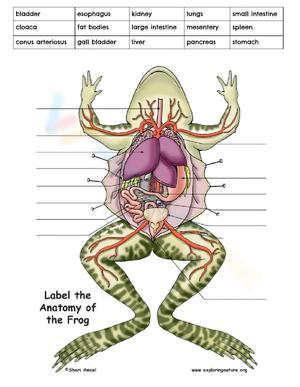
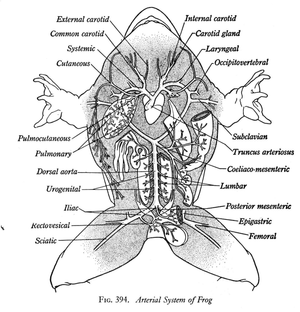
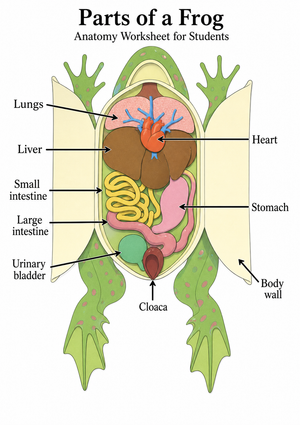
- Internal anatomy labeling: Focused on major systems: digestive (esophagus, stomach, small intestine, large intestine, liver, gallbladder), circulatory (three-chambered heart), and respiratory (lungs, glottis). Minor structures are noted but not belabored.
- Observation notes: Students record color, texture, relative size, and position — not just organ names. This is where "I see the liver" becomes "the liver is dark brown, multi-lobed, and covers most of the left upper cavity."
- Structure-function prompts: Short written responses asking what each organ does and how it connects to a broader system. Most students skip this task when it isn't required, so having it printed and built into the sequence matters.
- Post-lab review: Students write brief explanations connecting their observations to organ system concepts, giving teachers a usable formative check before the unit moves into comparative anatomy.
Frequent Student Errors Worth Anticipating Before Lab Day
The most persistent confusion we see in student work is between the small and large intestine. Students know "large" means bigger, so they label the coiled, longer structure as the large intestine when it is actually the small intestine. A labeling prompt that asks students to note relative diameter and position — not just overall length — catches this misread before it gets reinforced.
Frog liver identification is another consistent stumbling point. The structure is large, dark brown, and multi-lobed, and it looks nothing like the simplified single-lobe diagrams students have typically encountered. Students who label confidently during external anatomy often guess "stomach" or "kidney" for the liver on first inspection of the internal cavity. Including a brief texture-and-color note in the observation prompt gives students a reference point beyond shape alone.
Structure-function writing is where identification skills break down the fastest. A student who marks the heart correctly will still write "it pumps blood" without noting that the frog heart has three chambers — two atria and one ventricle — which is a meaningful structural difference from the four-chambered mammalian heart they've already studied. The function prompts in each worksheet push students toward that level of specificity rather than accepting a surface answer as complete.
Fitting These Worksheets Into Your Lab Unit Without Adding Prep Time
The day-before setup matters more than most teachers plan for. Assigning the vocabulary and external anatomy worksheet the class period before the lab means students arrive already familiar with the terms they'll hear during safety directions. That single move cuts the orientation phase of the lab significantly and creates more time for actual observation. When these 8th grade frog dissection printable worksheets are distributed the day before rather than the morning of, partner pairs work more independently, and the teacher spends less time fielding "what is this called?" from every table.
During the lab, the observation worksheet gives each student an accountable role. One student can handle the specimen and tools while the other records; then they switch when the worksheet moves from external to internal structures. This keeps both partners active and gives teachers two separate records to assess rather than one shared answer that reveals nothing about individual understanding.
After the lab, the same labeled worksheets function as review material without any additional printing or prep. Students can use their own annotated records to answer system-level questions, prepare for a quiz, or write comparative statements about frog and human anatomy. For students who were absent during the lab, the observation and function worksheets can be completed using teacher photographs, a projected demo, or a provided diagram — same learning targets, adjusted format.
Safety Expectations and Opt-Out Planning
Each worksheet used during or before lab carries printed reminders about gloves, splash goggles, proper tool handling, ventilation, and specimen disposal. Verbal announcements delivered once at the start of class don't hold — a printed reminder on the worksheet students are actively working from stays visible throughout the period. Treating safety as a step in the science process rather than a preliminary announcement is far more likely to carry into actual student behavior.
Opt-out planning should produce work that targets the same anatomy and observation goals, not easier busywork. The labeling and function worksheets transfer directly to a non-dissection format: students can complete them using a teacher demonstration, projected images, or a provided diagram set. NSTA's position on the use of animals in science instruction supports this — alternatives should match the educational rigor of the original activity. Teachers who build opt-out paths into their planning from the start avoid last-minute accommodations that shortchange the student's science learning.
Standard Alignment
These worksheets address MS-LS1 — From Molecules to Organisms: Structures and Processes, the primary NGSS domain for 8th grade life science in most state frameworks. The structure-function prompts and organ system labeling tasks specifically support MS-LS1-3, which asks students to use evidence-based argument to explain how the body operates as a system of interacting subsystems. When students write about how the frog's three-chambered heart circulates blood through both pulmonary and systemic circuits, they are constructing exactly the kind of claim that standard targets. The 8th grade frog dissection printable worksheets set also supports the NGSS science and engineering practice of obtaining, evaluating, and communicating information — through direct observation, annotation, and short written explanation anchored in specimen evidence.
Adjusting the Worksheets for a Range of Learners
For students who need more structured support, the labeling worksheets work well with a printed word bank placed alongside the diagram. This is especially useful for English learners or students with IEPs that include vocabulary accommodations — the student is still completing the anatomy identification task; they simply have terms available to reference rather than needing to retrieve them from memory under time pressure. That small adjustment keeps the cognitive demand focused on what the learning target actually is: correctly locating and identifying structures, not spelling from recall.
Students ready for extension can go further with the function prompts. Rather than writing one sentence about what the liver does, they can write a connected explanation of how the liver, gallbladder, and small intestine interact as a functional unit. The comparative anatomy task — asking how frog structures resemble or differ from human anatomy — also extends naturally for students with strong prior knowledge of body systems, pushing them from surface-level identification into structural reasoning about why vertebrates share so many core features.
Frequently Asked Questions
What should a complete set of frog dissection worksheets for 8th grade include?
A strong set covers pre-lab vocabulary, external and internal anatomy labeling with structures organized by system, observation notes with prompts for color and texture, structure-function explanation tasks, safety reminders built into each worksheet, and a post-lab formative check. Each worksheet should target one stage of the learning sequence so teachers can assign only what fits the available lab time — without modifying or cutting apart a longer document.
Can these worksheets still be used if a student opts out of the dissection?
Yes. The labeling and observation worksheets transfer directly to a demo or diagram-based format. The learning targets — identifying structures, recording observations, explaining function — hold regardless of whether the student is working from a specimen or from provided images. Teachers who plan opt-out paths using the same 8th grade frog dissection printable worksheets resources maintain instructional consistency and avoid the equity problem of offering an alternative that doesn't meet the same science goals.
How do these worksheets connect to organ system instruction later in the unit?
The structure-function prompts and system-level labeling in each worksheet build directly toward MS-LS1-3, which asks students to explain how body systems work together. Students who annotated their own worksheets during the lab have a concrete record to reference when instruction moves into comparative anatomy or broader body system discussion. The jump from "I labeled the small intestine" to "I can explain how the digestive system processes food from ingestion to absorption" is shorter when students have their own observation evidence to anchor the argument.
Clear All