


























0
Views
0
Downloads

0.0
0
Save
0 Likes
Share
Animal and Plant Cells: Explore Cell
0 Views
0 Downloads
Paste this activity's link or code into your existing LMS (Google Classroom, Canvas, Teams, Schoology, Moodle, etc.).
Students can open and work on the activity right away, with no student login required.
You'll still be able to track student progress and results from your teacher account.
Information
Description
What It Is:
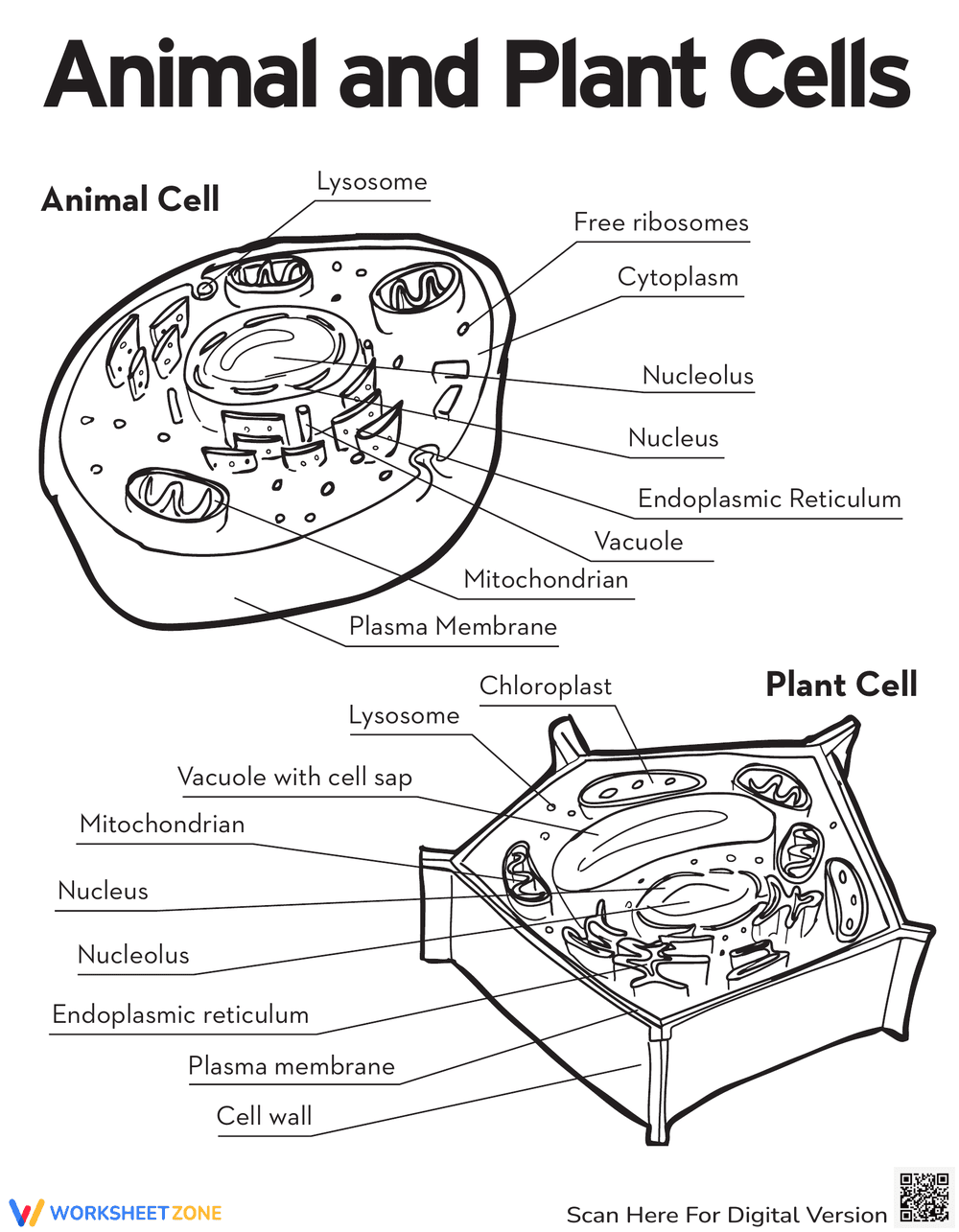
This is a black and white educational worksheet featuring labeled diagrams of animal and plant cells. The diagrams show the internal structures of each cell, including the nucleus, nucleolus, endoplasmic reticulum, mitochondria, vacuoles, plasma membrane, cytoplasm, lysosomes, free ribosomes, chloroplast (in the plant cell), and cell wall (in the plant cell). The worksheet is designed to help students learn the different parts of the cell and their locations.
Grade Level Suitability:
This worksheet is suitable for grades 6-9. The diagrams are detailed enough to be informative, but not overly complex, making them appropriate for middle school students learning about cell biology. The labels provide clear identification of each organelle.
Why Use It:
This worksheet helps students visually learn and identify the different organelles within animal and plant cells. It promotes understanding of cell structure and function, and reinforces vocabulary related to cell biology. It can be used for review, reinforcement, or as an introduction to the topic.
How to Use It:
Students can use this worksheet to label the parts of the cell. It can also be used as a reference during lectures or textbook readings. It could also be used as a coloring page to reinforce learning. Students can compare and contrast the structures of animal and plant cells based on the diagrams.
Target Users:
The target users are middle school students studying biology, science teachers looking for visual aids, and homeschool parents teaching cell structure. It is also useful for students who benefit from visual learning.
This is a black and white educational worksheet featuring labeled diagrams of animal and plant cells. The diagrams show the internal structures of each cell, including the nucleus, nucleolus, endoplasmic reticulum, mitochondria, vacuoles, plasma membrane, cytoplasm, lysosomes, free ribosomes, chloroplast (in the plant cell), and cell wall (in the plant cell). The worksheet is designed to help students learn the different parts of the cell and their locations.
Grade Level Suitability:
This worksheet is suitable for grades 6-9. The diagrams are detailed enough to be informative, but not overly complex, making them appropriate for middle school students learning about cell biology. The labels provide clear identification of each organelle.
Why Use It:
This worksheet helps students visually learn and identify the different organelles within animal and plant cells. It promotes understanding of cell structure and function, and reinforces vocabulary related to cell biology. It can be used for review, reinforcement, or as an introduction to the topic.
How to Use It:
Students can use this worksheet to label the parts of the cell. It can also be used as a reference during lectures or textbook readings. It could also be used as a coloring page to reinforce learning. Students can compare and contrast the structures of animal and plant cells based on the diagrams.
Target Users:
The target users are middle school students studying biology, science teachers looking for visual aids, and homeschool parents teaching cell structure. It is also useful for students who benefit from visual learning.


