


























Views
Downloads

Essential Plant Cell Coloring Worksheet | Grade 8-10
Paste this activity's link or code into your existing LMS (Google Classroom, Canvas, Teams, Schoology, Moodle, etc.).
Students can open and work on the activity right away, with no student login required.
You'll still be able to track student progress and results from your teacher account.
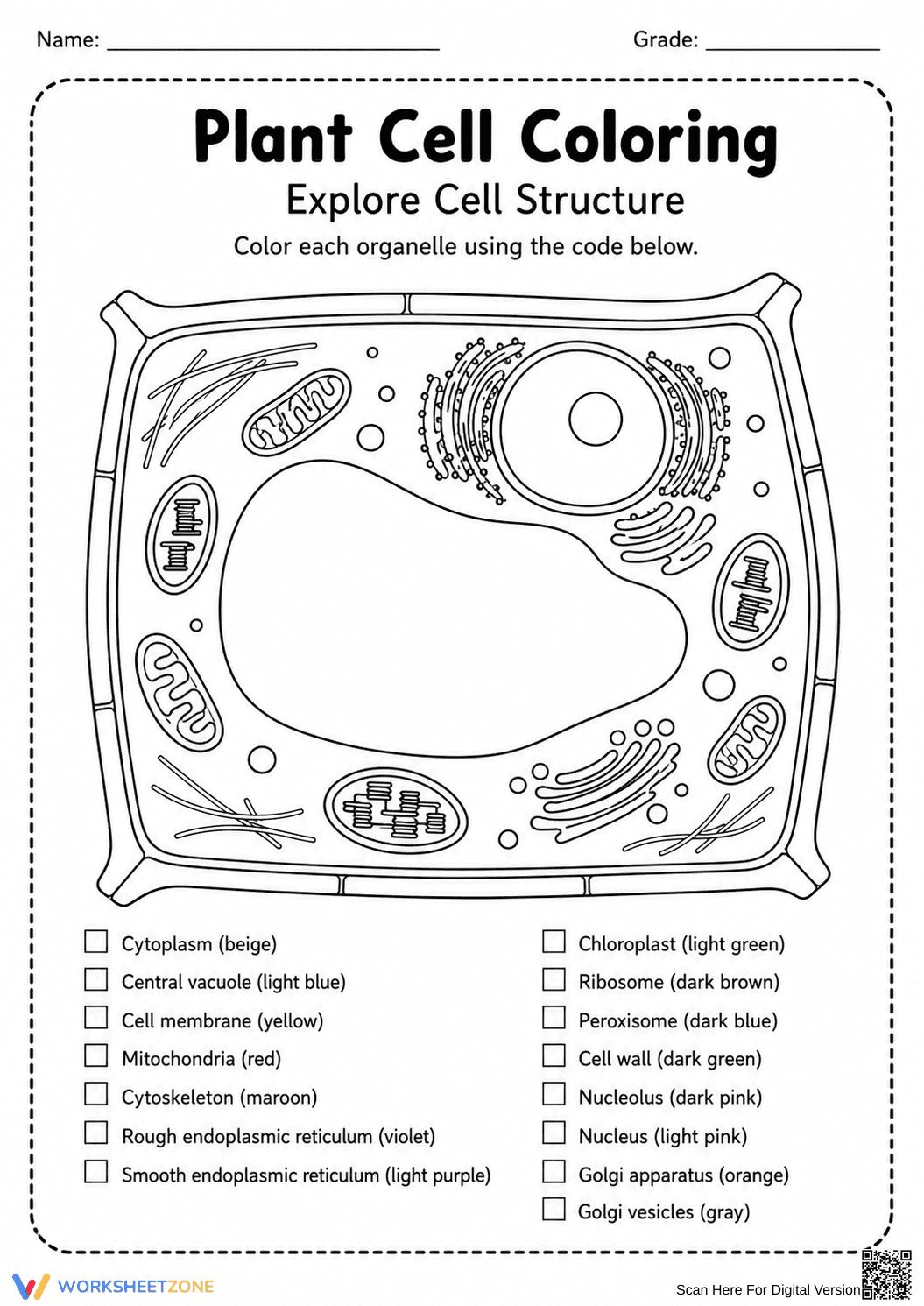
This Grade 8-10 plant cell coloring worksheet helps students master organelle identification through a structured visual model. By mapping 15 specific cellular components to a color-coded key, learners develop a spatial understanding of cell anatomy. This activity ensures students can distinguish between complex structures like the Golgi apparatus and endoplasmic reticulum with high accuracy.
At a Glance
- Grade: 8-10 · Subject: Science
- Standard:
MS-LS1-2— Develop and use a model to describe the function of a cell- Skill Focus: Plant cell organelle identification
- Format: 1 page · 15 problems · Answer key included · PDF
- Best For: Introductory biology lessons and review
- Time: 20–30 minutes
This single-page PDF features a high-resolution diagram of a composite plant cell. It includes 15 distinct tasks where students must locate and color organelles including the central vacuole, chloroplasts, and the cytoskeleton. The worksheet provides a clear checklist with specific color assignments, such as maroon for the cytoskeleton and violet for the rough endoplasmic reticulum, to ensure consistent results and easy grading.
Zero-Prep Workflow
- Print: Generate the single-page PDF for your entire class in under 30 seconds.
- Distribute: Hand out the sheets along with a standard set of colored pencils; no additional setup is required.
- Review: Use the built-in color key to provide immediate visual feedback, taking less than 1 minute per student.
This streamlined process makes the worksheet an ideal choice for emergency sub plans or as a quiet transition activity between lab stations.
Standards Alignment
This resource is aligned to `MS-LS1-2`, which requires students to develop and use a model to describe the function of a cell as a whole and the ways parts of cells contribute to that function. By interacting with the diagram, students build the foundational knowledge necessary for higher-level biological modeling. Both standard codes can be copied directly into lesson plans, IEP goals, or district curriculum mapping tools.
How to Use It
Use this worksheet during the "Explore" phase of a 5E lesson cycle to introduce cell anatomy. It serves as an effective formative assessment tool; teachers can quickly scan the room to see if students are correctly identifying the large central vacuole versus the smaller Golgi vesicles. Expect a completion time of 20 to 30 minutes depending on student detail.
Who It's For
This activity is designed for middle and high school biology students, particularly those who benefit from kinesthetic learning. It is an excellent resource for English Language Learners (ELLs) as it pairs vocabulary terms with visual representations. Pair this with a microscopic observation lab or a cell membrane anchor chart for a comprehensive unit.
According to the RAND AIRS 2024 report on instructional materials, visual modeling activities like coloring diagrams significantly improve the retention of complex anatomical structures in secondary science. This worksheet aligns with the NGSS MS-LS1-2 standard, focusing on the plain-English skill of identifying and modeling the components of a plant cell. Research by Fisher & Frey (2014) suggests that dual-coding—combining linguistic labels with visual representations—reduces cognitive load and helps students move information from short-term to long-term memory. By requiring students to actively select colors for 15 different organelles, this resource moves beyond passive reading to active engagement. It provides a reliable, evidence-based method for mastering the anatomy of the composite cell, making it a staple for any Grade 8-10 science curriculum focused on life sciences and cellular biology.


