




























0
Views
0
Downloads

0.0
0
Save
0 Likes
Share
The Animal Organelles: Explore Cell Structures
0 Views
0 Downloads

Paste this activity's link or code into your existing LMS (Google Classroom, Canvas, Teams, Schoology, Moodle, etc.).
Students can open and work on the activity right away, with no student login required.
You'll still be able to track student progress and results from your teacher account.
Information
Description
What It Is:
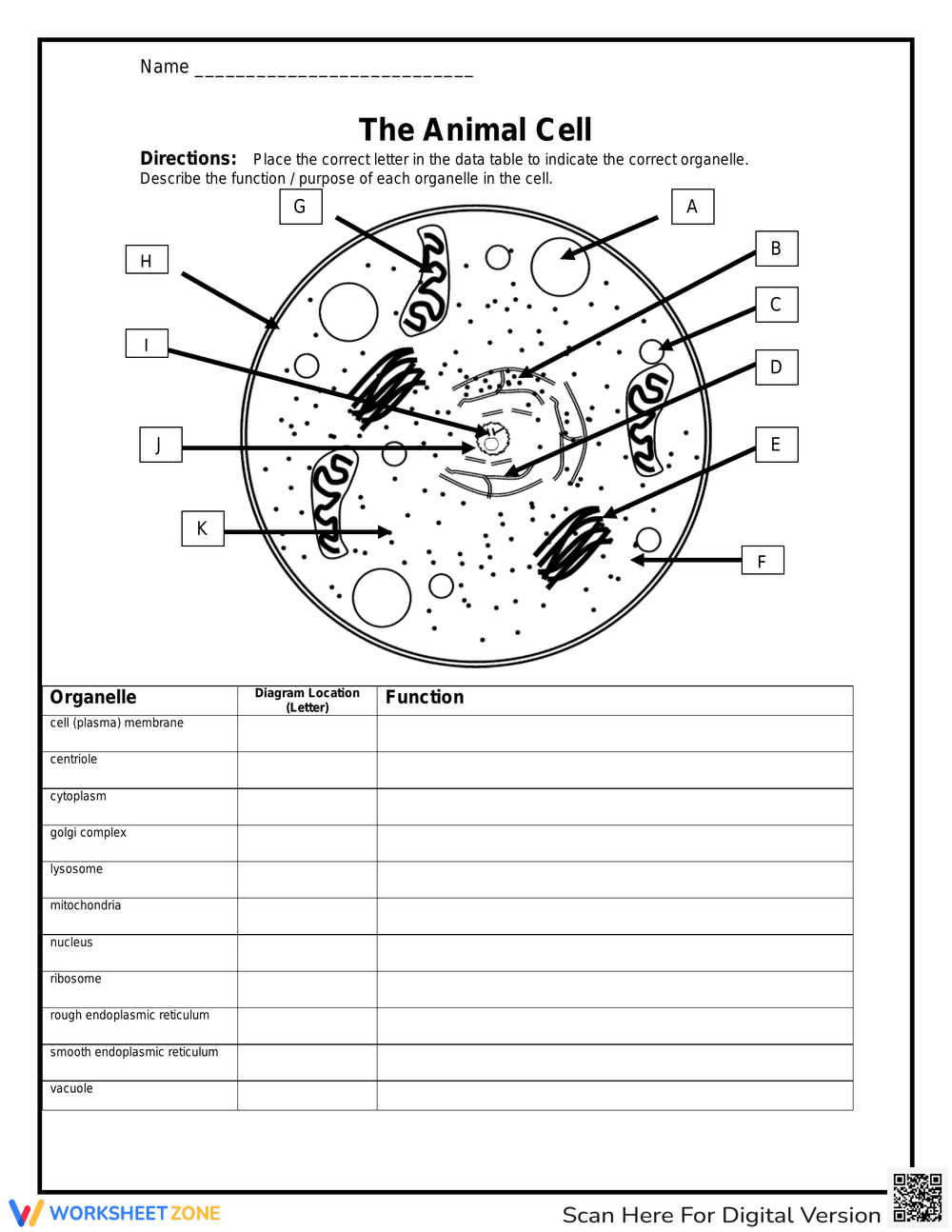
This is a worksheet focused on animal cell anatomy. It features a labeled diagram of an animal cell with organelles marked by letters A through M. Students are instructed to match the letter corresponding to each organelle on the diagram with its name in a table and then describe the function of each organelle. The worksheet includes a table listing organelles such as cell membrane, centriole, cytoplasm, golgi complex, lysosome, mitochondria, nucleus, ribosome, rough endoplasmic reticulum, smooth endoplasmic reticulum, and vacuole.
Grade Level Suitability:
This worksheet is suitable for grades 6-9. It introduces and reinforces the basic structure and function of animal cell organelles, aligning with middle school and early high school biology curricula. The matching and description activities require both identification and understanding of cellular functions.
Why Use It:
This worksheet provides a visual and interactive way for students to learn about the structure and function of animal cell organelles. It promotes critical thinking by requiring students to connect the visual representation of an organelle with its name and function. It also serves as a tool for assessment and reinforcement of key concepts in cell biology.
How to Use It:
Students should first identify each labeled organelle (A-M) on the cell diagram. Then, they should match the correct letter to the corresponding organelle name in the provided table. Finally, they should describe the function or purpose of each organelle in the 'Function' column of the table.
Target Users:
This worksheet is ideal for middle school and early high school students studying cell biology. It can be used by teachers as part of a lesson on cell structure and function, or by students for self-study and review. It is also beneficial for students who learn best through visual aids and hands-on activities.
This is a worksheet focused on animal cell anatomy. It features a labeled diagram of an animal cell with organelles marked by letters A through M. Students are instructed to match the letter corresponding to each organelle on the diagram with its name in a table and then describe the function of each organelle. The worksheet includes a table listing organelles such as cell membrane, centriole, cytoplasm, golgi complex, lysosome, mitochondria, nucleus, ribosome, rough endoplasmic reticulum, smooth endoplasmic reticulum, and vacuole.
Grade Level Suitability:
This worksheet is suitable for grades 6-9. It introduces and reinforces the basic structure and function of animal cell organelles, aligning with middle school and early high school biology curricula. The matching and description activities require both identification and understanding of cellular functions.
Why Use It:
This worksheet provides a visual and interactive way for students to learn about the structure and function of animal cell organelles. It promotes critical thinking by requiring students to connect the visual representation of an organelle with its name and function. It also serves as a tool for assessment and reinforcement of key concepts in cell biology.
How to Use It:
Students should first identify each labeled organelle (A-M) on the cell diagram. Then, they should match the correct letter to the corresponding organelle name in the provided table. Finally, they should describe the function or purpose of each organelle in the 'Function' column of the table.
Target Users:
This worksheet is ideal for middle school and early high school students studying cell biology. It can be used by teachers as part of a lesson on cell structure and function, or by students for self-study and review. It is also beneficial for students who learn best through visual aids and hands-on activities.


