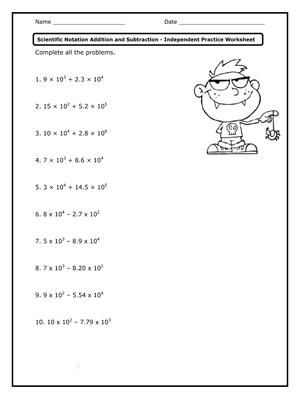
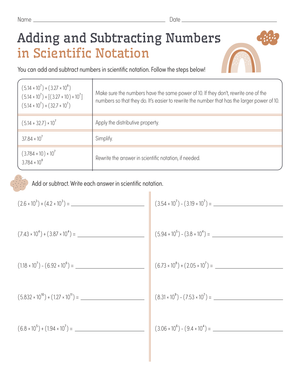
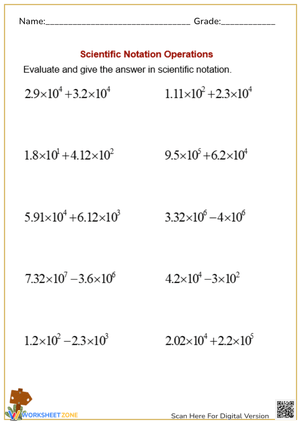
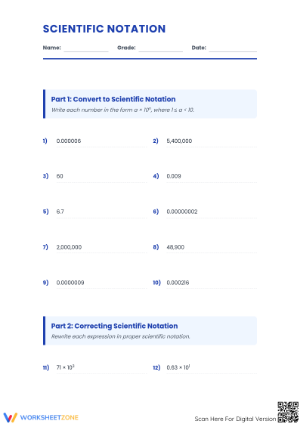
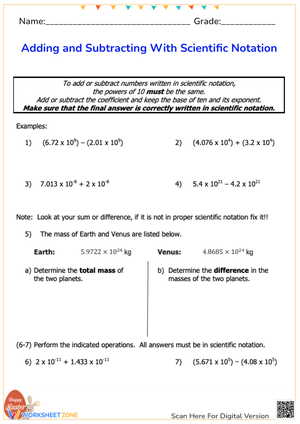
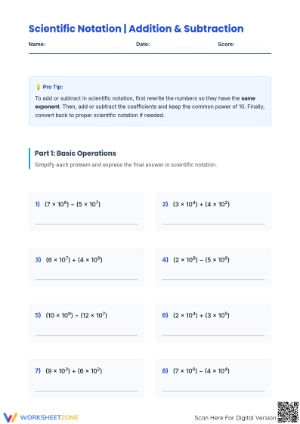
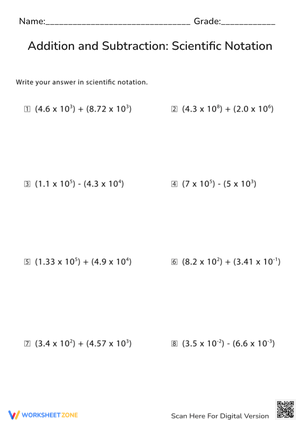
These adding and subtracting scientific notation printable worksheets for 8th grade target the single most common procedural breakdown at this level: students who handle multiplication in scientific notation confidently will still add the exponents when a problem calls for a sum. The set focuses on the match-first process — rewriting one or both values so the powers of 10 align before coefficients are combined — and carries that work through to the renormalization step, where a surprising number of students leave an answer that looks right but is not in proper scientific notation.
Skills Each Worksheet Builds
The set addresses three distinct tasks that must happen in sequence. Students first work on converting between equivalent forms — rewriting a number so its exponent changes while its value stays the same — before any addition or subtraction appears. This matters because the equivalence logic is the heart of the operation, and students who skip past it make the same rewrite error on every problem. A second group of worksheets presents problems with one term already adjusted, so students practice combining coefficients and checking whether the result falls within the required range — a coefficient of 1 to less than 10. The final worksheets require full independent work: choose which term to rewrite, complete the operation, and renormalize if needed.
- Rewriting numbers to equivalent forms with matching powers of 10
- Adding and subtracting coefficients after exponents align
- Renormalizing results that fall outside proper scientific notation range
- Distinguishing addition and subtraction rules from multiplication and division rules
- Estimating whether a computed result is reasonable in size
Student Mistakes Worth Catching Before They Harden
Scientific notation addition and subtraction surface predictable errors, which makes them easier to address systematically. The most common is treating the exponents the same way students treat a multiplication problem: they add or subtract them instead of matching them first. A student who adds 4.1 × 10 to the 3rd and 2.3 × 10 to the 5th and arrives at 6.4 × 10 to the 8th has applied the product rule to a sum problem. That error reflects a genuine rule confusion — not carelessness — and requires explicit contrast between the two operation types, not just more repetition of the same kind of practice.
A second cluster involves the rewrite itself. Students who know they must adjust one term will sometimes change the exponent without adjusting the coefficient proportionally. A student might rewrite 5.0 × 10 to the 4th as 0.5 × 10 to the 4th — editing only the coefficient — instead of moving to 0.5 × 10 to the 5th, changing the original value entirely. Subtraction problems compound this further: sign errors and decimal placement mistakes layer on top of the rewrite step, and students rarely identify where their process broke down without workspace that separates each phase.
Standard Alignment
CCSS 8.EE.A.4 requires students to perform operations with numbers expressed in scientific notation, including problems where they must interpret the size of results in context. The standard sits within the Expressions and Equations domain and builds directly on 8.EE.A.3, where students first learn to read and write scientific notation. Instructionally, addition and subtraction typically arrive in the second or third week of an exponent unit — after students can reliably convert numbers into proper form but before the unit extends into measurement or real-world data applications. The sequence in this set follows that placement precisely, opening with conversion practice before operations appear.
Building These Worksheets Into Your Lesson Plan
Short sets work well for the ten-minute opening block — three or four rewrite-and-solve problems as a bell ringer give students enough repetition to solidify the sequence without slowing the rest of the period. For first instruction, a brief two-problem whole-group example followed immediately by worksheet practice is more effective than an extended explanation. Students who are still forming the procedure lose it quickly if there is a long transition between the modeled example and their first independent attempt.
Adding and subtracting scientific notation printable worksheets for 8th grade also fit naturally into a spiral review rotation. Students often master the procedure during the original lesson but confuse it with multiplication rules a week later, when multiple exponent skills are active at once. A short recurring worksheet — used once during an otherwise unrelated unit — keeps the distinction sharp without requiring a full reteaching block. For small-group intervention after an assessment, a reduced-problem worksheet with labeled workspace for each step (match exponents, operate, check final form) helps isolate exactly where the process breaks down for individual students.
Adjusting Each Worksheet for a Range of Learners
The most useful differentiation targets the specific step causing difficulty rather than simplifying the entire worksheet. Students who struggle with the rewrite step benefit from a version that names the target exponent — "rewrite so both terms use 10 to the 4th" — so they can practice adjusting the coefficient without also deciding which power to use. Students working at grade level get mixed-exponent problems and choose their own rewrite strategy. Students ready for extension work with brief contextual problems — comparing the masses of two celestial bodies, for example — where they must also interpret which quantity is larger and by roughly how much.
Layout adjustments matter too. Students who need more support work through labeled steps: rewrite, combine, check final form. Students closer to fluency solve in a compact format without those labels. This keeps the mathematical expectations consistent while reducing the working-memory load for students who have not yet made any part of the process automatic.
Frequently Asked Questions
Do students need to be comfortable with multiplication in scientific notation before using these worksheets?
Not necessarily. Addition and subtraction in scientific notation depend on place-value reasoning and understanding of equivalent forms, not on prior fluency with products. Students who have worked with scientific notation in any form will find the opening conversion problems easier to enter, but the step-by-step sequence in the set works even for students relatively new to the notation. Teachers introducing the topic cold may want to spend a few minutes reviewing how changing the exponent requires an inverse adjustment to the coefficient before students begin the first worksheet.
When in an exponent unit do these worksheets fit best?
Most 8th grade units sequence integer exponents first, then scientific notation reading and writing, then multiplication and division, then addition and subtraction. These worksheets fit best at the addition-and-subtraction stage — after students can reliably write numbers in proper form but before the unit moves into real-world applications. Introducing adding and subtracting scientific notation printable worksheets for 8th grade before students have the notation basics produces coefficient errors that look like operation errors, which muddies assessment data and makes it harder to identify the actual instructional gap.
How should teachers handle the renormalization step in grading?
Treat it as a separate skill from the operation itself. A student who matches exponents correctly, adds coefficients correctly, and arrives at 13.4 × 10 to the 3rd has done the addition right — they have not finished the notation. Marking the process correct and the final form incomplete gives students clearer information than marking the whole problem wrong. That distinction also prevents students from concluding they do not understand the operation when the only issue is a formatting step at the end.
How well do these worksheets work for test review?
They work well as targeted practice in the days before an end-of-unit assessment. For timed review aligned to test conditions, remove the step prompts so students work in a format closer to what they will see on the actual exam. The focused, single-skill format of adding and subtracting scientific notation printable worksheets for 8th grade makes them more efficient for review than a broad mixed-topic set when the goal is reinforcing this specific procedure — especially for students whose only remaining gap is the match-first step or the renormalization check at the end.













 Interactive Worksheet Maker
 Quiz Maker
 Word Search Maker
 Crossword Puzzle Maker
 Word Scramble Generator
 Sentence Scramble Generator
 Handwriting Worksheet Generator
 Name Tracing Generator
 Fill In The Blank Generator