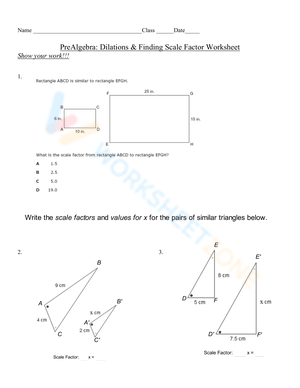
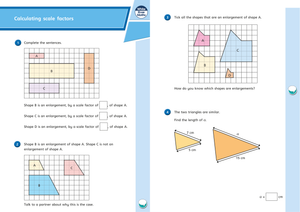
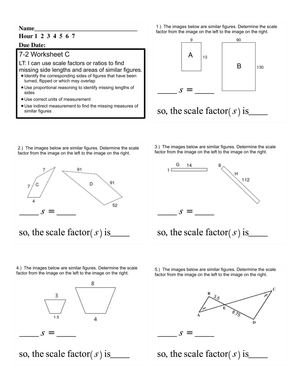
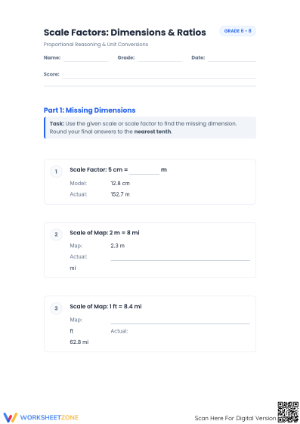
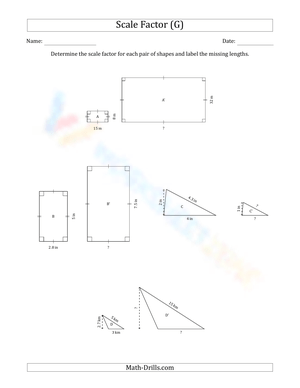
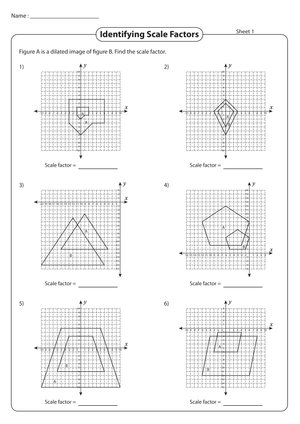
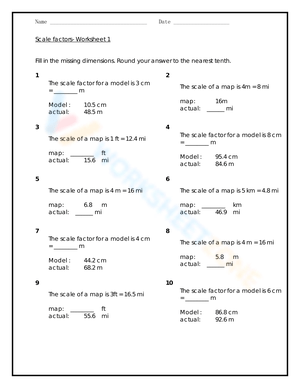
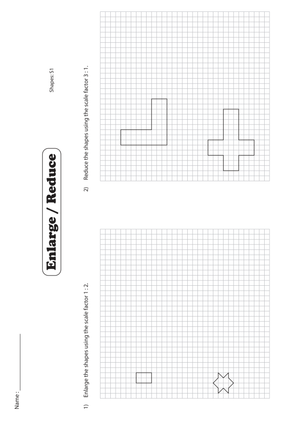
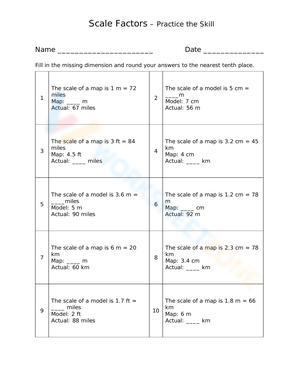
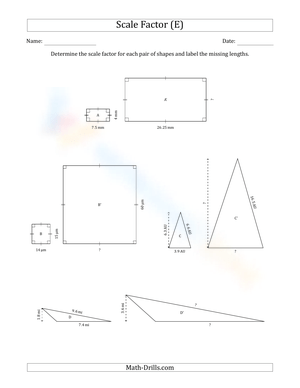
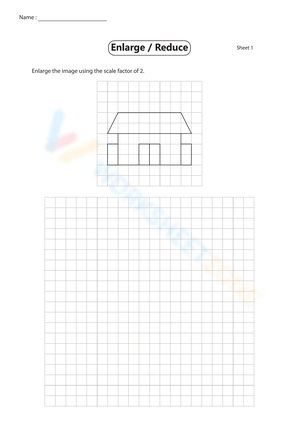
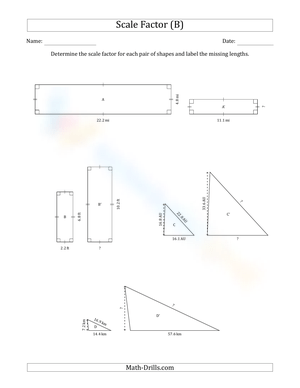
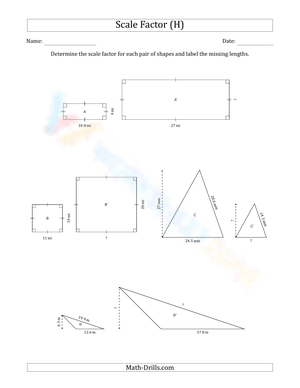
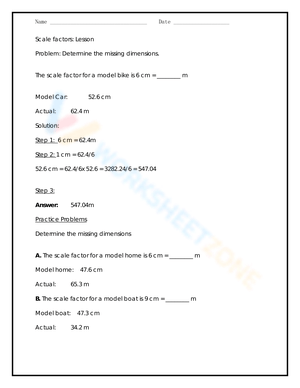
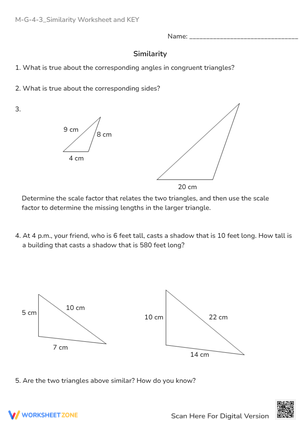
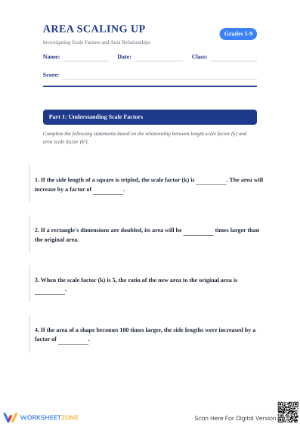
These 8th grade scale factor worksheets give teachers a ready-built set of geometry practice that spans three connected skill areas: computing scale factors from paired polygons, solving for missing side lengths in similar figures, and analyzing dilations on the coordinate plane. The resources fit naturally into the stretch of a Grade 8 geometry unit where students need concentrated repetition before the connections between scale factor, similarity, and slope start to feel coherent.
Skills These Worksheets Build
Each worksheet targets a specific layer of the scale factor progression rather than piling every problem type into a single drill. The task sequence moves from direct ratio work to missing-side reasoning to coordinate-grid dilations — the same order most 8th-grade teachers follow during instruction.
- Find the scale factor between two similar polygons using labeled corresponding side lengths.
- Determine whether a dilation produces an enlargement (scale factor greater than 1) or a reduction (scale factor greater than 0 and less than 1).
- Calculate missing side lengths when one polygon is a scaled copy of another.
- Plot dilations from a given center and record the coordinates of the resulting image.
- Explain, using side-length ratios, why two figures are or are not similar.
Separating problem types across individual worksheets also makes the set useful for diagnostic work. A student who handles ratio problems cleanly but stalls on grid-based dilations is showing you something specific — not a general struggle with scale factor, but a gap in how coordinate reasoning and transformation language connect for them.
Scale Factor Errors That Surface Early and Often in Student Work
The most consistent mistake we see when students work through 8th grade scale factor worksheets involves direction: students divide sides in the order image over pre-image when the problem calls for the reverse, landing on the reciprocal of the correct scale factor. With whole-number side lengths, the wrong answer looks numerically plausible — a scale factor of 3 versus one-third — and students move on without flagging it. Asking them to draw a labeled arrow from the pre-image to the image before writing any ratio catches most of that.
Missing-side problems produce a second reliable pattern. Students set up a proportion but match sides without verifying correspondence. A triangle with sides 6, 8, and 10 paired with a scaled copy drawn at a different orientation will catch students who pair the longest side of one figure with the shortest of the other. A quick routine of underlining corresponding pairs with matching colors, before any calculation begins, cuts those errors significantly.
On coordinate-grid worksheets, expect some students to apply the scale factor to only one coordinate. A student dilating the point (4, 6) by a scale factor of 2 from the origin will sometimes write (8, 6) — the x-value doubled, the y-value untouched. That error tells you the student is thinking about horizontal stretching rather than the full geometric transformation. A short exit question asking students to describe in words what happened to the distance from the origin usually surfaces this before it gets practiced into a habit.
Fitting These Worksheets Into Your Planning Week
Short tasks from this set work well as bell work during the opening days of a dilations unit. While you circulate and check homework, students can work through three or four ratio problems that reactivate the proportional reasoning they'll need before you get to new content. That routine also tells you quickly whether the class is ready to move to grid work or needs another day on similar figures and side-length ratios.
During partner work after a mini-lesson, a worksheet that mixes ratio tasks with a coordinate-grid problem gives students a chance to connect what you just demonstrated to skills they already practiced. The format shift — numeric computation followed by spatial reasoning — tends to generate real conversation, and listening to partner exchanges during that block often reveals more about understanding than reading finished answers does.
For homework, the 8th grade scale factor worksheets format holds up well because the work is visible at every step: students show the ratio, set up the proportion or scale multiplication, and record the result. A family member can follow the logic without knowing the curriculum, and a student who gets stuck can usually identify exactly which step lost them rather than confronting a blank answer line.
Standard Alignment
The resources connect directly to CCSS 8.G.A.4, which asks students to describe sequences of transformations that produce similar figures and to explain what dilations do to two-dimensional shapes. In classroom terms, this standard sits at the intersection of transformation work and proportional reasoning. Students are not just solving ratio equations — they are describing geometric change. Worksheets that pair numeric scale factor problems with coordinate-grid dilations address both sides of that expectation in the same assignment.
There is also a useful connection to CCSS 8.EE.B.5 for teachers building coherence across the year. Students who understand that a dilation multiplies every distance from the center of dilation by a constant factor carry a ready mental model into slope work, where a constant rate of change drives a similar multiplicative relationship. Running a few scale factor worksheets before you begin the slope unit reinforces that link without requiring a separate lesson to establish it.
Calibrating the Set for Students at Different Points in the Progression
For students who are still shaky on proportional reasoning, the ratio-only worksheets are the right entry point. Assign two or three items that provide both figures with all side lengths labeled, so the only task is dividing corresponding sides correctly. Hold the missing-value and coordinate-grid problems until those students can reliably find the scale factor from complete information. That narrowed scope keeps the cognitive demand at one step rather than asking students to juggle ratio setup, correspondence identification, and spatial reasoning simultaneously.
Students who are comfortable with the ratio mechanics benefit most from the grid-based worksheets and from problems that require a written explanation. Asking a student to write one sentence — "this is a reduction because the scale factor is three-fourths, which is less than 1" — takes thirty seconds and tells you far more about conceptual understanding than a numeric answer alone. Strong finishers can create their own dilation on a blank coordinate grid, record pre-image and image coordinates, and calculate the scale factor as a self-checking extension.
Frequently Asked Questions
What should 8th graders be able to do with scale factor by the end of the unit?
By the end of instruction, students should identify scale factor from paired figures, compute missing side lengths, classify dilations as enlargements or reductions, and apply scale factor on the coordinate plane. They should also be able to explain, not just calculate — articulating why two figures are similar or what a given scale factor tells you about the size change from pre-image to image.
How many problems does each worksheet contain?
Each worksheet focuses on one layer of the skill progression — ratios, missing sides, or coordinate-grid dilations — and includes enough problems for roughly 15 to 20 minutes of focused work. That length suits a warm-up block, a short independent practice segment, or a take-home assignment without requiring teachers to cut items to fit the lesson.
Are answer keys included?
Yes. Each worksheet comes with a corresponding answer key. During stations or intervention, having the key available lets you conference with a student in real time, check their setup and steps, and move on — rather than spending the following day grading before you know who needs reteaching.
Can these worksheets help students who missed earlier instruction on similar figures?
The ratio-focused resources in this collection are accessible to students with gaps in prior similar-figure instruction. The 8th grade scale factor worksheets in this set open with side-length comparisons that require only a working understanding of what "corresponding sides" means — no prior exposure to dilation vocabulary is assumed. Later worksheets build toward transformation language and coordinate reasoning, giving students a path forward without presupposing mastery of everything that typically precedes 8th-grade geometry.













 Interactive Worksheet Maker
 Quiz Maker
 Word Search Maker
 Crossword Puzzle Maker
 Word Scramble Generator
 Sentence Scramble Generator
 Handwriting Worksheet Generator
 Name Tracing Generator
 Fill In The Blank Generator