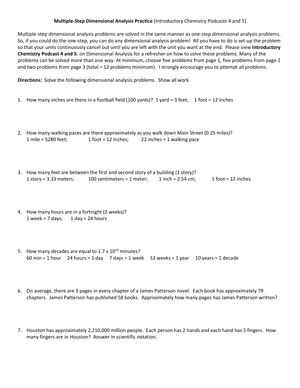
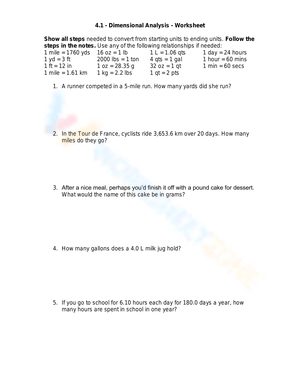
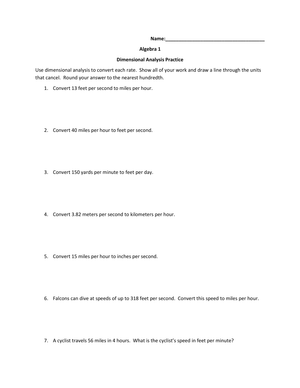
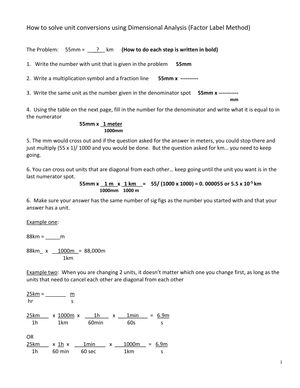
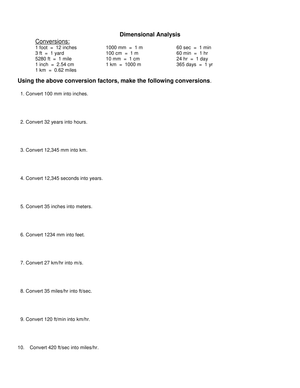
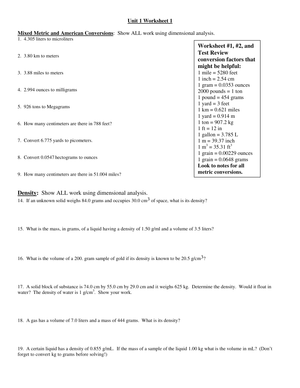
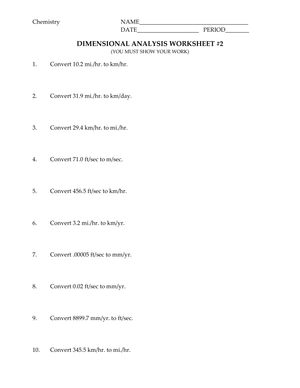
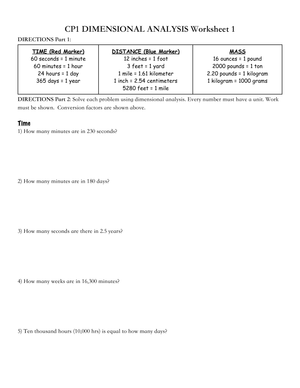
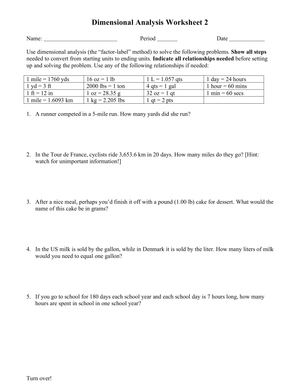
These 8th grade dimensional analysis printable worksheets give teachers a ready-to-use set for the specific moment in middle school when "just move the decimal" stops working — when problems involve rates, multi-step conversions, and unit relationships that guesswork can't untangle. The factor-label method gives students a visible procedure: start with the given quantity over 1, multiply by a unit ratio arranged so the unwanted unit cancels, and confirm that what remains is the target unit. When students do that reliably on paper, errors become diagnosable before the arithmetic even starts.
The Specific Skills Each Worksheet Targets
These 8th grade dimensional analysis printable worksheets cover the full span of conversion tasks Grade 8 teachers need, from basic one-step metric problems through multi-step rate conversions. Early worksheets concentrate on single-system practice — changing centimeters to meters, milligrams to grams — so students can build the habit of writing the conversion fraction before touching the arithmetic. When the number relationships are familiar, students put their cognitive energy into the setup rather than into recalling how many grams are in a kilogram.
Mid-level worksheets bring in customary units and require students to choose the correct ratio without being given it. Problems cover length, mass, volume, and time. That combination forces students to decide which relationship applies — not just execute a memorized step. The real skill development happens here, in the selection and orientation of the conversion factor, not in the multiplication that follows.
The most demanding worksheets introduce rate conversions and two-step problems. Converting miles per hour to feet per second requires two separate conversion factors applied in sequence, with units canceling at each step. These problems make the method matter in a way that single-step problems cannot: students who have been skipping the written setup run into trouble immediately and can see exactly why the structure exists.
- Metric conversions: single-step problems using powers of ten, with emphasis on writing the unit fraction correctly before calculating.
- Customary conversions: length, mass, volume, and time with less predictable number relationships.
- Mixed-unit practice: problems drawing from both systems so students identify the relevant relationship independently.
- Word problems: real-world contexts including travel speed, recipe scaling, and map distance.
- Rate conversions: multi-step problems requiring two conversion factors in sequence.
- Error analysis items: worked examples with deliberate mistakes that students locate and correct.
Every worksheet includes enough work space for students to write each conversion factor on a separate line, cross out the canceled units, and box the final answer with its unit label. That format makes teacher review fast: one glance at the setup line shows whether an error was conceptual or arithmetic.
Building These Worksheets Into the Week Without Disrupting Your Pacing
The most natural entry point is the bell ringer. Two one-step problems at the start of class take five to eight minutes and keep the method fresh during a unit that may span two or three weeks. After the initial lesson, assign a same-topic worksheet — metric only, or customary only — while the structure is still in working memory. That same-day follow-up does more for retention than sending home a mixed-practice worksheet the same night.
For partner work during instruction, the mixed-practice worksheets run well as a structured pair activity. Each student solves independently, then the pair must agree on a single written setup before comparing answers. That discussion step surfaces orientation errors that solo checking misses. The student who wrote inches over feet when the problem required feet over inches often doesn't notice until a partner asks why the units didn't cancel.
The multi-step and rate worksheets are most productive once the basic setup is automatic. Assign them as independent practice in the second half of a unit or as a Friday review block when students can work at their own pace and revisit earlier steps. The real-world contexts — speed, measurement comparison, scale — also connect naturally to concurrent science content, which makes these worksheets worth sharing with a science colleague if your school uses cross-curricular planning time.
One classroom habit worth building from the first day of instruction: require students to cross out canceled units physically on every line, not just at the end. That mark takes two seconds and is visible from across the room during a circulating pass. Students who skip it almost always have an orientation error hiding in the setup.
Student Errors Worth Anticipating Before You Teach the Lesson
The single most common setup error is writing the conversion factor in the wrong orientation. A student converting 3 hours to minutes will write 1 hour over 60 minutes rather than 60 minutes over 1 hour — the units multiply instead of cancel, and the result is a number that looks plausible but is wrong by a factor of 3,600. The student often doesn't catch it because the arithmetic still produced a number. Teaching students to verify unit cancellation before calculating, not after, eliminates this category of error almost entirely.
A second pattern shows up in students who are strong at mental math. They can often solve one-step metric problems without writing the conversion factor at all, and they resist the written setup because it feels unnecessary. That resistance is manageable for simple problems but breaks down hard on rate conversions, where mental shortcuts fail and the only reliable path is the full written method. Assigning a few multi-step problems early — before students have decided the setup is optional — lets them see the method's purpose when it actually matters.
There is also a labeling gap that appears even in accurate work. Students who calculate correctly sometimes write "the answer is 2,640" without a unit. In dimensional analysis, the unit is part of the answer — a number without a unit is an incomplete response. A printed prompt on each worksheet ("write the unit with every answer") handles this without turning it into a separate lesson, and it reinforces the broader point that dimensional analysis tracks quantities, not just numbers.
Standard Alignment
These worksheets build directly on CCSS 7.RP.A.1 (computing unit rates associated with ratios of fractions) and 7.RP.A.2 (recognizing and representing proportional relationships), which form the conceptual base students carry into Grade 8. The conversion work here extends those ratio skills into CCSS 8.EE.B.5 territory, where students interpret unit rates graphically and connect them to slope. For science teachers coordinating with math departments, the reasoning maps to NGSS Crosscutting Concept 3: Scale, Proportion, and Quantity, which expects students to use ratio reasoning to convert measurement units and solve real-world problems. In classroom terms, this is a recurring prerequisite — not a standalone unit — that reappears every time a rate, a formula, or a measurement comparison shows up across the full Grade 8 year.
Adjusting the Set for a Range of Learner Readiness
Most Grade 8 classrooms hold students at genuinely different starting points with unit conversion. Some enter with solid metric fluency from 7th grade science. Others reverse the factor orientation on nearly every problem and haven't internalized why one arrangement works and the other doesn't. The same worksheet set can serve both groups when teachers make deliberate choices about which problems to assign and what support to provide alongside them.
For students who need more structure, start with metric-only worksheets and provide a small reference table listing the conversion relationships. The goal is to put all cognitive effort on the setup process — choosing and orienting the conversion fraction — rather than on recalling that 1 mile equals 5,280 feet. A partially completed first problem, showing the original quantity placed over 1 and the first conversion fraction written out, gives students a model to follow without revealing the answer.
On-level students work through mixed-unit problems and select conversion factors independently. Word problems belong here: students must read a sentence, identify the given unit, name the target unit, and then build the conversion without the problem handing them the structure. That reading-to-setup step is often where mid-level students lose points on assessments, and consistent word problem practice builds it directly.
For students ready to go further, 8th grade dimensional analysis printable worksheets that include rate conversions and two-step problems present genuinely harder reasoning without changing the core method. Converting miles per hour to feet per second, or grams per liter to milligrams per milliliter, requires tracking two separate cancellations simultaneously. Assigning two or three of these as optional challenge items during independent practice keeps pacing flexible for the rest of the class.
One tradeoff worth naming: strong mental calculators sometimes find the written factor-label format tedious for problems they can solve in their heads. A direct conversation — "the structure protects you when the problem has three steps, not one" — tends to work better than requiring the full written setup for every simple problem.
Frequently Asked Questions
Do these worksheets cover metric units, customary units, or both?
Both. Metric problems appear first because powers of ten reduce the cognitive load while students focus on the setup. Customary problems follow, requiring careful work with relationships like 5,280 feet per mile or 16 ounces per pound that don't follow a base-ten pattern. The mixed-unit worksheets draw from both systems so students apply the same method regardless of which unit family the problem uses.
Can the same worksheet be used in math and science classes?
Yes. The factor-label method transfers without modification. The same reasoning students use to convert kilometers to meters in math applies directly to density, speed, and concentration problems in science. Teachers who coordinate with science colleagues sometimes distribute these as shared resources during weeks when both classes are working with measurement.
At what point in a unit should the harder worksheets be introduced?
Assign single-system and same-type problems first — those belong in the first two or three lessons. Mixed-unit and word problem worksheets fit well in the middle of the unit, after students can set up a basic conversion without prompting. Save rate conversions and two-step worksheets for the final third of the unit or for review before an assessment. Using 8th grade dimensional analysis printable worksheets across this full progression — not only as end-of-unit review — builds the method into working memory so it doesn't fade between the lesson and the test.
How much work space do students actually need?
More than most worksheet formats provide. Each step of a multi-step conversion needs its own line: the starting quantity, the first conversion fraction, the second if needed, and the final answer with its unit. Students who compress everything onto one line almost always drop a unit label somewhere. Worksheets with generous vertical space consistently produce more accurate work — not because students are more careful, but because the layout makes careful work easier to produce.













 Interactive Worksheet Maker
 Quiz Maker
 Word Search Maker
 Crossword Puzzle Maker
 Word Scramble Generator
 Sentence Scramble Generator
 Handwriting Worksheet Generator
 Name Tracing Generator
 Fill In The Blank Generator