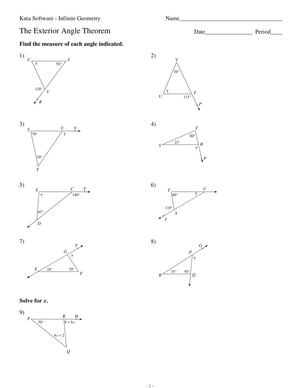
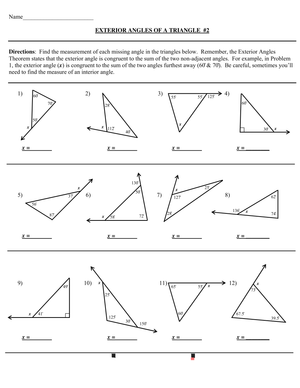
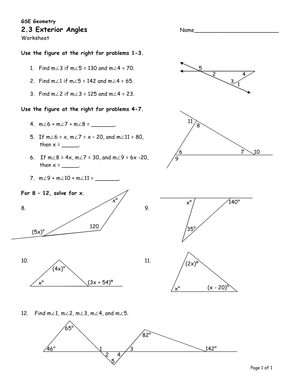
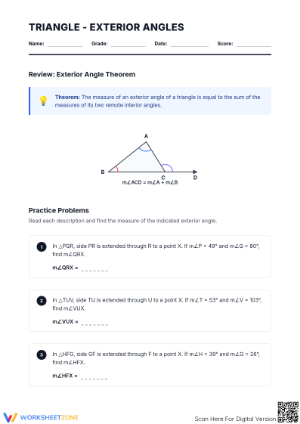
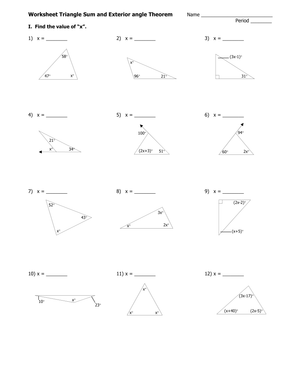
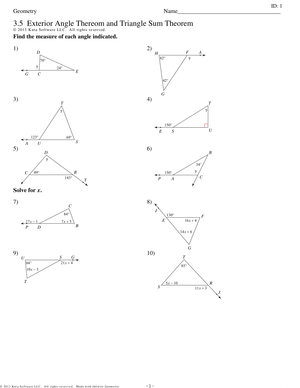
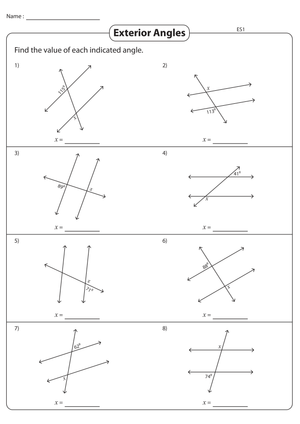
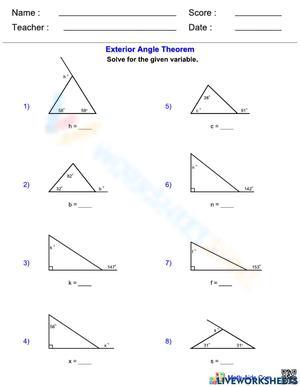
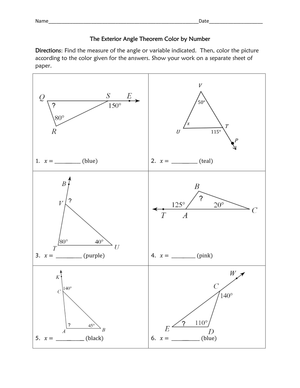
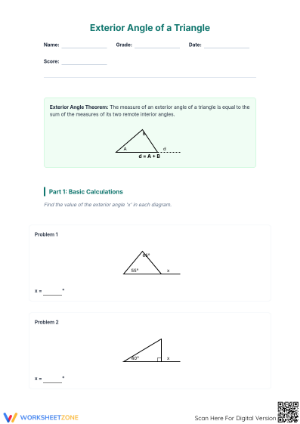
These 8th grade exterior angle theorem worksheets resources target one of the cleaner but easily misapplied relationships in Grade 8 geometry: the exterior angle of a triangle always equals the sum of its two remote interior angles. The set gives teachers a ready-to-print sequence that moves from direct numeric identification to algebraic equation solving, without requiring any additional prep or supplementary materials.
What Students Work Through in Each Worksheet
The entry point is identification. Before any computation, students locate the exterior angle and distinguish the two remote interior angles from the adjacent interior angle sitting right next to it. That step alone eliminates a surprisingly large portion of the errors we see in student work — not calculation errors, but figure-reading errors that lead to consistently wrong answers.
From there, each worksheet moves into direct computation. Students use known angle measures to find an unknown exterior angle, or reverse the relationship: given the exterior angle and one remote interior angle, they subtract to find the other. That second direction matters because it pushes students to see the theorem as a flexible relationship rather than a rule that only runs one way.
The algebraic layer is where Grade 8 geometry and equation solving genuinely converge. Problems at this level present expressions such as (3x + 10) for the exterior angle and (x + 4) and (2x + 6) for the two remote interior angles. Students write an equation, solve for x, then substitute back — and that final substitution step is where many students stop prematurely, handing in x as the answer rather than the actual angle measure. The set builds toward multi-step problems where both the triangle angle sum and the exterior angle theorem appear in the same figure, requiring students to choose the right relationship rather than apply the same strategy reflexively.
Student Mistakes Worth Anticipating Before the Lesson
The single most predictable error is angle misidentification. Students add the adjacent interior angle — the supplementary partner of the exterior angle — to one of the remote interior angles, producing a sum that exceeds 180°. They often notice the answer looks wrong without being able to name why. In standard upright orientations, students catch this error faster. Rotate the triangle 90° or flip it, and students who seemed solid suddenly reach for the wrong angle every time. Varying triangle orientation across the set surfaces that instability early, while there is still time to address it.
A second pattern appears specifically in algebraic problems. Students correctly write the equation and correctly solve for x, then record x as their final answer — skipping the substitution back into the original expression to find the degree measure. This is not a theorem misunderstanding; it is a multi-step problem management issue. Requiring students to underline the actual question — "find the measure of angle B," not "find x" — reduces this error more reliably than re-teaching the theorem itself.
There is also a vocabulary gap worth addressing directly. "Remote interior" appears in Grade 8 for the first time, and many students initially interpret "remote" as "across from the exterior angle," which leads them to select only one angle instead of two. Connecting "remote" to "far from the exterior angle" — and having students physically mark both far angles with a pen before computing — establishes the term as a functional label rather than an abstract one.
Building These Worksheets Into Your Geometry Unit
A two-day opening sequence works well. Introduce the theorem with a brief direct lesson on day one, then use the numeric identification worksheet as a whole-class activity the same day. On day two, open with three bell-work problems: students mark the exterior angle, circle the remote interior angles, then compute. That warm-up routine builds a visual checking habit before independent work begins, and it takes about six minutes — short enough to preserve full instruction time.
For partner work, a structure that holds students accountable: one partner annotates the diagram and identifies the relevant angles, the other writes and solves the equation. They switch roles after every two problems. This format slows impulsive answer-copying and gives students a reason to say the theorem aloud, which deepens retention more than silent written practice alone.
These 8th grade exterior angle theorem worksheets resources also fill the last ten minutes of a geometry class effectively. Two or three algebraic problems give enough formative information to sort students into small groups for the next day without consuming significant instruction time.
Station rotation fits this topic cleanly. One station runs direct numeric problems, a second uses variable expressions, and a third presents mixed-review triangles where students must decide whether to apply the exterior angle theorem, the triangle angle sum, or both. That third station is the most diagnostic: students who apply the same strategy to every figure without reading the problem carefully will show that habit immediately, and you will know exactly who needs a follow-up conversation.
Standard Alignment
These worksheets align directly with CCSS 8.G.A.5, which asks students to use informal arguments to establish facts about angle relationships in triangles, including the exterior angle. The standard specifically expects students to explain the reasoning — not just compute — which is why the algebraic and multi-step problems in this set matter instructionally. Writing an equation from a labeled diagram is the informal argument the standard describes. In most 8th grade courses, this topic lands mid-year, after students have built fluency with one-variable equations and are ready to apply algebraic reasoning to visual geometric contexts. That placement makes the algebraic problems on these worksheets a natural extension of work students have already begun.
Adjusting the Set for a Range of Student Readiness Levels
The theorem stays the same for every student — what changes is the complexity of the entry point and the number of steps required to reach the answer.
- Students who need more support: Start with large, clearly labeled diagrams where both remote interior angles carry whole numbers and only the exterior angle is missing. Add a printed prompt at the top of each worksheet: Step 1: Mark the exterior angle. Step 2: Circle the two remote interior angles. Step 3: Write the equation and solve. That three-step structure reduces the cognitive load of holding the procedure in memory while also doing geometry.
- On-level students: Mix direct computation with single-variable equations. The transition from reading a numeric relationship to writing an algebraic one is the target skill — problems should build toward constructing equations, not just solving ones already written out.
- Students ready for more challenge: Assign multi-step problems that combine the exterior angle theorem with the triangle angle sum in the same figure, or problems where the exterior angle expression requires simplification before it can be set equal to the sum of the remote interior angles.
- Intervention groups: Reduce the problem count and add annotation requirements. Finishing six problems correctly — with all angle labels marked and all work shown — builds more durable understanding than rushing through fifteen.
Teachers can also vary the delivery without changing any content. Some classes work through an entire worksheet independently; others complete the first three or four problems as a guided group before splitting off to work alone. The printable format supports both approaches without modification.
Frequently Asked Questions
Do these worksheets include algebraic problems, or only direct angle calculations?
The set includes both. Earlier problems use whole-number angle measures to establish identification and computation fluency. Later problems introduce variable expressions, requiring students to write equations, solve for x, and substitute back to find the actual angle measure — the full multi-step process that 8th grade geometry standards call for.
What is the exterior angle theorem in language students can use?
The exterior angle of a triangle equals the sum of its two remote interior angles — the two angles that are not next to the exterior angle. A version students tend to hold onto: the outside angle equals the two far-away inside angles added together. Having students write their own version of the rule before applying it to a diagram closes the gap between being able to state the theorem and being able to use it on a rotated or unfamiliar figure.
How does the set handle triangle orientation?
Varying triangle orientation across the set is essential. Students who only see upright triangles will often misidentify remote interior angles the moment a figure is tilted or reflected. The problems distribute different orientations throughout rather than fixing one standard view, which means errors from orientation confusion appear during practice — where they can be addressed — rather than on a quiz.
Are answer keys included?
Yes. Answer keys support teacher grading, student self-correction, and partner checking after practice. For algebraic problems especially, the key should show both the value of x and the final angle measure separately — because confirming only one without the other misses the most common stopping-point error in Grade 8 work.
Can these work in a class where students are also shaky on pre-algebra?
The 8th grade exterior angle theorem worksheets set is genuinely useful in classes where algebra and geometry are developing at the same time. Students who struggle with equation solving will hit difficulty on the algebraic problems — but the specific errors they make (not distributing correctly, combining unlike terms, stopping at x) reveal algebra gaps that can be addressed directly. The geometry worksheet becomes a dual-purpose formative tool rather than a single-skill check.
How many problems make sense in a single practice session?
Six to ten problems is usually enough for a focused exterior angle session, depending on whether the problems are numeric or algebraic. More problems rarely produce more learning when students rush through without annotating diagrams or showing steps. Fewer problems with visible work requirements give a cleaner picture of understanding and take less time to review as a class. These 8th grade exterior angle theorem worksheets resources are formatted to support that kind of deliberate, annotation-first practice rather than high-volume drilling.













 Interactive Worksheet Maker
 Quiz Maker
 Word Search Maker
 Crossword Puzzle Maker
 Word Scramble Generator
 Sentence Scramble Generator
 Handwriting Worksheet Generator
 Name Tracing Generator
 Fill In The Blank Generator