




























0
Views
0
Downloads

0.0
0
Save
0 Likes
Share
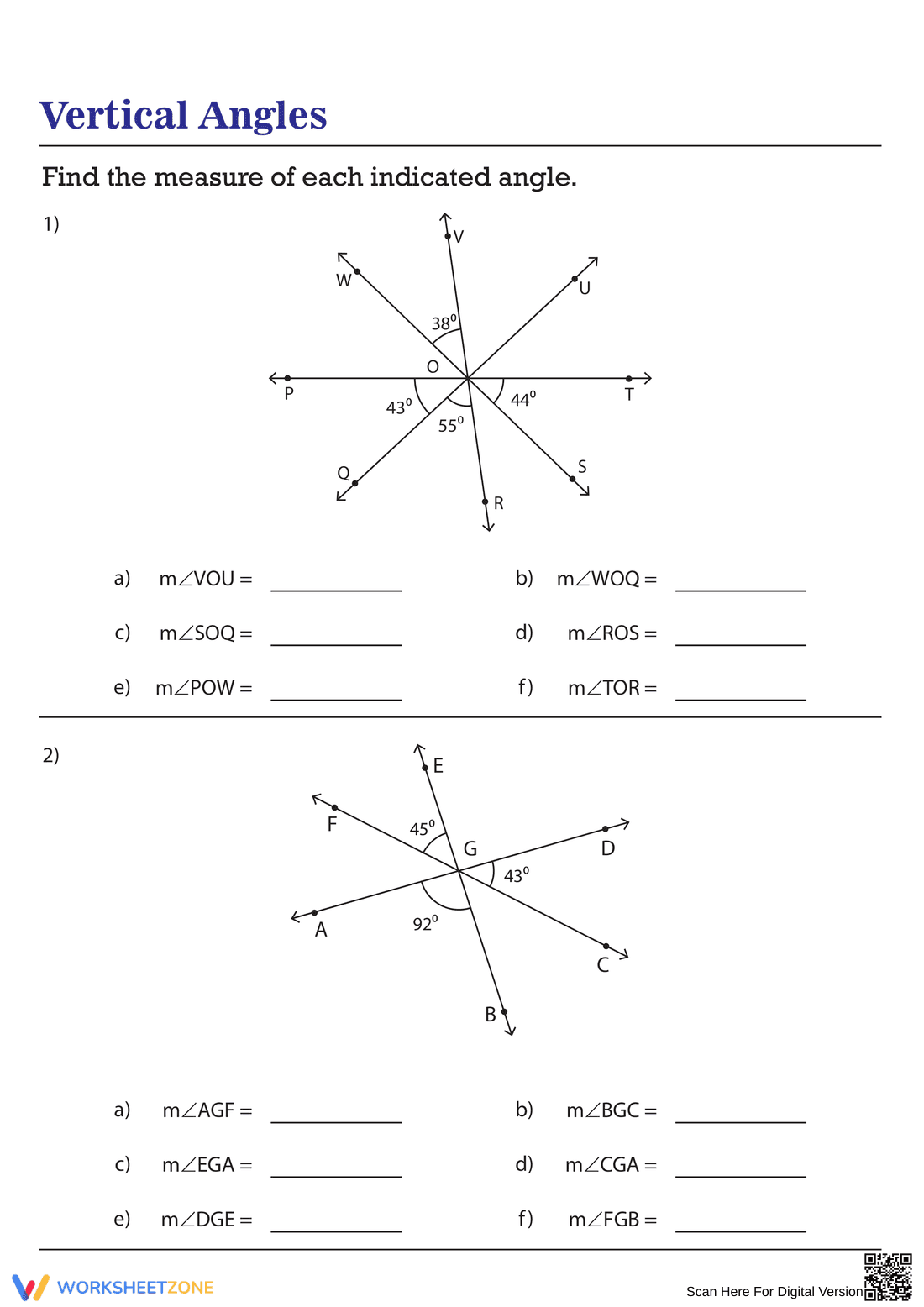
Vertical Angles: Find the Measure of Each Angle Worksheet
0 Views
0 Downloads

Paste this activity's link or code into your existing LMS (Google Classroom, Canvas, Teams, Schoology, Moodle, etc.).
Students can open and work on the activity right away, with no student login required.
You'll still be able to track student progress and results from your teacher account.
Information
Description
What It Is:
A geometry worksheet focused on vertical angles and angle relationships. Students use given angle measures around intersecting lines to determine the value of indicated angles by applying properties such as vertical angles, linear pairs, and supplementary angles.
Why Use It:
This worksheet strengthens students’ understanding of angle relationships formed when lines intersect. It helps learners recognize vertical angles, identify supplementary pairs, and interpret complex angle diagrams. Students build confidence in reasoning about angle sums, complementary and supplementary relationships, and geometric structure.
How to Use It:
• Identify pairs of vertical angles and set their measures equal.
• Use linear pair relationships to find missing supplementary angles.
• Read diagrams carefully to track shared rays and opposite angles.
• Record the measure of each indicated angle using reasoning or simple calculations.
Grade Suitability:
Best suited for Grades 6–8.
• Grade 6: Introduction to vertical and supplementary angles.
• Grade 7: Strengthening reasoning with intersecting lines and multiple angle types.
• Grade 8: Preparation for angle proofs and deeper geometric reasoning.
Target Users:
Teachers, students, homeschoolers, and tutors who need structured practice with vertical angles, supplementary angles, and angle relationships in intersecting line diagrams.
A geometry worksheet focused on vertical angles and angle relationships. Students use given angle measures around intersecting lines to determine the value of indicated angles by applying properties such as vertical angles, linear pairs, and supplementary angles.
Why Use It:
This worksheet strengthens students’ understanding of angle relationships formed when lines intersect. It helps learners recognize vertical angles, identify supplementary pairs, and interpret complex angle diagrams. Students build confidence in reasoning about angle sums, complementary and supplementary relationships, and geometric structure.
How to Use It:
• Identify pairs of vertical angles and set their measures equal.
• Use linear pair relationships to find missing supplementary angles.
• Read diagrams carefully to track shared rays and opposite angles.
• Record the measure of each indicated angle using reasoning or simple calculations.
Grade Suitability:
Best suited for Grades 6–8.
• Grade 6: Introduction to vertical and supplementary angles.
• Grade 7: Strengthening reasoning with intersecting lines and multiple angle types.
• Grade 8: Preparation for angle proofs and deeper geometric reasoning.
Target Users:
Teachers, students, homeschoolers, and tutors who need structured practice with vertical angles, supplementary angles, and angle relationships in intersecting line diagrams.


