Are We Similar PDF Worksheets for 8th Grade
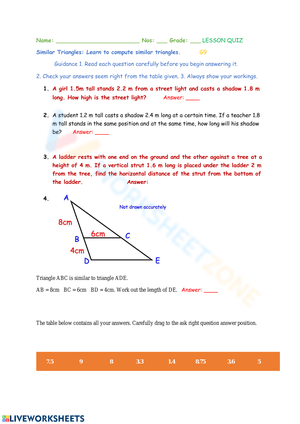
These are we similar pdf worksheets for 8th grade give teachers print-ready practice that moves from visual comparison to written justification — covering similar figures, scale factor, missing side lengths, and the angle relationships that hold the concept together. The set addresses what actually trips students up at this level: not recognizing that two shapes look alike, but proving it through corresponding parts and proportional reasoning.
The Specific Skills Targeted
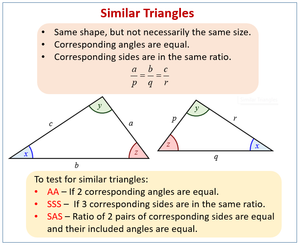
Grade 8 is where similarity shifts from a visual impression to a provable relationship. Students who understood congruence in 7th grade now extend that thinking to figures that share angle measures but differ in size — which means holding two ideas at once: angles are preserved, and side lengths scale by a constant ratio. Each worksheet builds on those two conditions through tasks that require evidence, not guesswork:
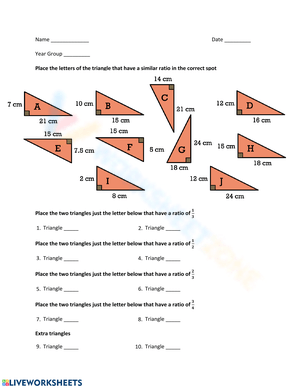
- Deciding whether two figures are similar or not similar, with written justification
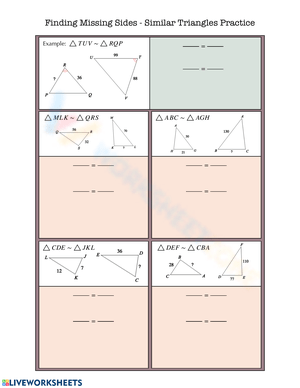
- Identifying corresponding angles and labeling matching vertices before solving
- Writing scale factors from one figure to the other, in both directions
- Setting up and solving proportions to find missing side lengths
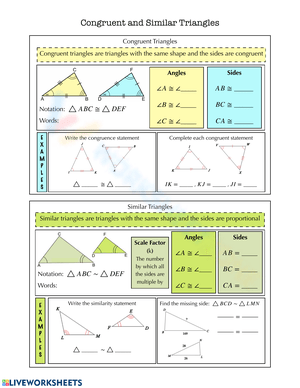
- Distinguishing similar figures from congruent figures and from figures that are neither
- Describing why a given pair is or isn't similar using both the angle and side-ratio conditions
The progression across the set matters. These are we similar pdf worksheets for 8th grade move students from recognition to proof to calculation — because students who can spot similarity by eye often fall apart when they need to justify it on paper or solve for an unknown side.
Mistakes Students Make That These Worksheets Help You Catch
The most persistent error in similarity work is setting up a proportion with mismatched sides. A student correctly identifies that two triangles are similar, then pairs the longest side of the first triangle with the second-longest side of the second — because those sides feel visually aligned in the diagram. The arithmetic proceeds cleanly. The proportion is wrong. Unless students are required to label corresponding vertices before writing anything else, this error produces a confident, incorrect answer every time.
A second pattern: students who have absorbed "enlargement" language treat scale factor as always greater than 1. When a problem shows a reduction, they invert the ratio without noticing. Asking students to name the direction of comparison — from Figure A to Figure B — before writing the scale factor corrects this most of the time. A third issue appears on non-example problems. Students who have drilled proportion-solving will sometimes declare two figures similar because they found a ratio, even when angle measures don't match. The explanation prompts built into these worksheets force students to address both conditions before committing to an answer.
Building These Worksheets Into Your Weekly Instruction
Similarity typically runs about two weeks in 8th grade pacing, and these worksheets map across that window without requiring separate planning for each day. In the first few days, the identification and corresponding-parts problems work well as warm-up questions — five or six minutes at the start of class is enough to find out whether students can reliably match vertices before the lesson moves to proportion-writing. The missing-side worksheets fit better as structured independent practice right after teacher modeling, when students need repetition while the steps are still fresh.
The justification prompts are worth saving for the days when you want to move past the procedure and check for conceptual understanding. Assign one as a closing task and ask two or three students to read their explanations aloud — that short discussion regularly surfaces the angle-condition gap, where students solved the proportion correctly but forgot they were supposed to verify angle measures as well. Before a quiz, one full worksheet used in pairs gives students a chance to argue through disagreements before the assessment.
Standard Alignment
These worksheets align to CCSS 8.G.A.4, which asks students to understand that two-dimensional figures are similar when one can be obtained from the other through a sequence of rotations, reflections, translations, and dilations. The standard sits within the 8th grade Geometry domain and requires students to describe the transformation sequence — not merely identify the relationship — which is why the explanation prompts in this set are central to the standard's intent, not optional add-ons. Many state frameworks also connect this standard to ratio and proportional reasoning from 7.RP.A, making the proportion-writing tasks here a bridge between prior content and new geometric contexts.
Adjusting the Set for a Range of Learners
The widest ability gap in similarity work usually falls between students who grasp ratio relationships quickly and students still working out equivalent fractions. For students who need more support, begin with worksheets that use whole-number side lengths and pre-labeled vertices. Removing the vertex-labeling step reduces working memory demand and lets students concentrate on the proportion structure itself. Once that's solid, bring the labeling task back in.
For students ready for more, the multi-step application problems are the right stretch — especially items where both figures carry a variable in a side length, requiring students to write and solve an equation rather than a simple proportion. Asking those students to write justifications detailed enough for a classmate to follow pushes them toward the kind of geometric reasoning that anticipates high school proof work. These are we similar pdf worksheets for 8th grade cover enough ground that a single class period can have two or three groups working on genuinely different demands without the teacher pulling together separate materials.
Frequently Asked Questions
What is the difference between similar and congruent figures?
Similar figures have equal corresponding angles and proportional side lengths, but the sides are not necessarily equal in measure. Congruent figures share both — equal angles and equal side lengths. Congruence is a special case of similarity where the scale factor equals 1. Several worksheets in the set include non-example comparisons that ask students to distinguish between similar, congruent, and neither, which directly addresses the confusion many students carry forward from 7th-grade geometry.
Do students need prior instruction before using these worksheets?
Yes. These worksheets work as practice following direct instruction on corresponding parts, scale factor, and proportion setup. The justification prompts assume students have seen the definition of similarity and at least one modeled example. For students encountering the concept for the first time, a brief teacher-led walkthrough before the first worksheet makes a visible difference in how confidently they approach the proportion problems.
How detailed are the answer keys?
Each worksheet includes a corresponding answer key that shows the correct proportion setup on missing-side problems — not just the final numerical answer. That detail supports targeted reteaching: a teacher can tell from a student's work whether the error came from mismatched sides, an inverted scale factor, or a calculation mistake, because the key shows what the correct setup looks like. Teachers searching for are we similar pdf worksheets for 8th grade with this level of answer-key detail will find it consistently across the set.
Clear All