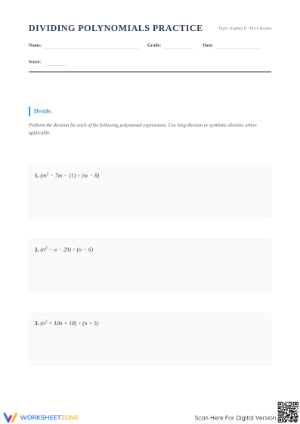
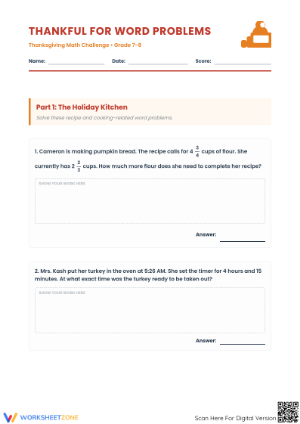
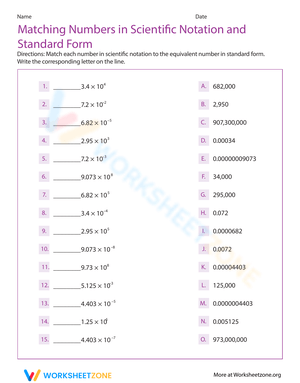
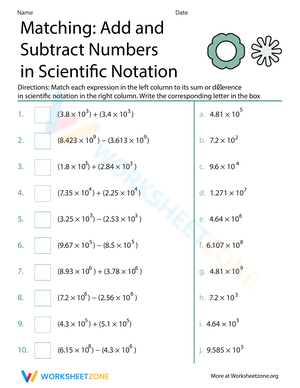
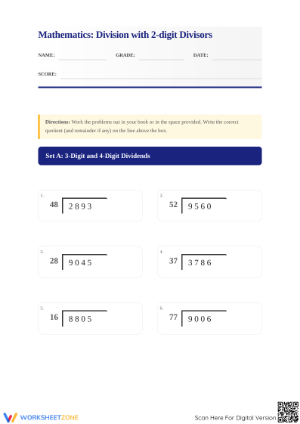
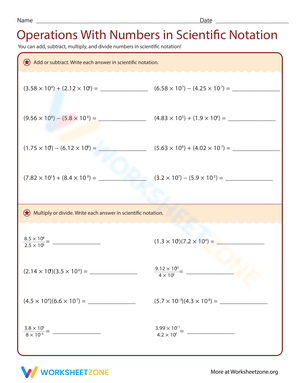
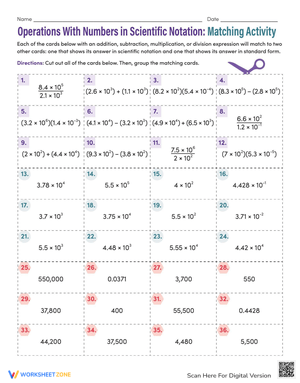
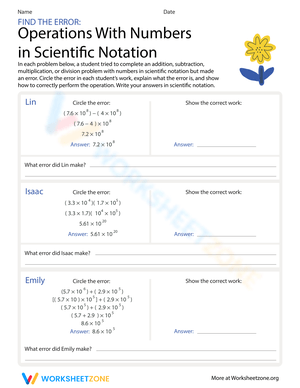
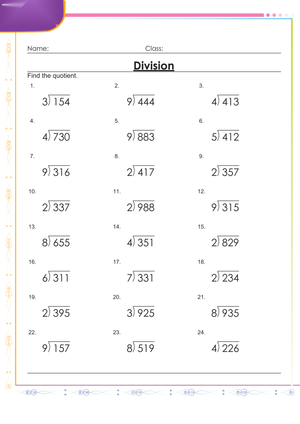
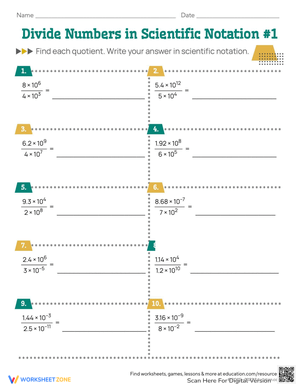
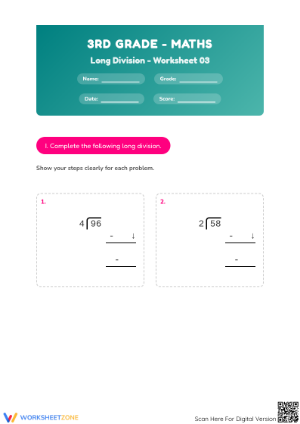
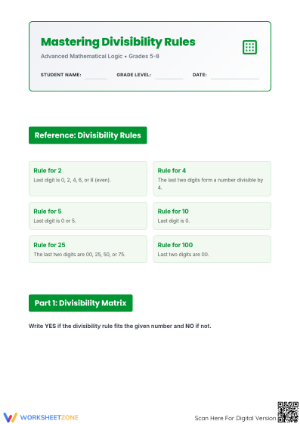
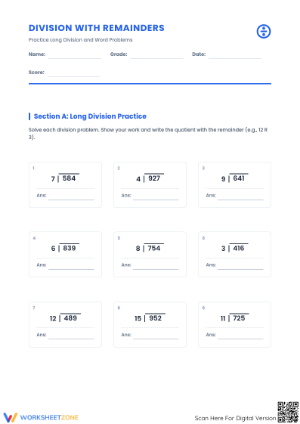
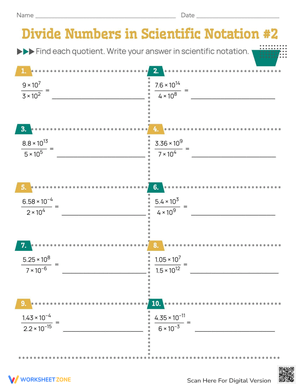
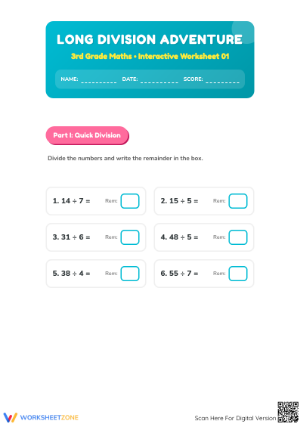
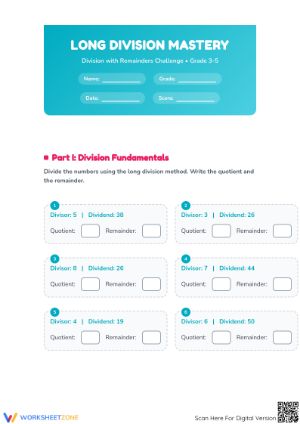
These division printable worksheets for 8th grade span all three rational number forms students need to handle fluently — signed integers, decimals, and fractions with mixed numbers — and each worksheet closes with a short set of application problems where students must identify division as the right operation before computing. Teachers get focused practice they can assign right after direct instruction, pull for small-group reteach, or use as a mixed-review resource without reformatting anything.
What's Covered Across the Worksheets
By eighth grade, division isn't one skill — it's at least four, each with its own procedure and its own failure point. The worksheets address each number form separately before combining them, so teachers can see exactly where a student breaks down rather than guessing from a mixed error pattern.
- Signed integer division: Focused practice on positive and negative quotients, reinforcing sign rules and asking students to assess reasonableness before recording a final answer.
- Decimal division: Problems requiring correct decimal placement in the quotient, with estimation built into several items so students have a number-sense check alongside the computation.
- Fraction and mixed number division: Step-by-step items that move through converting mixed numbers to improper fractions, writing the reciprocal of the divisor, and simplifying before multiplying.
- Word problems: Short application tasks involving unit rates, equal sharing, and ratio comparisons — the contexts where 8th graders most often encounter division during proportional reasoning and early algebra work.
- Mixed rational number review: Worksheets that present all number types together and require students to name the type and select a strategy before solving.
Frequent Student Errors These Worksheets Help You Catch
The errors that appear most often in 8th grade division fall into three distinct patterns, and knowing them in advance changes how a teacher monitors during independent work.
Sign errors in integer division are predictable and persistent. Students who correctly apply sign rules in multiplication will still write a positive quotient when dividing two negative numbers — usually because they memorized the rule without connecting it to the underlying structure. Asking students to determine the sign before computing the digits, rather than as a final step, catches a large share of these.
Fraction division produces a specific recurring error: students flip the wrong fraction. They flip the first fraction instead of the second, or sometimes both. A related pattern is that students who have been told to "multiply by the reciprocal" will multiply correctly but skip writing the reciprocal first — resulting in straight fraction multiplication and a product instead of a quotient. Requiring students to write "reciprocal = ___" as a labeled step before the multiplication clears this up for most of them.
Decimal division errors almost always involve the decimal point. Students who work through the digits correctly will still misplace the decimal, especially when the divisor is itself a decimal. A brief estimate before solving — rounding both values to the nearest whole number — gives students an order-of-magnitude check that catches placement errors without slowing the overall pace much.
Building These Worksheets Into Your Lesson Plans
The sequence that works best moves from focused to mixed. Assign one worksheet on fraction division right after direct instruction, review student work, and wait until most students can explain the reciprocal step before assigning a worksheet that combines fractions and integers. Jumping to mixed practice too early inflates error rates and makes it genuinely harder to figure out what's wrong.
Teachers who assign division printable worksheets for 8th grade across a unit — spacing them out rather than completing the whole set in two days — see better retention of sign rules and the reciprocal procedure. Integer division worksheets work naturally as bell ringers: four or five signed-number problems take five or six minutes and give teachers an immediate read on who retained the sign rules before the day's instruction begins. For intervention groups, the decimal worksheets work well when students write an estimate before each problem, which forces them to think about magnitude rather than just executing steps.
After independent practice, have students sort their completed items into three groups: problems they got right, problems where they made a procedural mistake, and problems where they aren't sure what went wrong. That sort takes three minutes and gives teachers more actionable information than a score alone, because it separates the student who made a sign slip from the student who doesn't understand what a reciprocal is.
Standard Alignment
The computation skills covered align to CCSS 7.NS.A.2, which addresses applying and extending previous understanding of multiplication and division to rational numbers, including integers, fractions, and decimals. That standard formally belongs to 7th grade, but most 8th grade teachers revisit it throughout the year because rational number fluency underpins the expressions and equations work in 8.EE. Students who can't divide fractions cleanly run into trouble when simplifying rational expressions and solving equations with fractional coefficients. These worksheets fit 8th grade curriculum most accurately when used as consolidation and fluency practice rather than first introduction to the concept.
Differentiating the Set Across Readiness Levels
Division printable worksheets for 8th grade are easy to adjust without building new materials. For students still developing procedural confidence, limit each session to one number type and have them annotate each step explicitly — writing "write reciprocal," "check sign," "simplify before multiplying" — before solving. That annotation slows them down in a useful way and reduces the number of silent errors that only surface when the completed worksheet comes back.
On-level students move through focused worksheets and then into mixed review. The challenge for this group is usually the word problems: they compute accurately once an expression is in front of them but struggle to set up the division when the problem describes a situation instead of naming an operation. A brief partner discussion about problem setup, before independent solving, handles this without taking much time.
For students who are already fluent, extend the mixed-review worksheets by asking them to write a word problem or real-world context for each computation. This keeps them working with the same resource without pulling them into separate advanced work, and the writing they produce gives teachers a window into conceptual understanding alongside procedural accuracy.
Frequently Asked Questions
What number types are covered across the worksheets?
The set covers signed integer division, decimal division, fraction division, and mixed number division. Several worksheets also include multi-step word problems where students must set up the division from context rather than execute a procedure they've already been shown.
Do these worksheets include answer keys?
Yes. Answer keys make the resources practical for homework, sub plans, and quick formative checks. Teachers can review a completed worksheet in a few minutes and sort the errors by type — sign mistakes, decimal misplacement, reciprocal errors — before deciding what the next day's small-group work should target.
How do these worksheets fit across a full unit, not just a single lesson?
The division printable worksheets for 8th grade work best when pulled individually across several weeks rather than completed in a concentrated block. A focused integer worksheet fits right after the first lesson, a fraction worksheet follows once that concept is taught, and the mixed-review worksheets are most useful near the end of the unit or during a station day before an assessment. Each worksheet matches a point in the pacing guide without requiring teachers to modify the resource.
Can these be used with students who are below grade level in division?
The worksheets that concentrate on a single number type — integers only, or fractions only — are practical for students who need to rebuild procedural understanding before handling mixed practice. Teachers often assign those targeted worksheets during intervention time while on-level students work through the mixed-review set independently.













 Interactive Worksheet Maker
 Quiz Maker
 Word Search Maker
 Crossword Puzzle Maker
 Word Scramble Generator
 Sentence Scramble Generator
 Handwriting Worksheet Generator
 Name Tracing Generator
 Fill In The Blank Generator