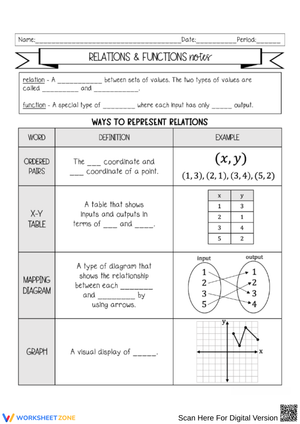
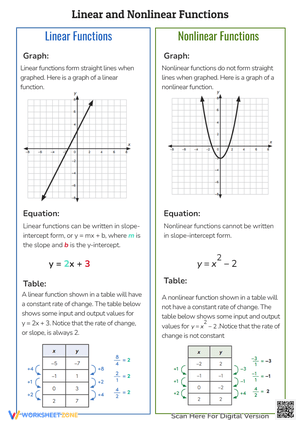
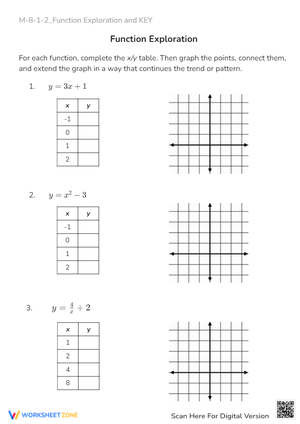
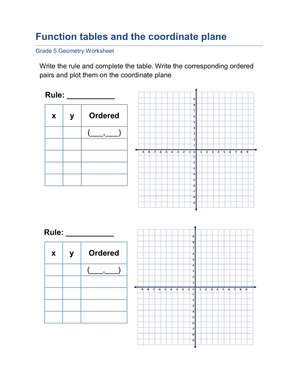
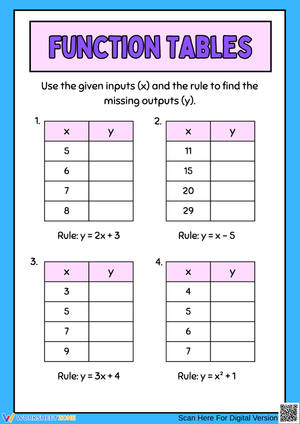
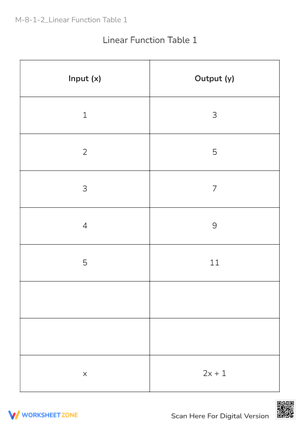
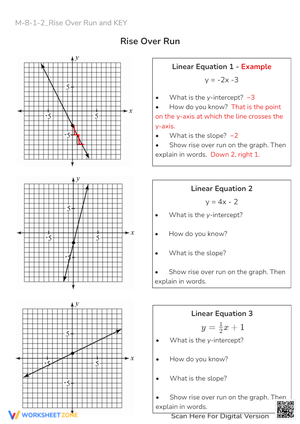
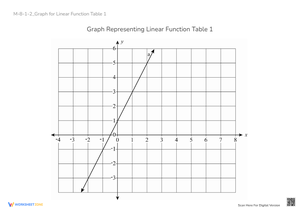
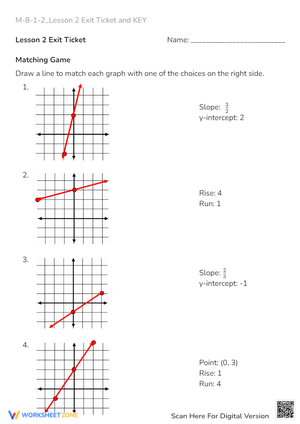
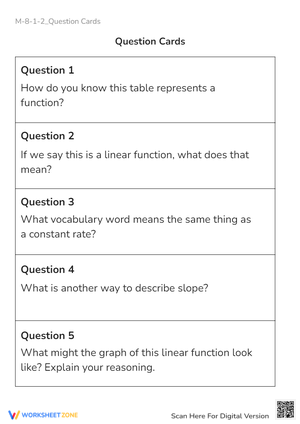
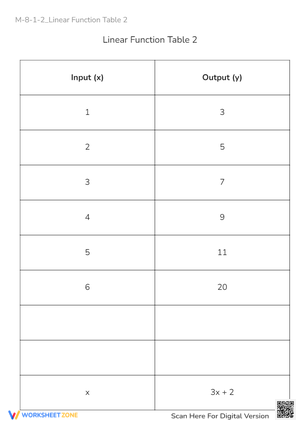
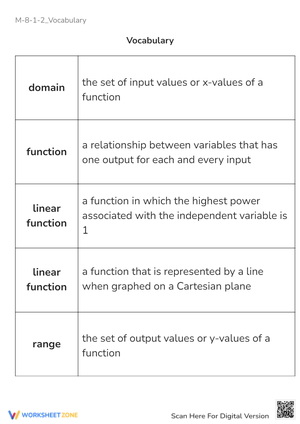
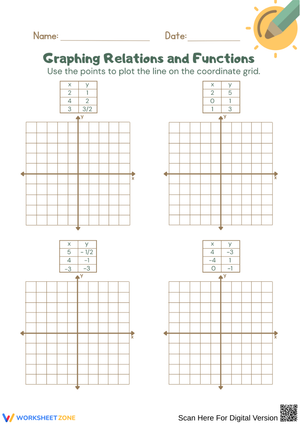
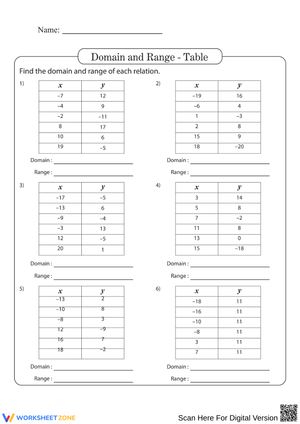
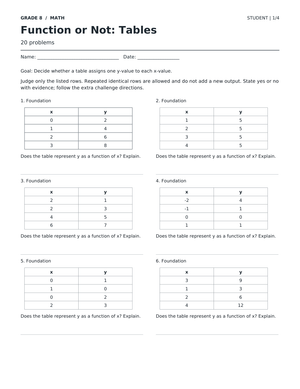
8th grade function table printable worksheets resources give algebra teachers a concrete tool for building the input-output reasoning at the center of Grade 8 function work. The set covers the full arc — completing outputs from a given rule, determining rules from finished tables, writing equations from completed tables, and comparing two functions shown in different forms. Clean formatting and self-contained directions make these worksheets ready to use for bell ringers, guided practice, small-group reteach, or exit tickets without any digital setup.
Errors Teachers Encounter Repeatedly in Function Table Work
The most persistent mistake at this grade appears when a table begins at x = 1 rather than x = 0. Students read the first y-value as the y-intercept and write something like y = 2x + 5 for a table showing (1, 5), (2, 7), (3, 9) — without checking whether the rule actually holds. Substituting x = 1 back in gives 7, not 5, but students who skip verification never see the problem. Building a checking step directly into the worksheet directions — "test your equation on at least two rows" — is a small move that pays off across the whole unit.
A second recurring confusion involves the function definition itself. Students learn that a function requires each input to have exactly one output, then apply it backwards: they flag tables as non-functions whenever two inputs share the same output value. A table where both x = 2 and x = 5 map to y = 8 is still a valid function. Students need deliberate practice with cases like this before they can apply the definition reliably under pressure.
There is also the rate-of-change error that surfaces with non-consecutive input values. If x increases by 2 each row — 0, 2, 4, 6 — and y increases by 6 each time, students frequently record the slope as 6 rather than 3. They are dividing the change in y by 1 instead of by the actual change in x. This structural error shows up on state assessments and often goes unaddressed until the linear equations unit is already well underway.
The Specific Skills Each Worksheet Targets
The worksheets address the range of function table tasks that Grade 8 students need before they can work confidently with linear relationships. Some worksheets focus narrowly on one skill; others combine two or three in a short sequence — a structure that works well for both skill introduction and mixed review later in the unit.
- Evaluating expressions: Students substitute given input values into a rule to find outputs.
- Completing tables with missing values: Students identify the pattern and fill in gaps, working in both directions — missing outputs and missing inputs.
- Writing equations from tables: Students examine a completed table and express the relationship as an algebraic rule.
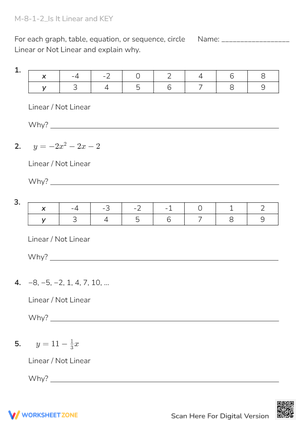
- Identifying functions and non-functions: Students determine whether a table represents a valid function and explain the reasoning using the definition.
- Comparing functions across representations: Students analyze a table alongside an equation, graph, or verbal description and determine which function has the greater rate of change or a different initial value.
- Interpreting real contexts: Students connect tables to situations like hourly earnings, distance over time, or a flat fee plus a per-item cost.
The 8th grade function table printable worksheets set is most effective when it includes both skill-specific worksheets and mixed-review options, since teachers need different materials at different points in a unit — a narrow, focused worksheet right after a mini-lesson and a broader review worksheet for the Friday block or end-of-unit study session.
Fitting These Worksheets Into Your Linear Relationships Unit
A reliable instructional sequence: model the skill, assign one worksheet for immediate practice while you circulate, then pull two or three items from a second worksheet as an exit ticket before students leave. That cycle — model, practice, check — can run across several class periods without feeling repetitive because the task type shifts each time.
- Bell ringers: Three to five function table items review the previous day's rule before new instruction begins, and the whole class can discuss answers during the first few minutes before the lesson formally opens.
- Immediate practice: Assign one worksheet in the 12 to 15 minutes after a mini-lesson — this is when misconceptions are most visible and easiest to address before they set.
- Station rotations: Place completion tasks at one station, equation-writing tasks at a second, and comparison tasks at a third while you work with a small reteach group at the teacher table.
- Exit tickets: Pull one completion item and one equation-writing item to get a fast, low-stakes read on understanding before the next class period.
- Substitute plans: Self-contained directions and included answer keys mean these worksheets run without narration from the teacher of record.
One annotation routine that consistently reduces the errors described above: before students write any equation, ask them to record the change in x and the change in y between consecutive rows. This slows down guessing and forces students to examine the full table rather than pattern-match from the first two rows. It takes roughly 90 seconds and eliminates most rate-of-change miscalculations at this grade level.
Standard Alignment
8.F.A.1 defines a function as a rule assigning each input exactly one output. Worksheets that ask students to examine a table and determine whether it represents a valid function — including tables where the relationship fails — address this standard directly. These tasks work best early in the unit, before equations and graphs enter the picture, because the table format keeps the focus on the input-output relationship itself.
8.F.A.2 calls for comparing properties of two functions each represented in a different way. Worksheets where students analyze a table next to an equation and decide which has the greater rate of change sit squarely in this standard. In most Grade 8 linear relationship sequences, this comparison work appears mid-unit, after students are comfortable analyzing a single function across representations.
8.F.B.4 extends the work to constructing a function that models a linear relationship and determining both the rate of change and the initial value. Writing an equation from a completed table — the most analytically demanding task type in the set — targets this standard directly and works well as a culminating task after students have practiced completion and pattern identification separately.
Adjusting the Work for Different Learners in the Room
Students who need more support do best starting with worksheets where the rule is already provided and the input values are positive integers with a clearly visible, consistent pattern. The goal at this level is procedural confidence: students practice the input-output relationship without the simultaneous demand of generating a rule. Keeping the arithmetic manageable lets the conceptual structure of the table stay visible rather than getting buried in computation.
On-level students can move through completion tasks and equation writing in the same class period. The key shift at this tier is asking students to work in both directions — given the rule, find the output; given the table, find the rule. That reversal is where understanding deepens, and it often surfaces the y-intercept error described earlier, which makes it a productive instructional moment rather than an inconvenient detour.
For students ready for more demanding work, the strongest worksheets in any 8th grade function table printable worksheets set are the comparison tasks — two functions shown in different forms, with a prompt asking which grows faster or what the rate of change reveals about a real situation. Adding a written justification requirement — "explain how you know" — turns a comparison task into a meaningful assessment item and gives teachers insight into student reasoning, not just answer accuracy.
Frequently Asked Questions
Do these worksheets include non-function relations, or only valid function tables?
Stronger sets include both. Students need practice recognizing when a table does not represent a function — specifically, when one input maps to two different outputs. If every table in a worksheet is automatically a valid function, students complete the work without ever applying the definition. Look for worksheets that mix in non-function relations and ask students to identify and explain the specific violation, not just mark it wrong.
How do I use these for reteach without simply repeating the same lesson?
For reteach, choose worksheets that isolate a single decision point — completing a table when the rule is already written, for instance — and pair that with the annotation routine of marking the change in x and the change in y on every row. This gives students who are struggling the structure to examine the pattern carefully without the simultaneous demand of generating an equation. The goal at this stage is fluency on a narrow task before the full sequence resumes.
My students rush through these tasks and make errors they could have caught themselves. What helps?
Build a verification step into the assignment: after writing a rule, students substitute their equation back into at least two rows and confirm the output matches. A student who writes y = 2x + 5 for a table starting at (1, 5) catches the error the moment they check x = 2: 2(2) + 5 = 9, not 7. That single check adds about 30 seconds and eliminates the most common equation-writing mistake at this level. Making verification a classroom norm rather than an optional step is what drives the habit — and it is easiest to reinforce when 8th grade function table printable worksheets materials have the step explicitly written into the directions rather than left to the teacher to remember aloud.













 Interactive Worksheet Maker
 Quiz Maker
 Word Search Maker
 Crossword Puzzle Maker
 Word Scramble Generator
 Sentence Scramble Generator
 Handwriting Worksheet Generator
 Name Tracing Generator
 Fill In The Blank Generator