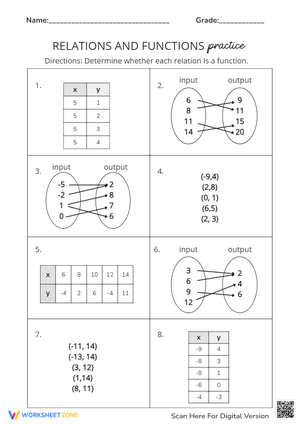
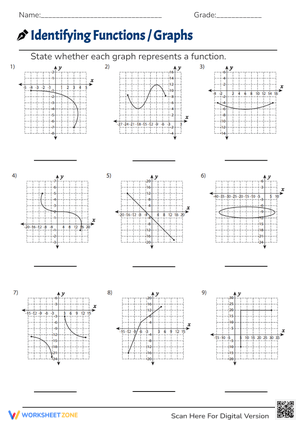
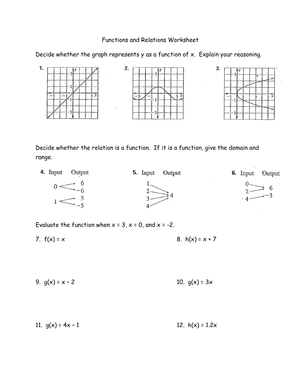
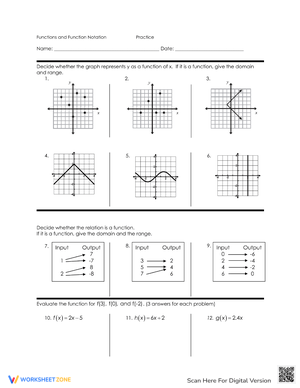
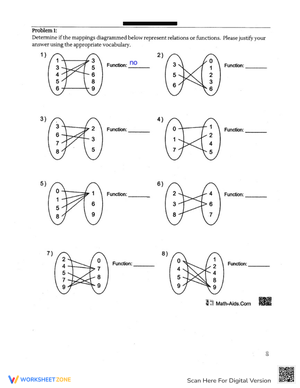
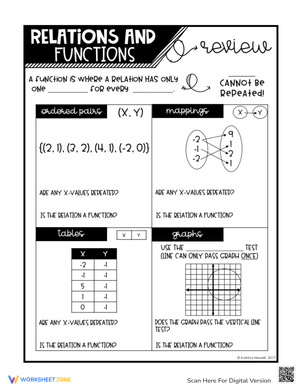
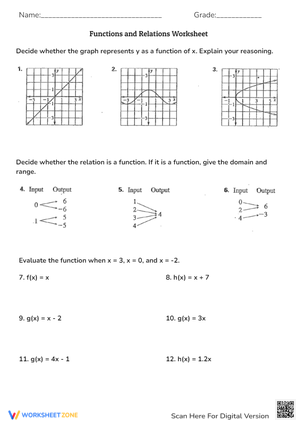
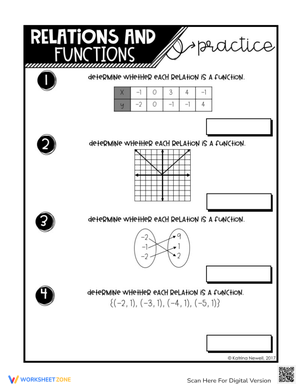
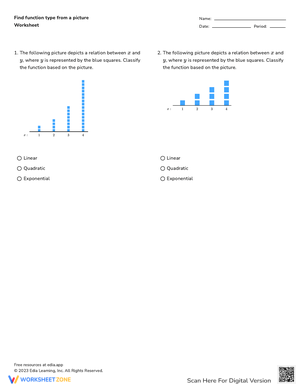
These 8th grade function or not a function pdf worksheets give teachers a focused set of materials for the moment in Grade 8 math when students first have to decide, representation by representation, whether what they're looking at qualifies as a function. The core rule is simple enough to state in one sentence: every input maps to exactly one output. Getting students to apply that rule consistently across tables, graphs, ordered pairs, and mapping diagrams is the actual instructional challenge.
The Specific Skills These Worksheets Target
Each worksheet organizes practice around a particular representation type, or mixes several together. That distinction matters because students do not automatically transfer the same reasoning from one format to another. A student who correctly identifies a non-function from a list of ordered pairs may not recognize the same issue when it shows up as a vertical-line-test failure on a curve.
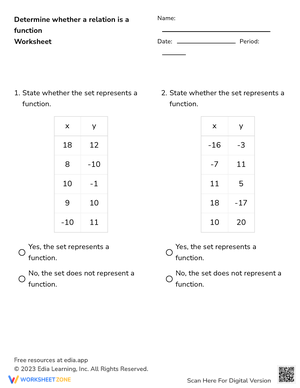
- Tables: Students scan input values and check whether any appear more than once with a different output.
- Ordered pairs: Students identify whether any x-value repeats with a different y-value — which requires looking at the first coordinate, not the second.
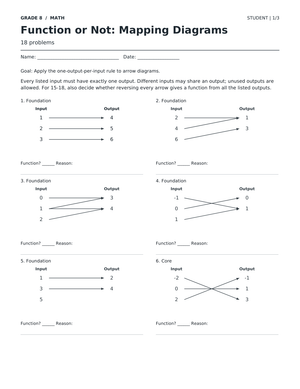
- Mapping diagrams: Students trace arrows and confirm that no input node branches to more than one output node.
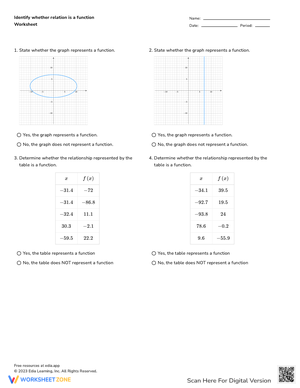
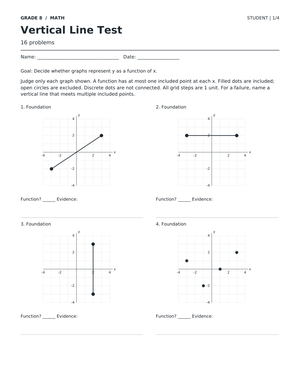
- Graphs: Students apply the vertical line test, determining whether any vertical line would intersect the graph at more than one point.
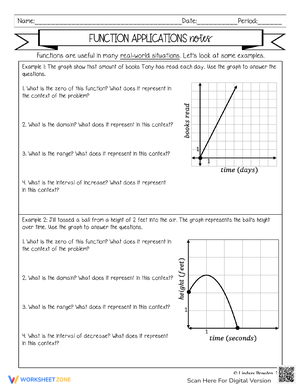
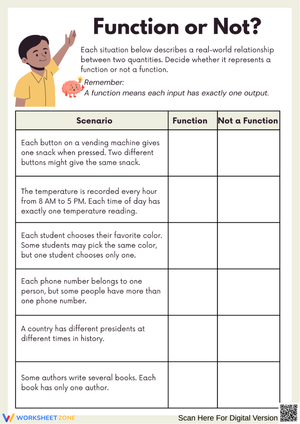
- Real-world contexts: Students decide whether a described input-output relationship fits the definition of a function without any visual format to lean on.
Starting with mapping diagrams and tables tends to accelerate understanding because the one-input-one-output structure is visually explicit there. Graphs and real-world contexts land better once that foundation is in place.
Mistakes Students Make That These Worksheets Help You Catch
The most persistent error in Grade 8 isn't misreading the rule — it's applying it to the wrong coordinate. Students check whether any output values repeat rather than whether any input values repeat. So a student looking at the pairs (2, 5), (3, 5), and (4, 5) may flag this as a non-function because the output 5 appears three times. It is, in fact, a perfectly valid function. That mistake is predictable enough that it's worth addressing explicitly before students work independently.
A second pattern involves the vertical line test. Students sometimes treat it as a visual judgment call — if a graph looks unusual, they guess "not a function." The actual question is structural: does any vertical line cross the graph at two or more points? A circle and a sideways-opening parabola both fail the test for the same concrete reason. Students who understand that reason make fewer errors than those deciding based on whether the graph looks familiar.
One subtler misconception is the belief that if two different inputs share the same output, the relation cannot be a function. Students who see a mapping diagram where two input nodes both point to a single output node sometimes mark it wrong out of habit. The correction is direct: the restriction runs in one direction only. One input cannot point to two outputs, but two inputs can point to the same one. That asymmetry is worth writing on the board and returning to repeatedly.
How to Build These Worksheets Into Your Lesson Plans
The most reliable routine is a short daily warm-up that stays on this topic for a full week. Monday, put a table on the board and have students identify the relation and explain why before discussion begins. Tuesday and Wednesday, use ordered pairs and mapping diagrams. Thursday, move to a graph with the vertical line test. Friday, put all four representations on one worksheet and require written justification for each answer. That sequence builds cross-format recognition without turning every class period into a function lesson. 8th grade function or not a function pdf worksheets are especially well-suited to this kind of spaced daily use because each one stands alone — no setup required from the previous day.
For small-group reteaching, one concrete technique: ask students to underline every x-value before making any decision. That single step slows down the process productively, forcing attention to inputs before outputs. Then, once a student marks a relation as a non-function, have them circle the specific input that breaks the rule. That annotation turns the worksheet into evidence of reasoning, not just a completion task.
Station work is another strong fit. Use four stations — one per representation type — and rotate students over two class periods. At each station, a short worksheet gives five to eight problems. Pairs work together and must agree before writing an answer. The conversation that happens when partners disagree is often where the most useful reasoning gets stated out loud.
Standard Alignment
These worksheets address CCSS 8.F.A.1, which defines a function as a rule that assigns exactly one output to each input and asks students to recognize functions from tables, graphs, equations, and verbal descriptions. The standard places this work at Grade 8 because students at this level are ready to move from the pattern recognition that dominated grades 6 and 7 into the more formal, rule-based thinking algebra requires. A solid grip on 8.F.A.1 sets up 8.F.A.2, where students compare properties of two functions presented in different representations — a task that breaks down fast when students are still uncertain about what makes something a function in the first place.
Adjusting the Set for a Range of Learners
8th grade function or not a function pdf worksheets work across a range of readiness levels without extensive modification, but a few targeted adjustments matter. For students who need more support, limiting each worksheet to a single representation type keeps the cognitive demand manageable. A reference box at the top — just the definition written plainly: "A relation is a function if each input has exactly one output" — gives students an anchor they can return to instead of relying on memory mid-problem. This is not about making the task easier; it removes a working-memory obstacle so students can focus on applying the rule rather than recalling it.
Students who have identification down can move into construction tasks. Give them a blank table or mapping diagram and ask them to fill it in two ways: once to make a function, once to make a non-function. A more demanding version: take a non-function from a worksheet and ask them to change the minimum number of values to make it qualify. Changing one ordered pair, redirecting one arrow, or erasing one point on a graph requires understanding the structure of the definition rather than just recognizing it. That's the difference between surface familiarity and actual conceptual control.
Frequently Asked Questions
Is the vertical line test something students are expected to explain, or just apply?
By the end of Grade 8, students need to do both. Applying it means drawing or imagining a vertical line and noting how many times it crosses the graph. Explaining it means connecting that result to the definition: if a vertical line crosses a graph twice, there is one x-value paired with two different y-values, which violates the rule that each input can have only one output. Worksheets that include a written justification prompt push students toward that second level — and it's at that second level where the understanding actually sticks.
Can these worksheets be used before formal instruction on functions?
Not effectively. These worksheets assume students have already encountered the definition of a function and know what input-output vocabulary means. Used before instruction, they produce guessing. Used after even a brief introductory lesson, they give students the structured repetition they need to stabilize the concept. Think of them as practice tools, not entry points.
How should I handle a student who keeps getting the right answer but for the wrong reason?
Add a justification requirement. If a student can identify a non-function but writes "because it looks weird" as the explanation, you know they're relying on visual pattern-matching rather than the definition. Requiring students to name the specific input that causes the problem — "Input 3 maps to both 7 and 9" — makes the reasoning explicit and catches surface-level guessing much faster than checking final answers alone. That kind of written evidence is also useful when deciding who needs reteaching the next day.
How do these worksheets fit into state assessment preparation?
Function identification appears consistently on Grade 8 standardized math assessments, often as a selected-response item presenting a table, mapping diagram, or graph and asking whether it represents a function — sometimes with a follow-up asking students to identify which specific element breaks the rule. 8th grade function or not a function pdf worksheets in a mixed-format style, where students shift between representation types within a single sitting, mirror that assessment structure more directly than single-format practice does, and give students the cross-format flexibility those items require.













 Interactive Worksheet Maker
 Quiz Maker
 Word Search Maker
 Crossword Puzzle Maker
 Word Scramble Generator
 Sentence Scramble Generator
 Handwriting Worksheet Generator
 Name Tracing Generator
 Fill In The Blank Generator