Identifying Functions worksheets for 8th Grade
These identifying functions worksheets for 8th grade address the representational gap that shows up in almost every algebra classroom: a student who correctly labels a table as a function will mark a mapping diagram wrong ten seconds later, using the same relationship. The set covers tables, ordered pairs, mapping diagrams, and graphs — and deliberately mixes those formats so students build the rule rather than a format-specific shortcut.
The Specific Skills Covered
Each worksheet targets the core definition from CCSS 8.F.A.1: a function assigns exactly one output to each input. That definition sounds simple, but students have to apply it correctly across four distinct visual formats before the understanding actually transfers.
- Tables: Students scan the input column for repeated values paired with different outputs — not just any repeated value anywhere in the table.
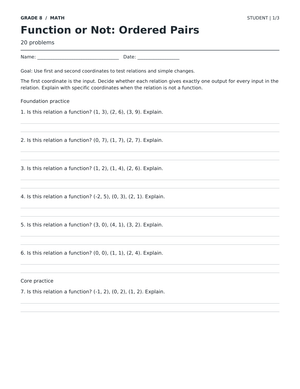
- Ordered pairs: Students identify whether any x-value appears more than once with a different y-value, catching the "same x, same y is fine" confusion before it hardens into a habit.
- Mapping diagrams: Students trace whether any single input arrow fans out to multiple outputs.
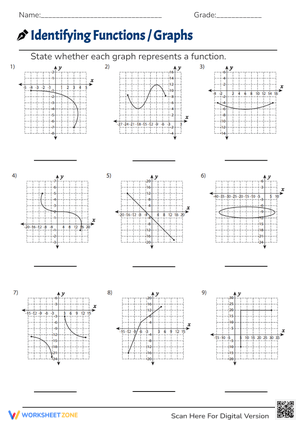
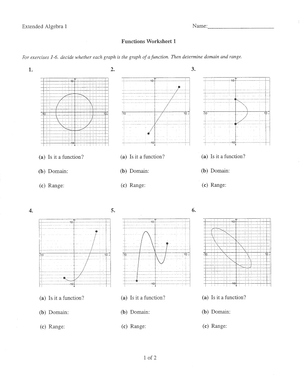
- Graphs: Students apply the vertical line test and write the reasoning — not just circle an answer.
- Mixed classification items: Students sort a set of relations as function or not a function and give a one-sentence justification for each decision.
The written justification step matters more than it looks. Left to multiple-choice or label-only formats, a significant number of 8th graders guess correctly for the wrong reason — particularly on graphs, where they rely on "looks straight" instead of actually applying the vertical line test with any precision.
Frequent Misconceptions Worth Anticipating
The most common and persistent error is confusing repeated outputs with repeated inputs. A student who has been told "x can't repeat" will mark the relation {(2, 5), (3, 5), (4, 5)} as not a function because 5 appears three times in the y column. These worksheets place that exact type of case in the middle of each set — after students feel confident — so the error surfaces in a controlled setting rather than on a test.
The vertical line test causes its own category of mistakes. Students who picked up the phrase from a quick lesson often draw one line through the leftmost point of a graph and stop there. They need practice drawing multiple vertical checks across the full graph, especially on parabolas, absolute value graphs, and circles, where one region passes but another fails. Watching a student draw one careful vertical line on a circle graph, declare it a function, and hand in the paper is a reliable signal they need a visual correction before moving forward.
Two other errors show up consistently in student work at this level:
- Reading the wrong column in a table: Students check the output column for repeats instead of the input column. Having students shade the input column before analyzing reduces this significantly.
- Assuming every mapping diagram is a function: The arrow format looks organized, and students sometimes interpret "organized" as "valid." Non-examples where one input connects to two different outputs are essential for correcting that assumption.
How to Build These Worksheets Into Your Lesson Plans
Function identification works best with short, repeated exposures rather than one extended practice session. A five-minute warm-up using two or three mixed-format items — done three or four times across a week — produces more durable recall than a single full-period block of problems. Teachers who run these as Monday, Wednesday, and Friday bell ringers report that students stop second-guessing the vertical line test by Thursday of the second week.
Structured partner work is another strong option. Give pairs one worksheet with eight to ten items and ask them to reach a consensus decision before labeling each one. The argument that breaks out over whether a graph passes the vertical line test near the y-axis is exactly the kind of productive friction that hardens the concept. Follow that with a five-question exit ticket — two tables, one mapping diagram, one set of ordered pairs, one graph — to separate students who argued their way to understanding from those who followed their partner's lead.
For small-group intervention, keep representations separate at first. Spend one session only on tables, a second only on mapping diagrams, then introduce mixed practice once both formats are secure. Jumping to mixed-format work too early overloads students who are still unsure of the basic rule, and the resulting confusion shows up as random guessing rather than a cleanly identifiable skill gap.
Standard Alignment
These worksheets align to CCSS 8.F.A.1, which requires students to understand that a function is a rule assigning exactly one output to each input and to determine whether a relation is a function from a table, graph, or set of ordered pairs. This standard appears in Grade 8 because it sets the conceptual foundation for linear functions, slope, and function notation — all of which follow in the same unit. Teachers often introduce 8.F.A.1 before slope work precisely because students who cannot distinguish a function from a non-function struggle later with the idea that a linear function has a single, consistent rate of change. The identifying functions worksheets for 8th grade in this set give direct practice with the representations named in the standard — tables, graphs, and ordered pairs — with mapping diagrams added as a common classroom tool for making the input-output relationship visible before formal graph work begins.
Adjusting for a Mixed-Ability Classroom
For students who need more support, separate the representations before mixing them. A worksheet that covers only mapping diagrams first — where the input-output relationship is literally drawn as an arrow — gives a concrete visual anchor before abstract table scanning begins. Once that format is secure, move to tables, then ordered pairs, then graphs. Mixing formats too early creates confusion that looks like a concept gap when it is actually a sequencing problem.
On-level students benefit from a balanced worksheet with clear examples and at least two close non-examples — pairs that look nearly identical but produce opposite answers. Ask those students to write one sentence explaining each decision. The identifying functions worksheets for 8th grade in this set include mixed-format items suited for that instructional level, where the goal is both procedural accuracy and the ability to justify in writing.
For students ready for more challenge, extend beyond classification. Ask them to write a real-world situation that matches a non-function relation, or to produce a graph that passes the vertical line test in one region but fails in another. A round-trip task also works well: give a function in table form, ask students to sketch a graph, then verify whether their graph passes the vertical line test. That forces them to work the concept in both directions rather than applying one fixed procedure.
Frequently Asked Questions
How do students determine whether a relation is a function?
Students check whether each input maps to exactly one output. The specific strategy depends on the representation: in tables and ordered pairs, they look for any repeated x-value paired with a different y-value; in mapping diagrams, they check whether any input arrow connects to more than one output; on graphs, they apply the vertical line test. Teaching all four strategies together — rather than treating the vertical line test as the only method — gives students a more stable understanding of the underlying rule.
When do 8th graders typically encounter the vertical line test?
Most teachers introduce the vertical line test after students have already worked with tables and ordered pairs, because the input-output definition is easier to see in those formats first. By the time graphs appear, students already understand the rule, so the vertical line test becomes a visual translation of a concept rather than an isolated trick to memorize. Introducing it too early — before the definition is secure — leads to students applying the procedure without understanding what it actually checks.
Do these worksheets work well for homework or test review?
They work best in short sets rather than full worksheets assigned all at once. Five to eight items for homework keeps the task manageable and still provides enough repetition to reinforce the skill. For test review, a mixed-format set covering all four representations gives a more accurate picture of readiness than a format-specific review worksheet does — because the assessment itself will mix representations, and students need to be ready to switch between them without warning.
Is there a version that covers all four representations on one worksheet?
The identifying functions worksheets for 8th grade in this set include both single-format worksheets for targeted practice and mixed-format options that cover tables, ordered pairs, mapping diagrams, and graphs together. The mixed-format worksheets make the most instructional sense once each individual representation has been introduced, since the challenge at that point is transfer — not initial learning.
Clear All