These heat transfer printable worksheets for 7th grade address a specific gap that shows up reliably in middle school physical science: students have heard "conduction, convection, radiation" enough times to recite the list, but they still reach for the wrong term when an actual example lands in front of them. The set moves students through several task formats — labeling diagrams, sequencing convection cycles, classifying real-world scenarios, explaining energy flow in terms of particle motion — so that practice is not just repetition of the same item type. That variety reveals where understanding is genuine and where it is still propped up by memorized phrases.
The Specific Skills These Worksheets Build
Each worksheet targets a distinct aspect of thermal energy transfer rather than covering every concept at once. Across the set, students:
- Distinguish heat, thermal energy, temperature, and particle motion in writing and in context
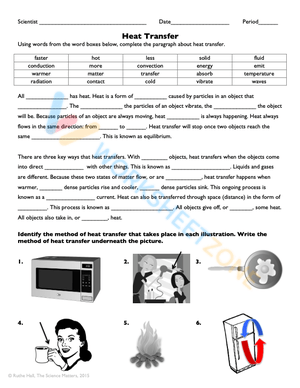
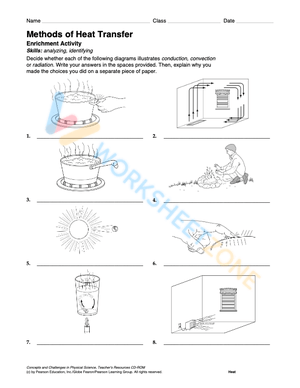
- Label diagrams showing conduction through a solid, convection currents in a fluid column, and radiant energy moving across open space
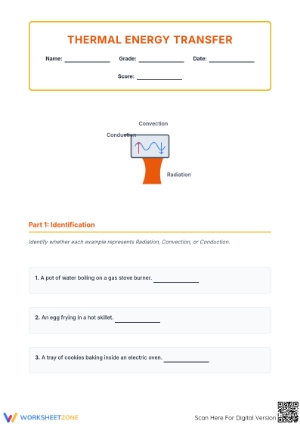
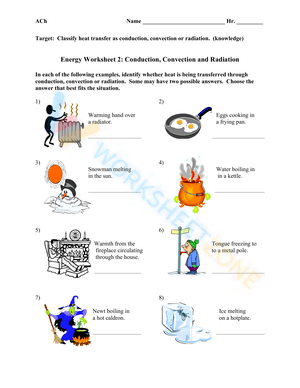
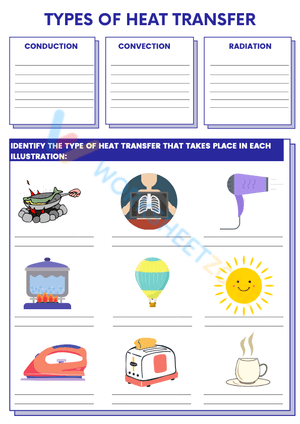
- Classify everyday scenarios — a metal spoon handle warming in soup, warm air rising near a baseboard heater, sunlight heating a dark sidewalk — as conduction, convection, or radiation
- Sequence the steps of a convection cycle in both water and air, using particle density as the reasoning
- Identify multiple transfer types operating in the same situation, such as a pot of boiling water on a stove
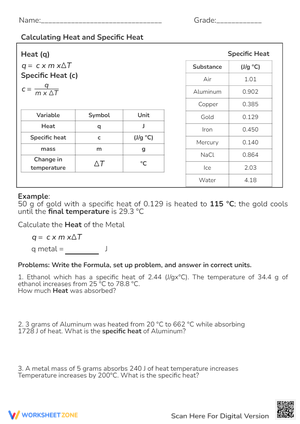
- Write short explanations of energy flow direction using the principle that energy moves from regions of higher temperature toward cooler surroundings
That last category — integrated scenarios — consistently exposes a deeper gap than single-type identification tasks do. Students who correctly label a convection diagram in isolation will sometimes mark a boiling pot as "convection only," missing the conduction happening between the burner and the pot's base, and then again between the pot and the water touching its bottom. Items built around that complexity push students toward the kind of flexible thinking that assessment questions actually test.
Frequent Student Errors Worth Watching For
The most persistent confusion in 7th grade heat transfer is the meaning of radiation. Students who have encountered "radiation" in a health or safety context — X-rays, nuclear material, warnings about UV exposure — arrive in physical science carrying a mental image of something hazardous and invisible. When a worksheet asks them to classify a heat lamp or a campfire, they will often mark it as convection because that feels warmer and more physical. These worksheets address this by placing radiation examples in ordinary domestic contexts first: sunlight coming through a car window, a toaster coil glowing, the warmth felt standing near a fireplace before any air movement has occurred. That reframing works better than restating the definition.
Convection explanations reveal a different error pattern. Students know the phrase "warm air rises," but when asked to explain why, a significant number write exactly that — warm air rises — without referencing density, particle spacing, or any mechanism. Worksheet prompts that ask students to sequence convection steps force them past the circular explanation: warm fluid expands, becomes less dense than surrounding fluid, rises, loses energy to cooler surroundings, becomes denser, sinks, and repeats. Putting those steps out of order on the worksheet and asking students to number them in sequence is more effective at building the actual reasoning than a blank-response explanation prompt.
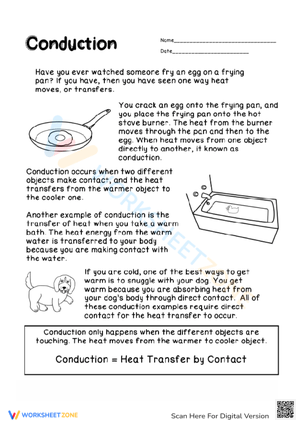
Conduction errors tend to be subtler. Many 7th graders assume that because metal surfaces feel cold to the touch, metal must not transfer heat well. The disconnect between how a material feels and how quickly it conducts thermal energy is not intuitive, and it does not resolve through lecture alone. Worksheet items that ask students to compare a metal spoon and a wooden spoon left in the same bowl of hot soup — same environment, different perceived temperature when touched — put that question directly in front of them and create a genuine cognitive moment rather than a surface-level definition review.
Building These Worksheets Into a Thermal Energy Unit
The most effective placement for each worksheet is the class period after a brief hands-on experience, not before. A quick conduction comparison — two students each holding one end of a metal rod and one end of a wooden dowel near a gentle heat source, then reporting what they feel — takes about six minutes and gives the whole class a shared reference. The worksheet that follows is no longer abstract. Students are writing about something their hands experienced, and the vocabulary sticks differently as a result.
For convection, a pot of water with food coloring added just as heat begins transfers the same concept. Students watch, describe the motion, and then the sequencing worksheet gives them the language framework for what they saw. The radiation diagram worksheet fits naturally into the first 10 to 12 minutes of a class on a sunny day — have students note which surfaces in the room feel warmer and name what is causing it before they open the worksheet. That brief observation gives the printed task an anchor point students can return to while they work.
Keeping written justification to one or two prompts per worksheet also reduces cognitive load. Students who are not managing a paragraph response after every single item give better, more thoughtful answers on the prompts that actually require explanation — and teachers get a clearer window into who has internalized the concept versus who is copying vocabulary from earlier on the page. Heat transfer printable worksheets for 7th grade work best as part of a sequence where the worksheet follows experience, not the other way around.
For station rotations in a 45-minute block, three stations — one for vocabulary matching, one for diagram labeling, one for scenario classification — let students contact the content three times in three different ways during a single period. That repetition with format variety holds attention better than one longer task at a desk.
Standard Alignment
These worksheets connect directly to NGSS MS-PS3-3, which asks students to apply scientific principles to understand how devices minimize or maximize thermal energy transfer — a task that requires students to first understand all three transfer mechanisms and be able to predict how they interact. The vocabulary, diagram, and scenario tasks across this set build that conceptual base. MS-PS3-4 connects thermal energy transfer to particle kinetic energy and temperature change; worksheet prompts that ask students to explain energy flow direction in terms of particle motion and temperature difference support that expectation. In practical terms, MS-PS3-3 is where students name and explain the mechanism; MS-PS3-4 is where they start connecting what they observe in temperature readings to what is happening at the particle level.
Most state science standards derived from NGSS place these performance expectations in 7th grade, typically mid-year when the physical science strand moves from motion and forces toward energy. Teachers working from a pacing calendar will find these worksheets align with the second or third week of a thermal energy unit.
Adjusting the Worksheets for a Range of Learners
Students who need more support move through the vocabulary-matching and diagram-labeling worksheets before attempting scenario classification. Adding a word bank to any short-response prompt — printed directly on the worksheet or written on the board — removes the word-retrieval barrier without lowering the conceptual demand. For students who freeze when an unfamiliar example appears, providing two or three anchor scenarios as a printed reference card (one example per transfer type) keeps the worksheet moving forward without turning independent practice into a guessing exercise.
Students ready for more challenge get the most from prompts that ask them to identify all three transfer types operating simultaneously in a single system — a thermos, a greenhouse, a car sitting in a sunny parking lot — and argue which mechanism dominates and why. There is no single correct answer to that kind of prompt, and that is precisely what makes it worth assigning. Heat transfer printable worksheets for 7th grade that include open-ended extension prompts at the bottom of the page give advanced students genuine analytical work rather than more of the same classification items they finished in five minutes.
Frequently Asked Questions
What grade level are these worksheets written for?
The set targets 7th grade physical science but functions well in 6th or 8th grade depending on where a school's curriculum places the thermal energy unit. Reading level and science vocabulary are calibrated for middle school; 6th graders often benefit from reviewing the word bank as a class before working independently, while 8th graders can move directly to the scenario and extension tasks.
Do the worksheets require materials or equipment beyond printing?
No. Each worksheet is self-contained. Several diagram items reference common objects — a metal spoon, a sunny window, a boiling pot — but students work entirely from the printed material. No lab equipment, manipulatives, or technology are needed, which is part of what makes these reliable for substitute days.
How long does a typical worksheet take to complete?
Vocabulary-matching and single-concept diagram worksheets take most students 12 to 18 minutes. The mixed-review and scenario worksheets run 20 to 25 minutes. Both ranges fit within a standard bell ringer block, a station rotation slot, or the independent work portion following direct instruction. The timing also makes these workable as exit tasks in the final minutes of a period.
Are answer keys included with the set?
Yes. Each worksheet comes with a corresponding answer key so teachers can check responses during independent work or use the resources for homework without building a rubric from scratch. Heat transfer printable worksheets for 7th grade function best as formative tools when teachers can review student answers the same day they are completed — the answer keys make that practical even on a tight planning schedule.












 Interactive Worksheet Maker
 Quiz Maker
 Word Search Maker
 Crossword Puzzle Maker
 Word Scramble Generator
 Sentence Scramble Generator
 Handwriting Worksheet Generator
 Name Tracing Generator
 Fill In The Blank Generator