




























1 / 9
0
Views
0
Downloads


0.0
0
Save
0 Likes
Share
Test Your Knowledge: Properties of Waves Assessment
0 Views
0 Downloads

Paste this activity's link or code into your existing LMS (Google Classroom, Canvas, Teams, Schoology, Moodle, etc.).
Students can open and work on the activity right away, with no student login required.
You'll still be able to track student progress and results from your teacher account.
Information
Description
What It Is:
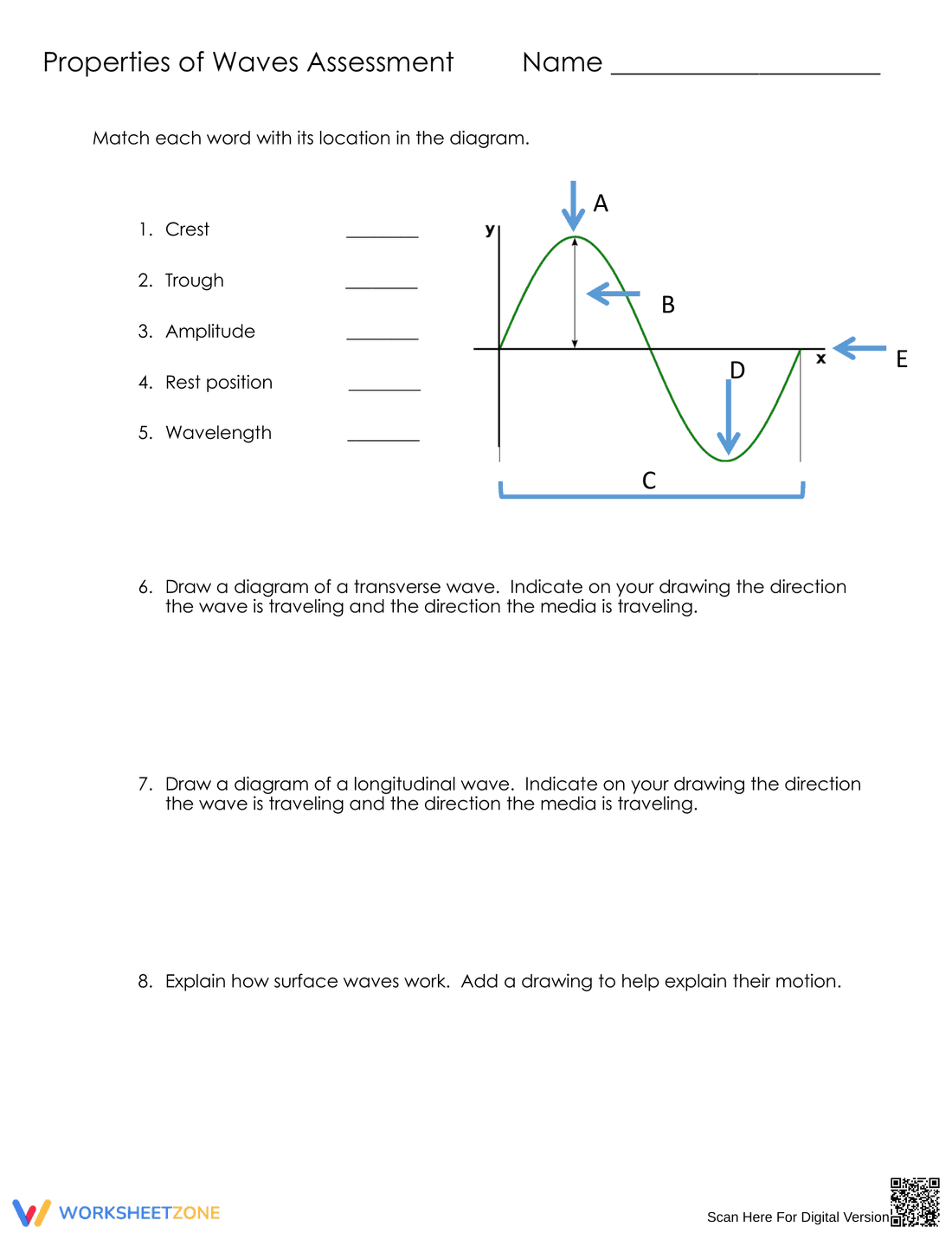
This is a science worksheet focusing on the properties of waves. It includes a matching section where students identify parts of a wave (crest, trough, amplitude, rest position, wavelength) on a labeled diagram. It also includes drawing and explanation questions about transverse waves, longitudinal waves, and surface waves.
Grade Level Suitability:
This worksheet is suitable for grades 6-9. The matching section tests basic vocabulary, while the drawing and explanation sections require a deeper understanding of wave properties, making it appropriate for middle school science or introductory high school physics.
Why Use It:
This worksheet reinforces understanding of wave properties and allows students to visually represent and explain different types of waves. It promotes critical thinking by requiring students to connect vocabulary with visual representations and to explain complex concepts in their own words.
How to Use It:
Begin by having students complete the matching section. Then, instruct them to draw diagrams of transverse and longitudinal waves, clearly indicating the direction of wave travel and media movement. Finally, have them explain and illustrate how surface waves work. Review student responses for accuracy and understanding.
Target Users:
This worksheet is designed for science students in middle school and early high school who are learning about wave properties. It is also suitable for teachers looking for a quick assessment or reinforcement activity on this topic.
This is a science worksheet focusing on the properties of waves. It includes a matching section where students identify parts of a wave (crest, trough, amplitude, rest position, wavelength) on a labeled diagram. It also includes drawing and explanation questions about transverse waves, longitudinal waves, and surface waves.
Grade Level Suitability:
This worksheet is suitable for grades 6-9. The matching section tests basic vocabulary, while the drawing and explanation sections require a deeper understanding of wave properties, making it appropriate for middle school science or introductory high school physics.
Why Use It:
This worksheet reinforces understanding of wave properties and allows students to visually represent and explain different types of waves. It promotes critical thinking by requiring students to connect vocabulary with visual representations and to explain complex concepts in their own words.
How to Use It:
Begin by having students complete the matching section. Then, instruct them to draw diagrams of transverse and longitudinal waves, clearly indicating the direction of wave travel and media movement. Finally, have them explain and illustrate how surface waves work. Review student responses for accuracy and understanding.
Target Users:
This worksheet is designed for science students in middle school and early high school who are learning about wave properties. It is also suitable for teachers looking for a quick assessment or reinforcement activity on this topic.


