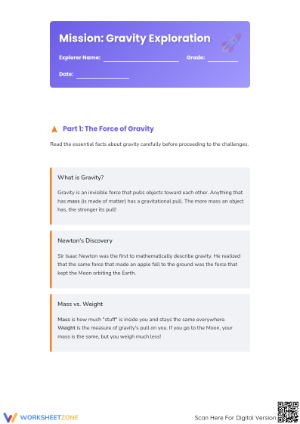
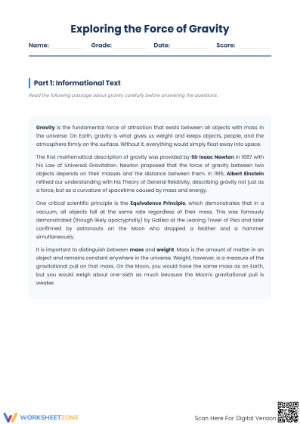
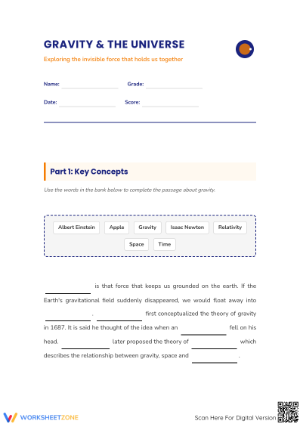
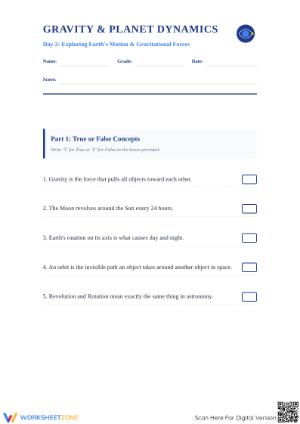
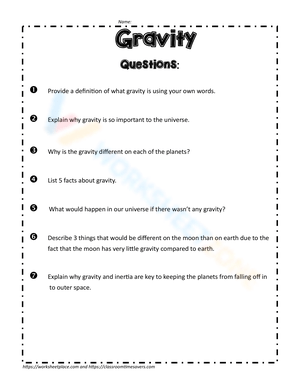
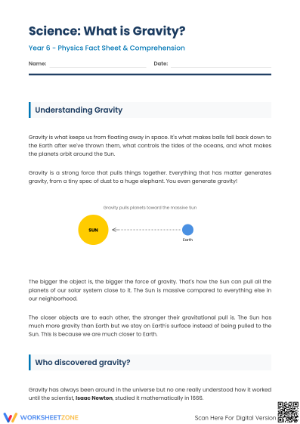
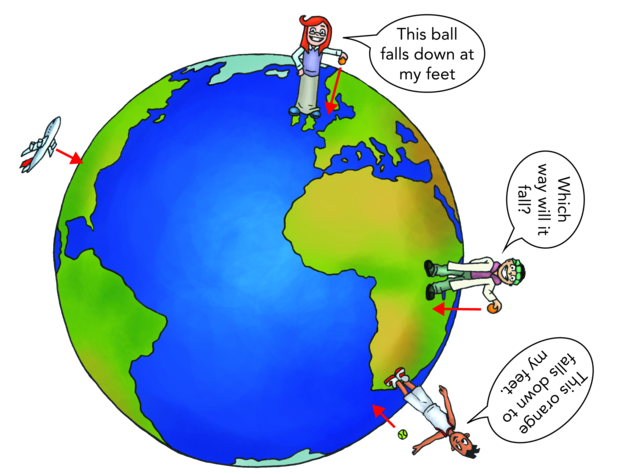
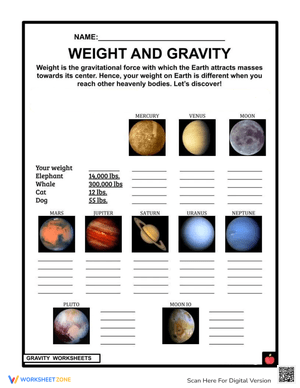
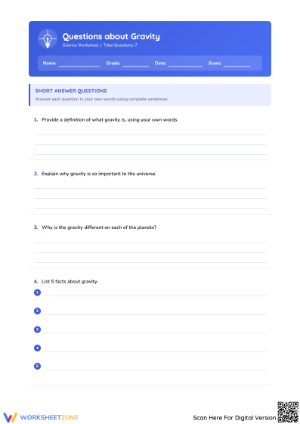
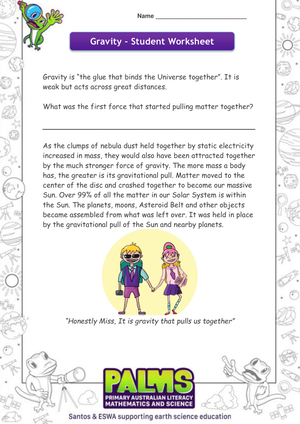
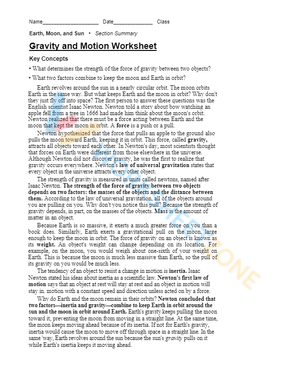
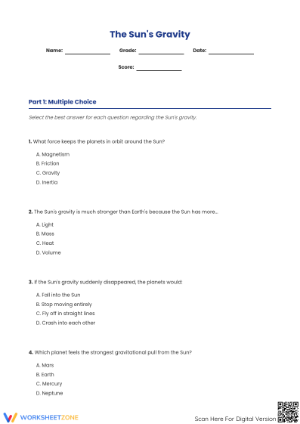
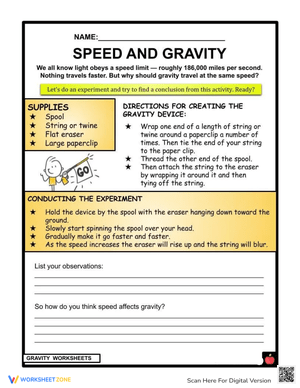
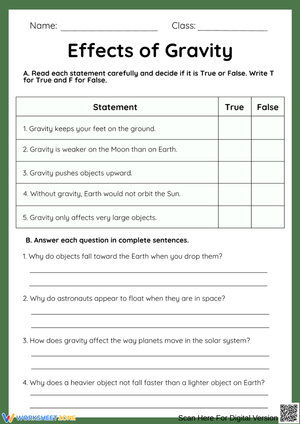
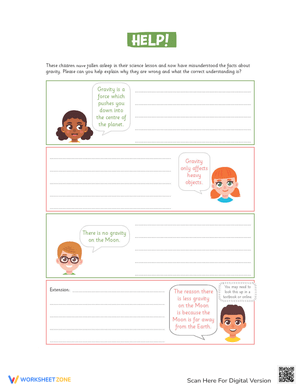
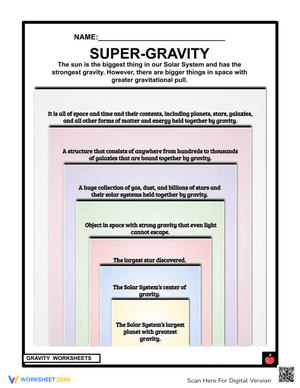
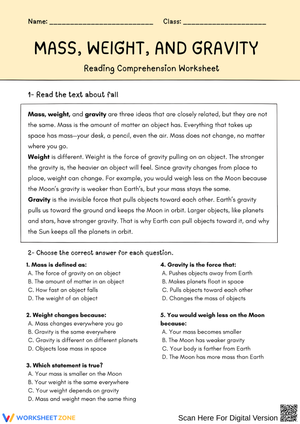
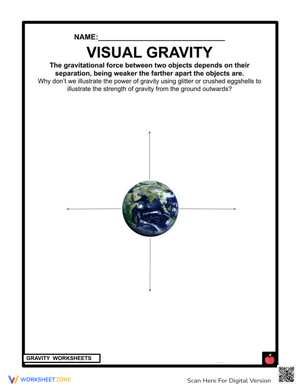
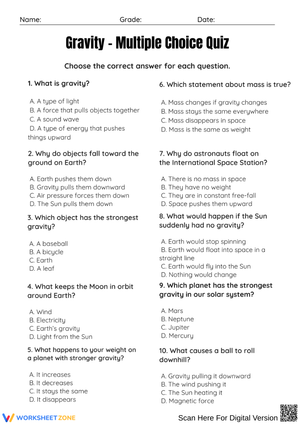
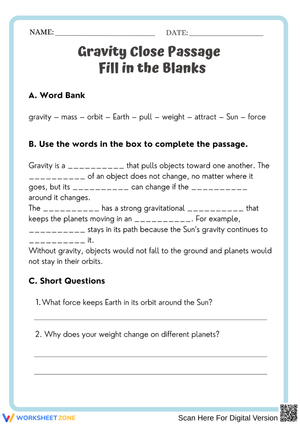
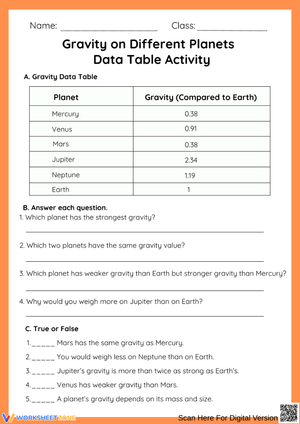
These 7th grade gravity worksheets give middle school science teachers focused, printable practice resources that move students past vocabulary recall and into actual reasoning about gravitational force, mass, weight, and orbital motion. Each worksheet addresses a specific concept so teachers can match the practice to exactly where students are in the unit — whether that's day two of a forces sequence or the week before a unit assessment. PDF formatting keeps diagrams, question spacing, and labeled illustrations intact whether teachers print the set or post it in an LMS.
Core Concepts Covered Across the Set
Gravity in grade 7 is more conceptually demanding than it first appears. Students arrive with intuitive — and often inaccurate — models of how gravity works, and the goal of practice at this level isn't definitional accuracy alone but the ability to apply gravitational reasoning to unfamiliar situations. The worksheets span the full range of ideas seventh graders are expected to handle in a forces and motion sequence:
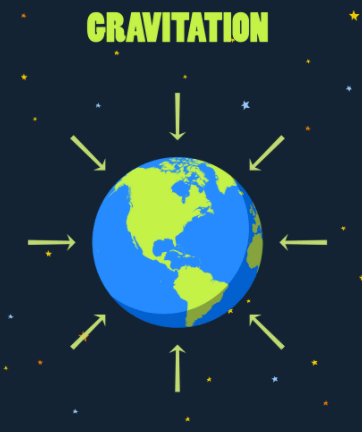
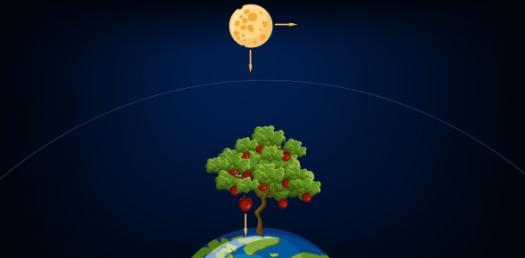
- Gravity as a mutual force: Students examine how gravitational pull acts between any two objects with mass — not just between Earth and falling objects — and how the size of each mass affects the strength of that pull.
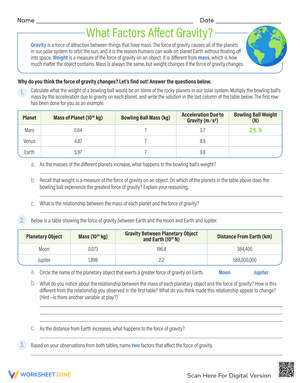
- Mass versus weight: Worksheets addressing this distinction ask students to do more than define the terms. They compare values across environments, identify correct units, and work through scenarios where an object's mass stays constant while its weight changes.
- Free fall: Practice includes questions about what happens when gravity acts as the dominant force on a moving object, and why a falling feather and a falling bowling ball behave differently in air versus in a vacuum.
- Acceleration due to gravity: Students work with the concept that falling objects speed up as they fall rather than moving at constant speed, and connect that idea to the value 9.8 m/s² without just memorizing the number in isolation.
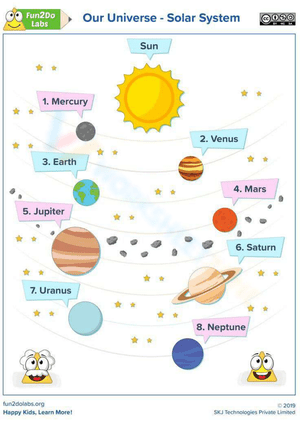
- Orbital motion and space systems: Several worksheets connect gravity to why moons, satellites, and planets maintain orbit rather than drifting away or spiraling inward.
- Real-world transfer: Tides, weight comparisons across planetary surfaces, and falling-object scenarios give students practice applying gravitational concepts beyond a textbook diagram.
When teachers look for 7th grade gravity worksheets resources, the most useful sets cover this range rather than circling the same two or three vocabulary terms repeatedly. A student who can define gravity but cannot explain why the ISS doesn't fall to Earth hasn't finished building the concept.
Errors That Surface Consistently — and What to Do About Them
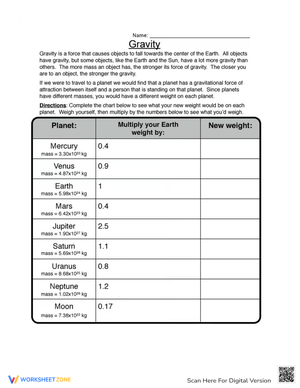
The most persistent mistake in grade 7 gravity work is treating weight as a fixed property rather than a force measurement that depends on the local gravitational field. Students who correctly state that "gravity pulls things toward Earth" will still write that they weigh the same amount on the moon, because in everyday speech, weight feels like something you have rather than something that gets measured relative to a gravitational field. Worksheets that ask students to calculate or compare weight values across environments — the moon, Mars, deep space — are far more effective at surfacing this confusion than definition-matching tasks alone.
The second major misconception involves space. When students see footage of astronauts aboard the International Space Station, most conclude that there is no gravity in space. The actual explanation — that orbiting astronauts are in continuous free fall around Earth and that gravitational pull at ISS altitude is still roughly 90% of its surface value — is genuinely counterintuitive and doesn't stick from a single reading. Constructed-response questions that ask students to explain what "weightlessness" actually means, or why a satellite doesn't crash toward Earth, put that reasoning on paper where teachers can read it and address it before the next lesson.
A third, more procedural error: students conflate units. They write "kilograms of weight" or "Newtons of mass" without recognizing that mass is measured in kilograms and weight — as a force — is measured in Newtons. A sorting or matching task early in the unit catches this before it embeds itself in lab reports and test answers.
Where These Worksheets Fit in Your Lesson Planning
Gravity practice works better distributed across a unit than saved for a single end-of-unit review session. A vocabulary or concept worksheet that opens with three to five recall questions makes a reliable bell ringer before a lesson on free fall or orbital motion — students activate what they already know, and teachers spot gaps before committing to the main lesson task. The remaining questions on the same worksheet shift easily into guided practice immediately after a mini-lesson, or become homework that reinforces the day's target without introducing new material.
Station rotations benefit from one worksheet per station. A diagram-labeling worksheet, a short reading passage with text-based questions, and a calculation practice worksheet give students three different entry points into the same gravitational concepts without requiring three separate lesson plans. For sub days, a self-contained worksheet — reading passage, follow-up questions, and an answer key — is genuinely easier to leave than any activity that depends on the teacher's live presence.
One approach worth building into the unit: assign a worksheet as guided partner work the first time through, then use the same worksheet — or a close parallel — as an individual check two days later. Students who reasoned through the questions with a partner generally perform more confidently on the second attempt, and comparing the two sets of responses gives teachers useful formative data about which gravitational concepts are actually holding versus which ones students borrowed from a partner without internalizing.
Adjusting the Work for a Range of Science Learners
Grade 7 science classes routinely span three or four years of science readiness within the same room, and gravity is one of the topics where that gap shows up visibly in written work. Students who struggle with abstract reasoning benefit most from worksheets that pair short text with a labeled diagram and limit each question to a single concept. Word banks, sentence frames such as "The gravitational force increases when ___," and partially worked calculation examples give those students a structured entry point without removing the reasoning entirely.
On-level learners generally do well with a balanced worksheet — vocabulary work, diagram interpretation, and two or three written explanation prompts asking them to compare scenarios or justify an answer with evidence from a passage or illustration. The key is that on-level at grade 7 means students can explain relationships and evaluate examples; tasks that only ask them to recall or match definitions leave their actual understanding unchecked.
For students ready for more challenge, extension prompts make the most difference. Ask them to explain why two objects with very different masses fall at the same rate in a vacuum while their weights differ, or to analyze why a satellite in low orbit experiences more atmospheric drag than one in higher orbit while still remaining gravitationally bound to Earth. Posting a 7th grade gravity worksheets set in a learning management system also makes it practical to assign different worksheets to different student groups without sorting papers before class.
Standard Alignment
The content in this set aligns primarily with NGSS MS-PS2-4, which asks students to construct and present arguments using evidence to support the claim that gravitational interactions are attractive and depend on the masses of interacting objects. In classroom terms, MS-PS2-4 is where the mass-versus-weight distinction, mutual gravitational force, and the role of mass in determining gravitational strength all live — the conceptual core of most seventh-grade gravity units. MS-PS2-2, which asks students to investigate how changes in an object's motion depend on net force and mass, connects directly to free fall practice and the idea that falling objects accelerate rather than travel at constant speed.
Both standards appear in seventh-grade science sequences in most states that have adopted or adapted the NGSS framework. Some states embed gravity content in an Earth and space science strand or sequence it into eighth grade, so teachers should confirm their local scope and sequence — but the core gravitational concepts these worksheets address are consistent across middle school science regardless of the specific standard code used.
Frequently Asked Questions
What's the difference between a gravity worksheet for 6th grade and one for 7th grade?
At the sixth-grade level, gravity practice typically stays qualitative — students recognize gravity as a pulling force and understand that more massive objects exert stronger gravitational pull. Seventh-grade work is expected to be more precise: students distinguish mass from weight using correct units, work with the concept of gravitational acceleration, and explain orbital motion as a form of continuous free fall. These 7th grade gravity worksheets resources reflect that increased demand through explanation prompts, calculation practice, and space-system scenarios rather than relying only on Earth-based falling-object examples.
Can these worksheets work for both in-class practice and homework?
Yes, and the format supports both uses. Worksheets that include a reading passage, a diagram, and follow-up questions work well for independent in-class practice because students have everything they need in front of them. Shorter vocabulary or calculation worksheets are better suited for homework because they reinforce a single concept students already encountered that day. Sending home a worksheet that introduces something completely unfamiliar tends to generate confusion rather than practice.
How many worksheets does a gravity unit typically need?
Most teachers find that four to six worksheets cover a gravity unit without repetition — one or two for vocabulary and foundational concepts, one for diagram work and visual reasoning, one for free fall and acceleration, one connecting gravity to orbital motion and space systems, and one for unit review or assessment preparation. That spread supports bell ringers, guided practice, homework, and a review session without repeating the same task format day after day.
Are these worksheets usable in Google Classroom or a similar LMS?
PDF worksheets upload cleanly to Google Classroom, Canvas, and most other learning management systems. Teachers can assign specific worksheets to specific student groups, add direction overlays, or share them as makeup work for absent students. The formatting — diagrams, question spacing, answer lines — stays intact across devices, which makes them workable as digital practice even when students never print them.












 Interactive Worksheet Maker
 Quiz Maker
 Word Search Maker
 Crossword Puzzle Maker
 Word Scramble Generator
 Sentence Scramble Generator
 Handwriting Worksheet Generator
 Name Tracing Generator
 Fill In The Blank Generator