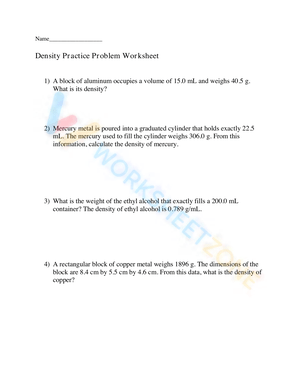
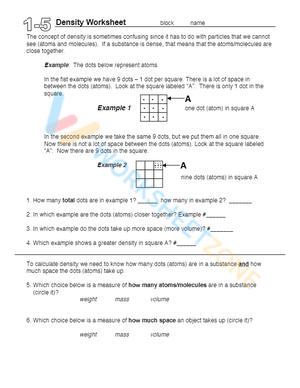
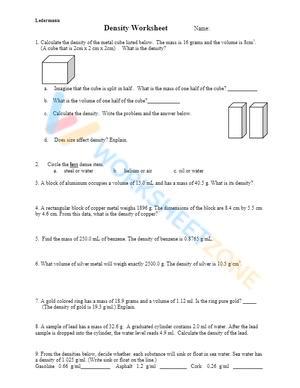
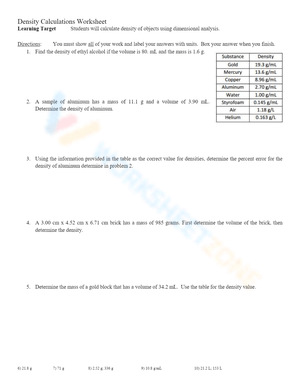
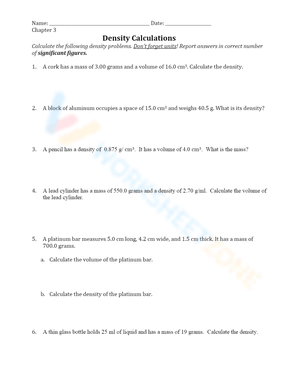
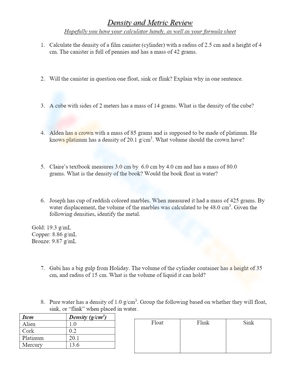
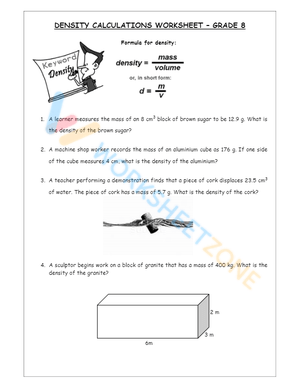
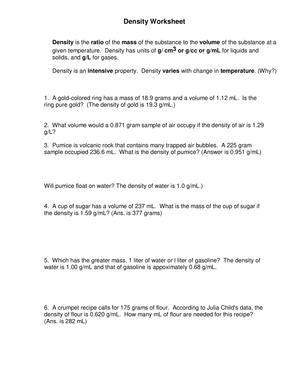
These 7th grade density printable worksheets resources give teachers standalone practice worksheets covering the density formula in all three arrangements — solving for density, solving for missing mass, and solving for missing volume — alongside the reasoning work students need to connect calculation results to float-or-sink predictions. Each worksheet operates independently, which makes the set easy to distribute across a unit, pull for a station rotation, or use for targeted reteaching after a quiz.
The Specific Calculation and Reasoning Skills Covered
Density sits at an unusual intersection in 7th grade science: students must execute a math procedure and then explain what the result means in physical terms. These worksheets address both halves of that demand, not just the arithmetic.
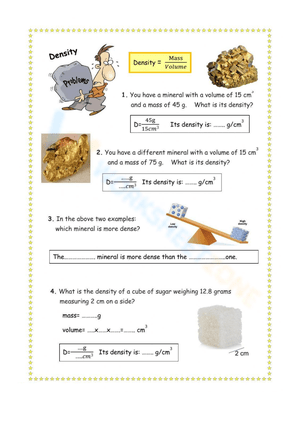
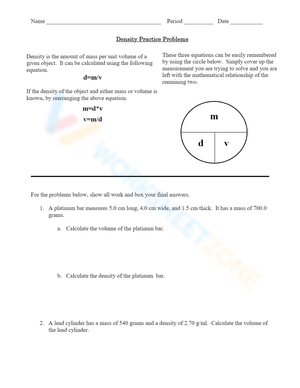
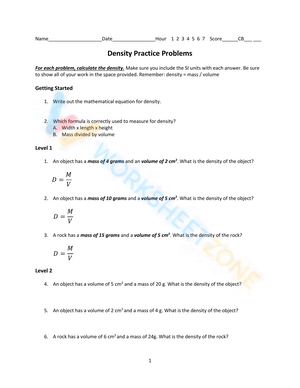
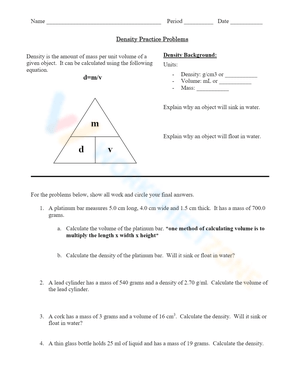
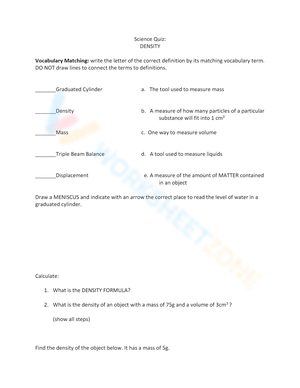
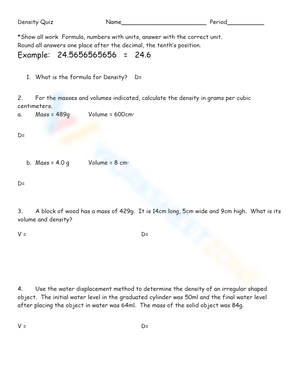
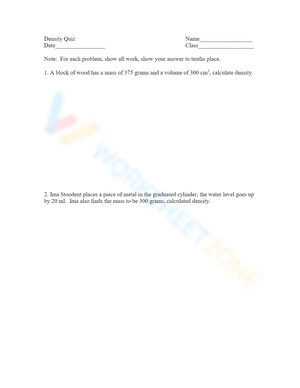
- Using D = m/V to calculate density when mass and volume are given directly
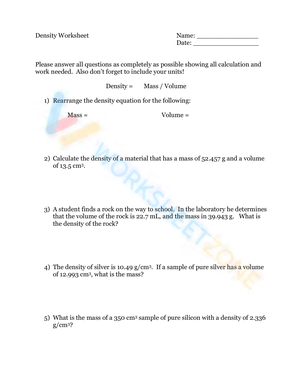
- Rearranging the formula to find missing mass or missing volume
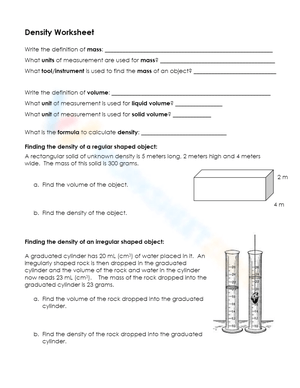
- Tracking units accurately — g/cm³ for solids, g/mL for liquids — and recognizing when given values aren't in compatible units before calculating
- Reading water displacement data for irregular objects and incorporating that measurement into calculations
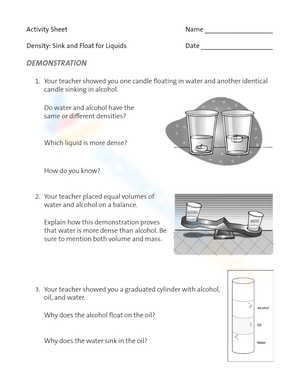
- Comparing the densities of two or more materials and drawing a supported conclusion about which sinks or floats
- Writing short evidence-based explanations after completing calculation problems
That last skill carries more weight than it initially appears. A student can correctly arrive at 0.9 g/cm³ and still mark "sinks" — unless they understand that 1.0 g/cm³ is the reference point for water and that any value below that means the object floats. These worksheets ask for that interpretive step explicitly, not as a bonus.
Student Mistakes That Show Up Consistently in Density Work
The most reliable error pattern in density calculation isn't forgetting to divide — it's assigning the wrong unit after solving. A student will calculate 3.5 and write "3.5 grams" rather than "3.5 g/cm³," which signals they treated density as a simple measurement rather than a ratio. Several worksheets in this set include a dedicated unit column in the answer table precisely because separating the number from the unit forces students to think about what they're actually labeling.
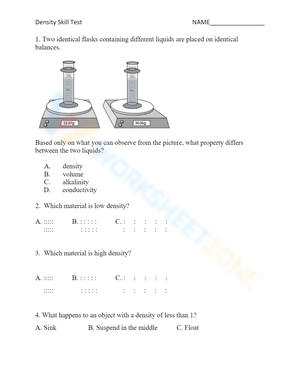
Float-or-sink reasoning produces its own consistent error. Students who see a density of 0.7 g/cm³ sometimes conclude the object sinks because "less than 1" feels like a small amount, and small amounts feel like they should go down. The misconception runs deep enough that checking a box isn't sufficient correction. Each worksheet that asks a float-or-sink question also requires a sentence explaining the reasoning, which makes the conceptual gap visible rather than hidden inside a lucky guess.
A third pattern appears when students solve for mass rather than density. Students who have memorized D = m/V often freeze when mass is the unknown — not because they misunderstand density, but because they've internalized the formula as a one-directional process. Mixed-variable worksheets address this by rotating the unknown across consecutive problems within the same worksheet, so students practice all three rearrangements in a single sitting rather than treating each version as a separate skill.
How to Sequence These Worksheets Through a Density Unit
The most effective sequence starts simply: one worksheet focused on direct density calculation, with mass and volume provided and the formula visible at the top. That's the entry point. Once students can execute D = m/V reliably, move to a worksheet where the unknown rotates — sometimes density, sometimes mass, sometimes volume — so students engage with the relationship rather than a memorized procedure.
Station rotations work especially well with 7th grade density printable worksheets resources because each worksheet is self-contained and calibrated to roughly the same time window. A three-station setup might run like this: pencil-and-paper calculation at the first station, hands-on volume measurement — water displacement in a graduated cylinder or ruler measurements on a rectangular block — at the second, and a data-table comparison task at the third. Students carry a worksheet through each stop, and the three together cover the full calculate-measure-explain arc without needing a lab report or lengthy write-up.
For the final 8 to 10 minutes of a lab period, after equipment is cleaned up but before dismissal, a short worksheet with two calculation problems and one written response is exactly the right fit. No additional directions needed, students can start independently, and teachers get immediate evidence of where understanding stands before the next class.
Standard Alignment
Density instruction at the middle school level maps to the NGSS disciplinary core idea PS1.A (Structure and Properties of Matter), which establishes that substances have characteristic physical properties — density among them — that remain constant and can be used to identify unknown materials. The performance expectation MS-PS1-2 asks students to analyze and interpret data on the properties of substances, and density is the most common quantitative physical property 7th graders use in that analysis. In classroom terms, that means density worksheets aren't supplemental material — they're central to the evidence-based reasoning these standards require.
Teachers in Texas work with TEKS 7.7, which addresses physical properties of matter and explicitly includes density as a measurable, testable characteristic of substances; density calculation appears on the 7th grade STAAR science assessment. In California and other NGSS-aligned states, density serves as a foundational concept before later work in the PS1 and ESS2 strands. Across all of these frameworks, the skill these worksheets build — calculating density, tracking units, and connecting results to observable physical behavior — is the same skill being assessed.
Tuning Each Worksheet Up or Down for Different Learners
For students still solidifying number sense, the most useful adjustment is reducing arithmetic complexity without simplifying the concept. Use worksheets that feature whole-number values — a mass of 24 g and a volume of 8 cm³, for example — include a formula reference box at the top, and provide a three-column table where students record mass, volume, and density before writing any calculation. This keeps the cognitive load on the science, not on managing messy division.
On-level students work through standard mixed-variable problems and are expected to include a brief written explanation with each solved problem. A useful addition for students in this group who tend to rush: ask them to estimate before solving. If a student predicts the density will be "close to water" and then arrives at 12.4 g/cm³, the mismatch prompts more careful re-examination than a red mark does.
Students ready for more challenge benefit from 7th grade density printable worksheets resources that require a unit conversion step before solving — converting mL to cm³, or grams to kilograms — or multi-step word problems that ask students to calculate volume from given dimensions before they can set up the density formula at all. Comparison tasks involving four or five materials in a ranked data table also work well at this level, especially when students must support their ranking in writing rather than simply ordering numbers.
Frequently Asked Questions
What prior knowledge should students have before starting density worksheets?
Comfort with basic division and a working sense of mass and volume as distinct measurements are the main prerequisites. Students who have used a balance scale and a graduated cylinder will move faster, but those tools don't need to be mastered first. The formula itself appears on most worksheets in the set, so no prior density instruction is required — number sense and the habit of showing steps are enough to begin.
How do these worksheets fit into a lesson that also includes a hands-on lab?
They fit before, during, and after. Before a lab, a direct-calculation worksheet gives students a clean model of the formula so they aren't learning it and measuring at the same time. During a station rotation, a calculation worksheet runs alongside measurement stations without competing for lab-procedure attention. After a lab, a worksheet that asks students to use their collected data to compare densities and explain a float-or-sink outcome turns raw numbers into science reasoning.
How many worksheets does a typical density unit need?
Most 7th grade density printable worksheets sets include enough variety to span a two-to-three week unit without repetition. A typical arc runs: direct calculation, mixed-variable practice, displacement-based measurement application, float-or-sink reasoning, and a cumulative review. Teachers who don't need the full sequence pull individual worksheets for bell ringers, exit tickets, or reteaching sessions without disrupting the rest of the unit.
Can students use these worksheets independently, or do they need direct instruction first?
Most worksheets in the set are written for guided or semi-independent use — students need at least a brief teacher model of the formula before they begin, but they don't need ongoing support to work through the problems. For true independent use, such as sub plans or homework, choose worksheets that include a formula box and a worked example at the top of the worksheet.












 Interactive Worksheet Maker
 Quiz Maker
 Word Search Maker
 Crossword Puzzle Maker
 Word Scramble Generator
 Sentence Scramble Generator
 Handwriting Worksheet Generator
 Name Tracing Generator
 Fill In The Blank Generator