7th Grade Magnetism worksheets for Science Class
These 7th grade magnetism worksheets resources give teachers a print-ready set that moves students from pole identification and attraction-repulsion prediction through field diagram interpretation, material classification, and electromagnet principles. Each worksheet addresses a specific stage of conceptual development, so teachers can assign individual resources based on where a class actually is in the unit rather than working through the set in order. Answer keys are included throughout, and the format handles multiple instructional contexts — bell ringers, post-lab follow-up, sub plans, and quiz review.
Where This Topic Sits in Seventh-Grade Science
Magnetism typically arrives in seventh grade after students have built some foundation with forces and motion, and the timing reflects a genuine shift in what students are expected to do. At this level, the goal is no longer just to observe that magnets attract or repel. Students are expected to explain magnetic fields as invisible force regions, reason about poles without being able to see them, distinguish ferromagnetic materials from other metals, and connect magnetic phenomena to technology they actually use. That move — from observable fact to conceptual model — is one of the harder transitions in middle school physical science, and it doesn't happen from lecture alone. A strong 7th grade magnetism worksheets set supports that transition by giving students repeated, structured practice with the diagram-based and written reasoning the unit demands.
What the Set Covers
The worksheets address every major topic a Grade 7 magnetism unit requires. Some focus on a single concept; others ask students to connect two or three ideas through short explanation or diagram work.
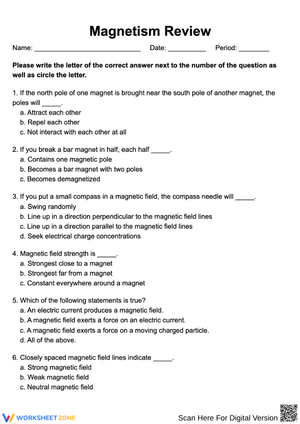
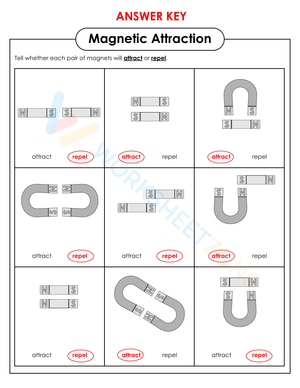
- Poles and force direction: Students predict whether given pole combinations attract or repel across multiple setups, then explain the pattern in their own words — not just identify one outcome but generalize a rule.
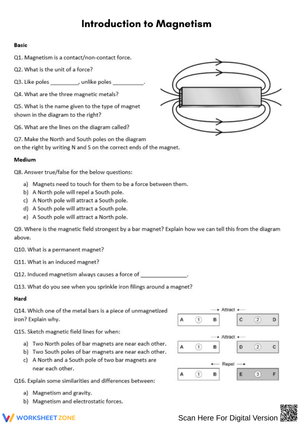
- Magnetic field diagrams: Worksheets include labeled visuals, partially drawn fields, and blank diagrams at increasing levels of difficulty. Students mark field line direction, identify poles from the diagram alone, and describe how field strength changes with distance.
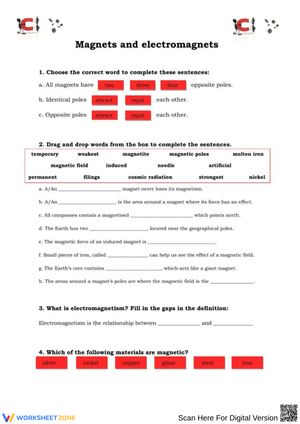
- Magnetic materials: Classification tasks ask students to sort common objects — steel washers, copper coins, aluminum foil strips, plastic caps, iron nails — by predicted magnetic behavior, distinguishing ferromagnetic materials from conductive but non-magnetic ones.
- Electromagnets: Students analyze coil-and-battery setups, predict the effect of adding current or increasing coil wraps, and explain how a temporary magnetic effect differs from a permanent magnet.
- Real-world applications: Short-answer questions connect concepts to compasses, electric motors, speakers, and MRI technology — not as trivia, but as contexts where students apply the models and vocabulary they've practiced.
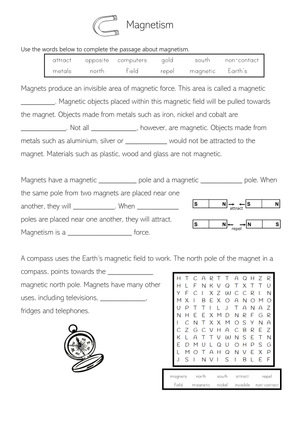
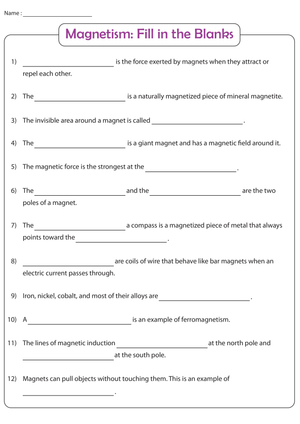
Vocabulary practice runs throughout each worksheet in context. Students use terms like ferromagnetic, magnetic flux, induced magnetism, and poles while answering questions, not just in isolated definition-matching sections.
Common Misconceptions to Anticipate and Correct
The most durable error in magnetism units is the "all metals are magnetic" assumption. Students who correctly identify a steel paper clip as ferromagnetic will confidently predict that a copper penny, an aluminum soda can, or a brass key should also attract to a magnet — because they're metal, and metals "go with magnets." This isn't carelessness. It's a direct extension of the oversimplified rule students absorbed in third or fourth grade. Worksheets that ask students to sort a mixed list of materials, write a prediction first, and then reconcile that prediction with observed or described results bring that assumption into the open where it can actually be addressed.
A second consistent error appears on field-line diagrams. When given a blank field diagram, students draw lines that look plausible but point toward both poles rather than forming closed loops that exit the north pole and enter the south pole. They understand that field lines exist in some intuitive sense, but the directional convention doesn't hold without repeated practice. Several worksheets include partially completed diagrams so students finish an established pattern rather than invent one from scratch — a format that catches directional errors before they solidify into habits.
Less common but worth watching: students who complete the electromagnet lab sometimes conclude that electric current and permanent magnetism are the same phenomenon running through different hardware. A short-answer prompt asking what happens to the electromagnet when the battery is disconnected almost always reveals whether that distinction held or quietly collapsed.
Building These Worksheets Into Your Lesson Plans
The most effective use pattern isn't distributing the whole set at once — it's matching each worksheet to a specific instructional moment. A field-diagram worksheet lands differently after students have spent five or ten minutes with iron filings and a bar magnet than it does before. An electromagnet worksheet consolidates understanding after the coil activity, not in place of it. Sequence matters here more than coverage.
Bell ringers are a natural home for single-concept tasks: one pole-interaction prediction, one material-classification item, or one partially drawn diagram to complete takes under eight minutes and gives students something concrete to focus on before class discussion opens. Station rotations work well too — one worksheet per station alongside a physical object (a bar magnet, a compass, a few sorted materials) keeps students testing observations rather than recalling facts from memory. For sub days, any self-contained worksheet in the set that includes a reading passage and short-response questions runs without teacher guidance.
The strongest use case for 7th grade magnetism worksheets resources is often the ten minutes immediately after a hands-on lab. That's when students have fresh observational data and a head full of unorganized impressions. A focused writing task — record what you saw, label the diagram, revise your original prediction — turns the worksheet into formative evidence of actual thinking, not just completed seatwork.
Standard Alignment
The set aligns most directly to NGSS MS-PS2-3, which asks students to analyze data to identify factors affecting the strength of electric and magnetic forces, and MS-PS2-5, which focuses on fields that transmit forces between objects not in direct contact. MS-PS2-5 is the more conceptually demanding standard — it asks students to reason about forces acting across empty space, which is exactly the challenge the field-diagram worksheets address. In planning terms, teachers typically use the pole-interaction and material-classification worksheets during initial instruction toward MS-PS2-3, then shift to field-diagram and electromagnet worksheets as the unit moves toward MS-PS2-5. The short-answer and diagram tasks produce written student work that documents progress on both standards, which matters when department teams review formative assessment data at the end of a unit.
Differentiating the Set Across Ability Levels
For students who need more entry-level support, the matching and labeling tasks are more accessible starting points than the open-ended explanation questions. Some worksheets include sentence frames for short-answer items — "The north pole of Magnet A will ___ the south pole of Magnet B because ___" — which reduce the language demand without reducing the science thinking. Assigning diagram sections before written-response sections also lowers the initial cognitive load for students who hesitate in front of dense text.
Students ready for more challenge can move well past the fill-in tasks. Why does doubling the coil count increase the strength of an electromagnet? What does the field diagram between two like poles tell you about the direction of force, compared to two unlike poles? These analysis questions appear as extension items throughout the set. In a mixed class, teachers typically assign the core worksheet to everyone and add one or two extension questions for students who finish early — no separate materials needed, no extra prep.
One honest limitation worth knowing before you plan: the worksheets that ask students to construct their own field diagrams from scratch produce guesswork when students haven't yet observed a physical field demonstration. A student who has only seen a textbook image of field lines — and never watched iron filings orient around a bar magnet — tends to draw something that looks plausible on paper but doesn't reflect actual field geometry. These particular worksheets work as post-lab consolidation tasks, not as cold introductions to the concept. Knowing that in advance prevents a round of re-teaching incorrect diagram habits.
Frequently Asked Questions
Do these worksheets require lab equipment to complete?
No equipment is needed for any worksheet in the set. Students work from diagrams, reading passages, and written reasoning tasks. That said, several worksheets produce meaningfully deeper learning when paired with physical bar magnets, a compass, or a sorting tray of common objects. The worksheets stand alone, but pairing them with hands-on materials — whenever logistics allow — makes the abstract content more concrete.
What is the approximate reading level across the set?
Reading passages and question stems target roughly a sixth to seventh grade reading level. Field-diagram and classification tasks rely primarily on visual interpretation rather than reading fluency, which keeps them accessible to students who struggle with dense text while still requiring genuine scientific reasoning.
How do I use these resources with students who missed instruction?
Each worksheet in the set functions independently — there's no assumed prior worksheet in the sequence. Students returning from an absence can use the reading-passage worksheets for background and the diagram worksheets for conceptual practice. Directions and visual prompts carry enough context that most students can work through them with minimal re-teaching, which is a core reason the 7th grade magnetism worksheets format holds up for makeup work and extended-absence situations.
Are answer keys included with the set?
Yes. Every worksheet comes with an answer key covering vocabulary items, diagram labels, and suggested responses for short-answer questions. Short-answer keys identify the essential science content a response should include rather than requiring word-for-word matches, which makes grading judgment calls faster without sacrificing accuracy.
Clear All