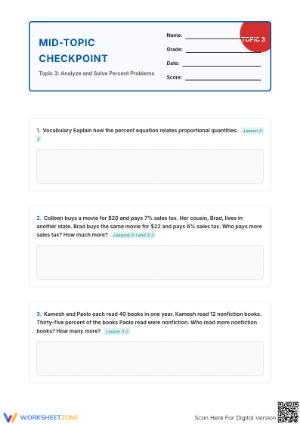
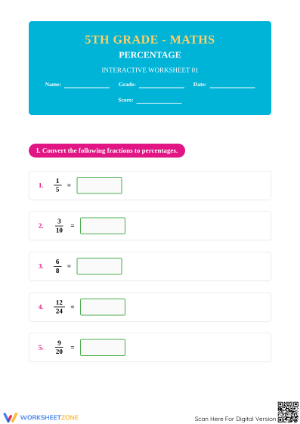
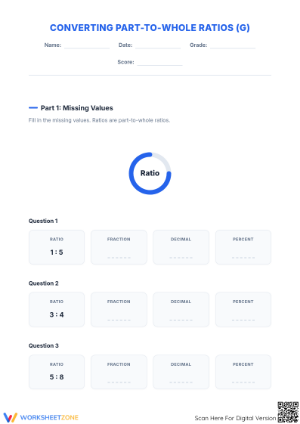
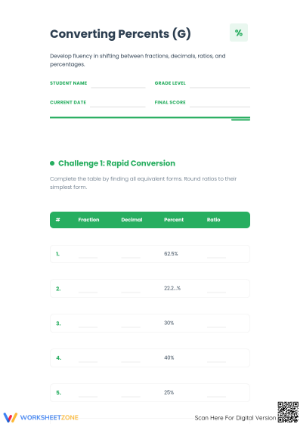
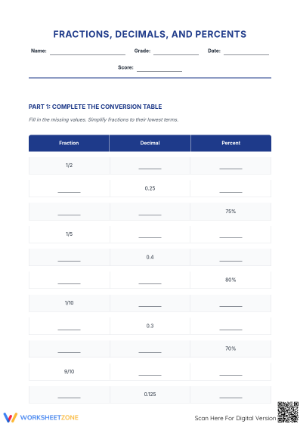
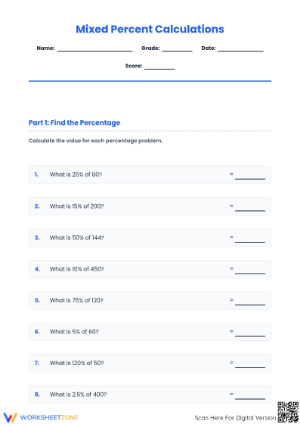
These percents worksheets for 7th grade give teachers targeted, print-ready practice across the full range of Grade 7 percent skills — from converting between fractions, decimals, and percents to multi-step consumer math problems involving discounts, tax, and markup. Each worksheet is a standalone PDF, ready to print, copy, or project for whatever spot in the lesson it fits best.
The Specific Skills Targeted
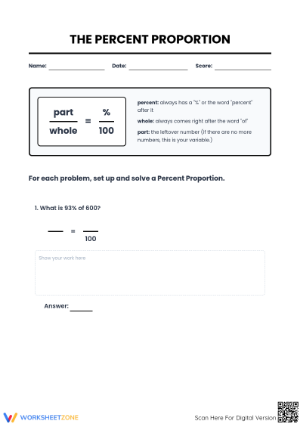
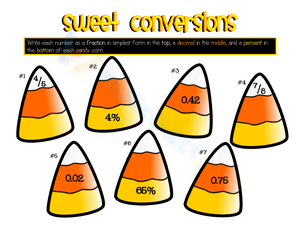
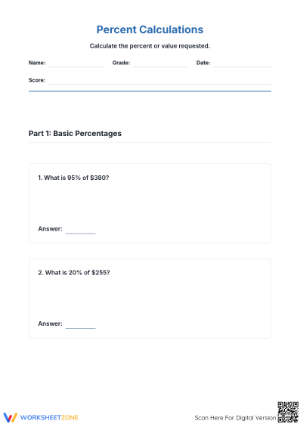
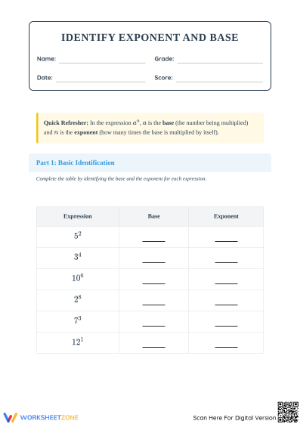
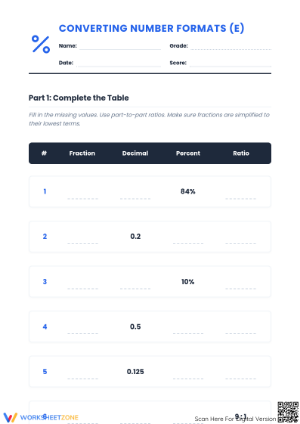
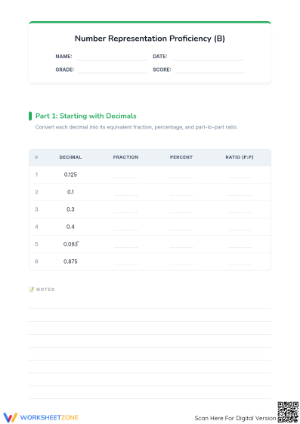
The set moves through the natural instructional sequence of a Grade 7 percent unit. Early worksheets focus on form conversions: students rewrite percents as decimals and fractions and vice versa until the three representations feel interchangeable rather than isolated. From there, the practice shifts to finding a percent of a number, then to solving for the missing value — the part, the whole, or the percent itself.
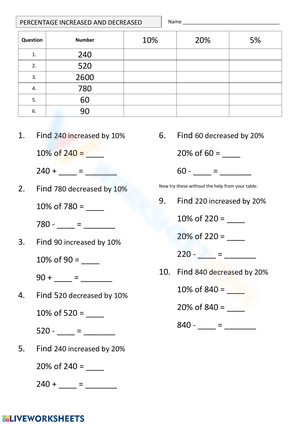
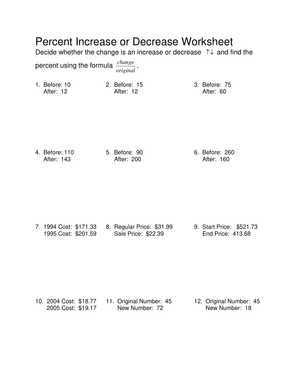
A percents worksheets for 7th grade collection that stops at basic computation leaves students underprepared for what they encounter later in the unit and on assessments. That's why this set also includes percent increase and decrease worksheets, where students compare an original amount to a new one and calculate the rate of change, alongside consumer math worksheets covering tax, tip, gratuity, commission, markup, markdown, and fees. A final group combines multiple skill types in a single task set, requiring students to determine which operation applies before they calculate.
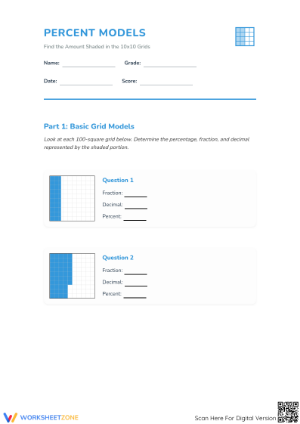
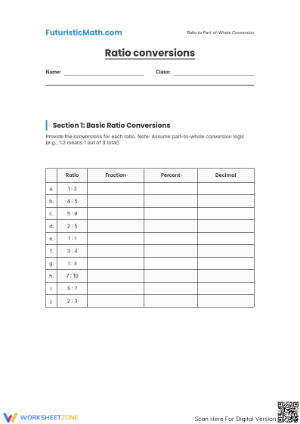
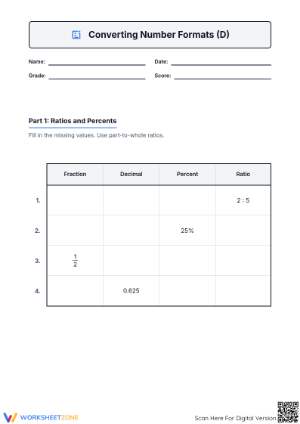
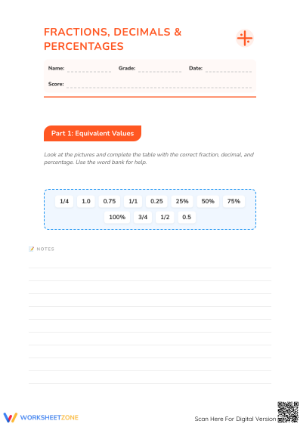
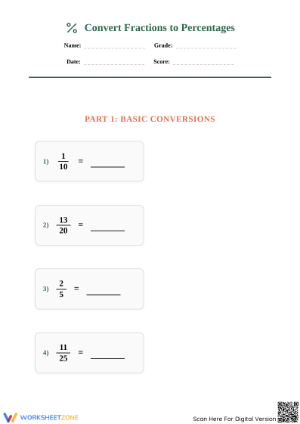
- Fraction-decimal-percent conversions in both directions, including benchmark and non-benchmark values
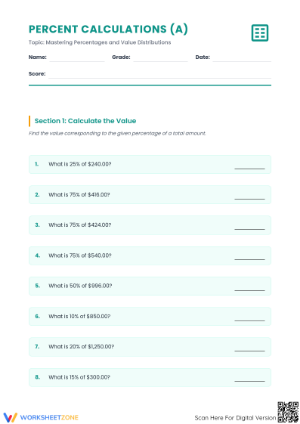
- Percent of a number with whole-number and decimal base values
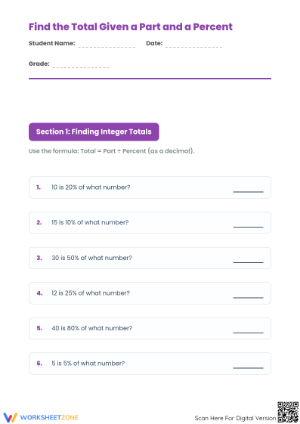
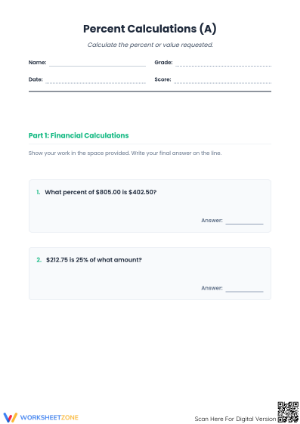
- Part, whole, and percent as missing-value problems
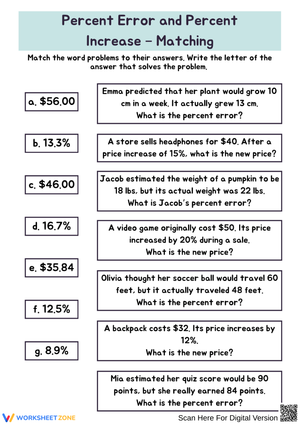
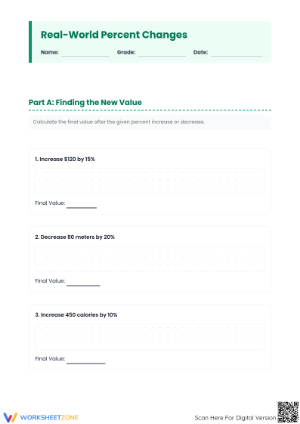
- Percent increase and decrease with and without real-world context
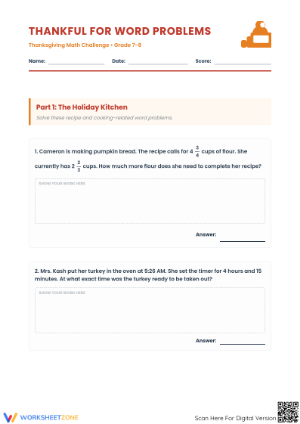
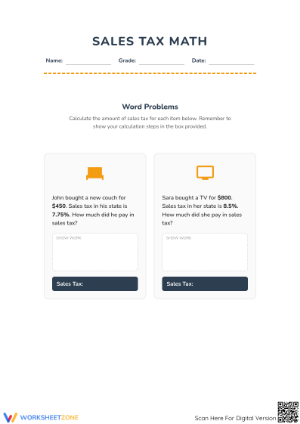
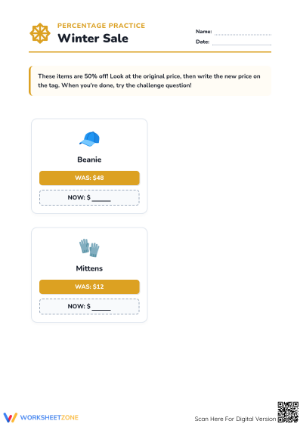
- Consumer math applications: tax, tip, discount, commission, markup, and markdown
- Mixed review requiring skill selection before computation
Common Student Mistakes Teachers Should Anticipate
The most consistent error in Grade 7 percent work is decimal placement. A student who correctly converts 35% to 0.35 will, under time pressure or after returning from a break, write 3.5 — especially when the percent has no obvious benchmark feel. That single mistake cascades through every calculation that follows, and because the result looks plausible, students rarely catch it on their own.
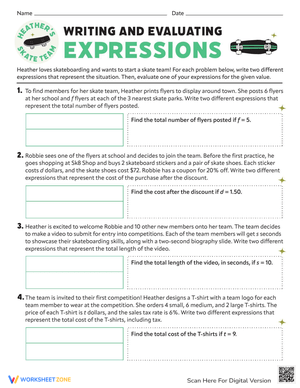
A more conceptual error surfaces in percent change problems. Students calculate the amount of change correctly but divide by the new value instead of the original. If a jacket drops from $40 to $32, they compute 8 ÷ 32 rather than 8 ÷ 40. The result is a positive percent, the student feels finished, and the structural error goes unnoticed. Prompting students to identify and label the original value before writing any equation — which these worksheets do explicitly — reduces this error significantly.
Multi-step consumer math problems introduce a third trouble spot. When a scenario involves both a discount and a sales tax, students frequently apply the tax to the original price and the discount to the taxed price, or reverse both steps entirely. Sequencing practice so students work each calculation in isolation before combining them in a single scenario prevents that confusion from becoming a fixed habit.
Where These Worksheets Fit Into a Percent Unit
The format lends itself to short, focused assignments more than to long sit-down practice sessions. A five-problem conversion worksheet works well as a Monday warm-up to open a percent unit — students complete it in the first eight minutes while attendance is taken, and the teacher uses the results to decide whether to move forward or briefly revisit the prior concept.
Mid-unit, skill-specific worksheets slot naturally after direct instruction. Teach percent increase on day one, assign the percent change worksheet the following day as independent practice, then introduce consumer math applications on day three. The mixed-review worksheets belong at the end of the unit: as a pre-quiz study tool or the review block during the class period before a unit assessment. Sorting worksheets into two working categories — single-skill fluency and decision-making application — helps teachers deploy them more precisely, because the gap students show on fluency tasks is often different from the gap that surfaces when they must identify the problem type before solving.
For sub plans, the labeled PDFs with answer keys are especially practical. A substitute doesn't need to know the current unit sequence — each worksheet has a narrow objective and clear directions, so students can work independently without teacher guidance.
Standard Alignment
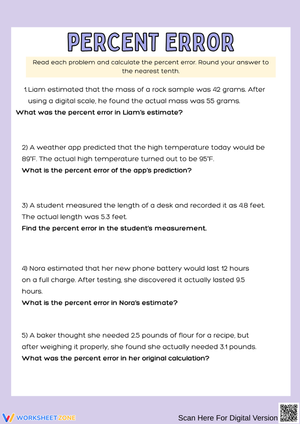
These worksheets align to CCSS 7.RP.A.3, which requires students to use proportional relationships to solve multistep percent problems, including tax, tips, discounts, markup, markdowns, commissions, fees, percent increase, percent decrease, and percent error. This standard sits at the center of the Grade 7 ratios and proportional relationships domain and is typically addressed in the mid-to-late fall semester, after students have built fluency with unit rates and proportional reasoning.
The sequencing in this set reflects how 7.RP.A.3 plays out in most classrooms: conversions and percent-of-a-number as the entry point, followed by missing-value problems, then percent change, then consumer math contexts. Teachers who address 7.RP.A.1 and 7.RP.A.2 earlier in the unit will find these worksheets a direct follow-on within the same domain.
Matching the Worksheets to Where Students Actually Are
Percents worksheets for 7th grade work best when the specific worksheet matches where a student actually is — not where the unit calendar says they should be. Students still working on decimal fluency need the benchmark percent worksheets first. Building through 10%, 25%, 50%, and 75% before introducing 13% or 7.5% isn't remediation for most students; it's the sequence that makes decimal conversion accurate and automatic before the numbers get harder.
For students ready to move beyond standard computation, the same worksheets support extension through added constraints: require a written estimate before solving, ask for a second solution method, or turn a consumer math worksheet into an error-analysis task by presenting two student solutions — one correct, one with the discount-and-tax order reversed — and asking which is right and why.
Students who struggle specifically with word problems — not the arithmetic but the reading and problem setup — often benefit from vocabulary work before the worksheet begins. Pre-teaching original price, markup, markdown, and gratuity in a brief verbal discussion removes a barrier that no amount of reteaching the procedures will fix. Three minutes of vocabulary work before distributing the worksheets frequently produces more accurate responses than re-explaining the math after students have already made errors.
Frequently Asked Questions
What percent topics does this set cover?
The worksheets address conversions among fractions, decimals, and percents; finding a percent of a number; solving for the part, whole, or percent; percent increase and decrease; and consumer math applications including tax, tip, discount, markup, and markdown. Mixed-review worksheets require students to apply multiple skills within a single problem set.
Are these worksheets appropriate for students working below grade level in a 7th grade class?
Yes. The conversion and percent-of-a-number worksheets work well for students who need to rebuild foundational understanding before tackling percent change or consumer math. Assign those worksheets first, track which errors persist using the answer keys, and move students to the next worksheet in the sequence only when the earlier skills are solid.
How do printable percent practice resources fit alongside digital instruction?
These percents worksheets for 7th grade complement digital tools rather than compete with them. A teacher might introduce percent increase with a visual model on a class screen, then assign the corresponding worksheet the next day for written, independent practice. That combination — seeing the concept visually, then writing it out by hand — strengthens retention without doubling instructional time.
Do the worksheets include answer keys?
Each worksheet comes with a corresponding answer key. In small-group intervention settings, teacher-held answer keys allow immediate feedback — which matters most when an error pattern is still forming and can be corrected before it becomes habitual. In independent stations with established routines, answer keys support student self-checking as well.













 Interactive Worksheet Maker
 Quiz Maker
 Word Search Maker
 Crossword Puzzle Maker
 Word Scramble Generator
 Sentence Scramble Generator
 Handwriting Worksheet Generator
 Name Tracing Generator
 Fill In The Blank Generator