


























Views
Downloads

Printable Math Worksheet: Fraction Decimal Percent Ratio
Paste this activity's link or code into your existing LMS (Google Classroom, Canvas, Teams, Schoology, Moodle, etc.).
Students can open and work on the activity right away, with no student login required.
You'll still be able to track student progress and results from your teacher account.
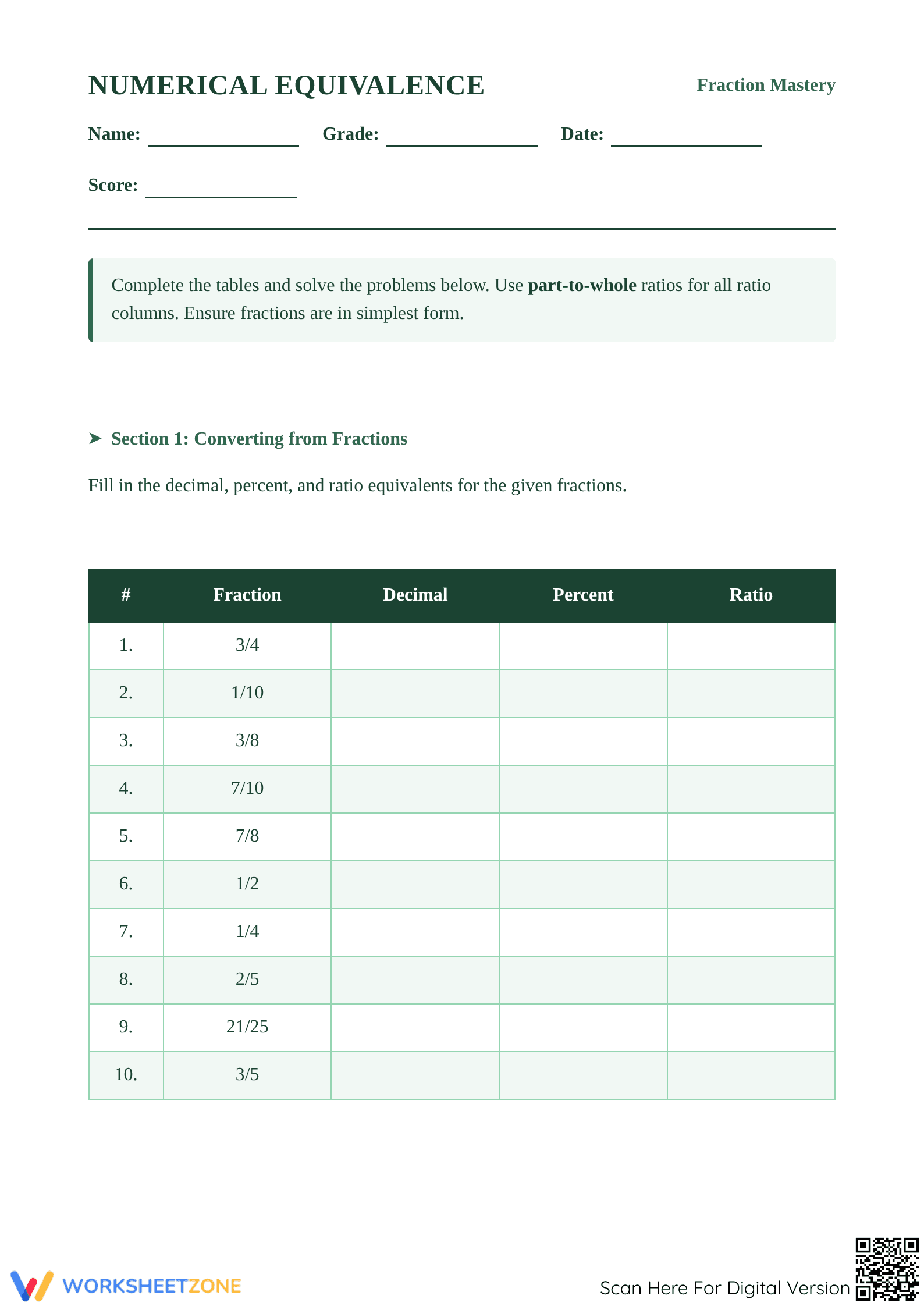
Master the relationship between different numerical representations with this comprehensive conversion worksheet. Students move beyond simple computation to understand how fractions, decimals, percents, and ratios describe the same part-to-whole relationships. This essential practice builds the fluency required for advanced statistics and algebra, ensuring students can translate data across various mathematical formats without friction.
At a Glance
- Grade: 6 · Subject: Math
- Standard:
CCSS.MATH.CONTENT.6.RP.A.3— Use ratio and rate reasoning to solve real-world and mathematical problems involving numerical equivalence- Skill Focus: Multi-way Numerical Conversion
- Format: 3 pages · 23 problems · Answer key included · PDF
- Best For: Middle school students requiring extra fluency practice with rational numbers
- Time: 25–40 minutes
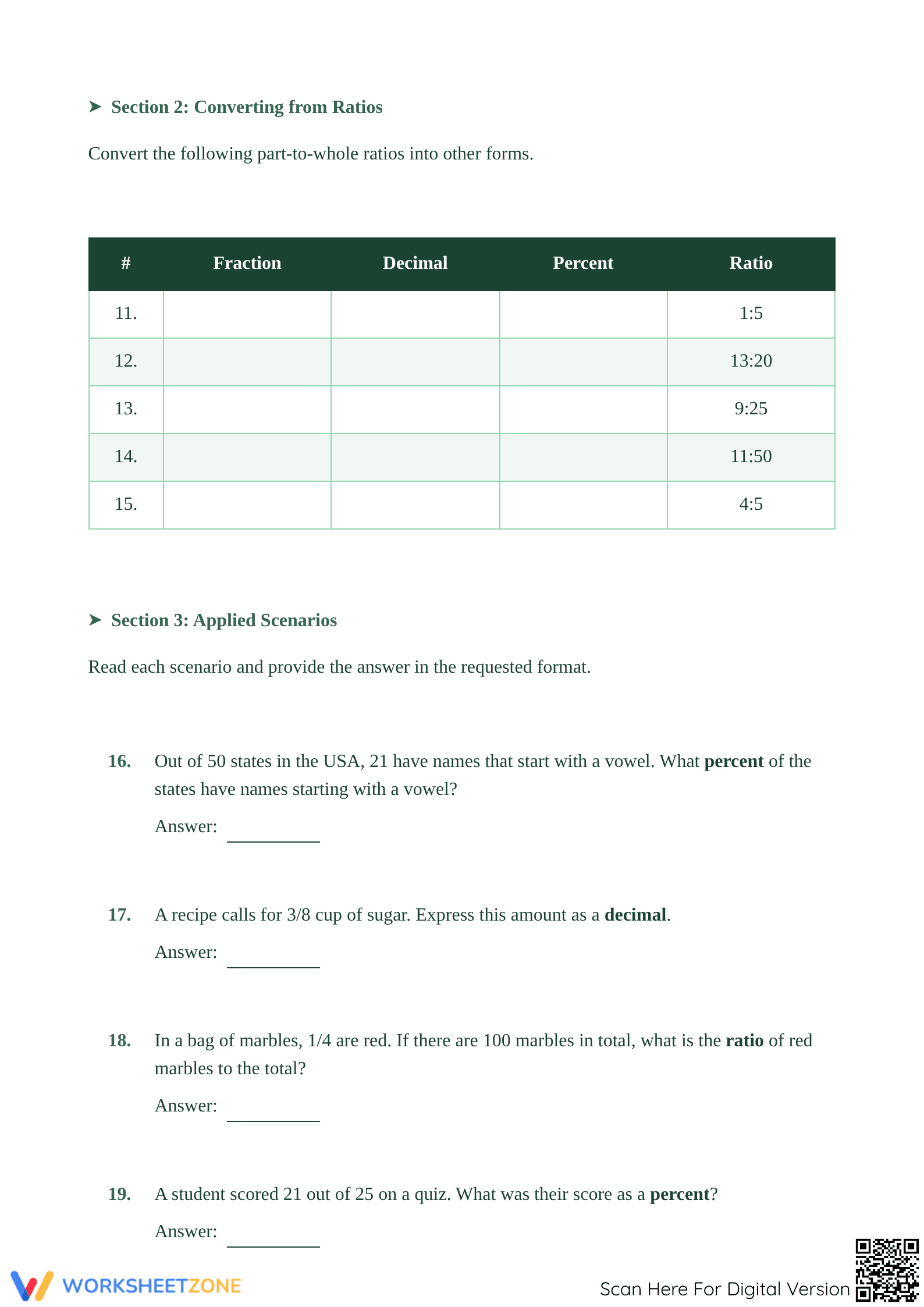
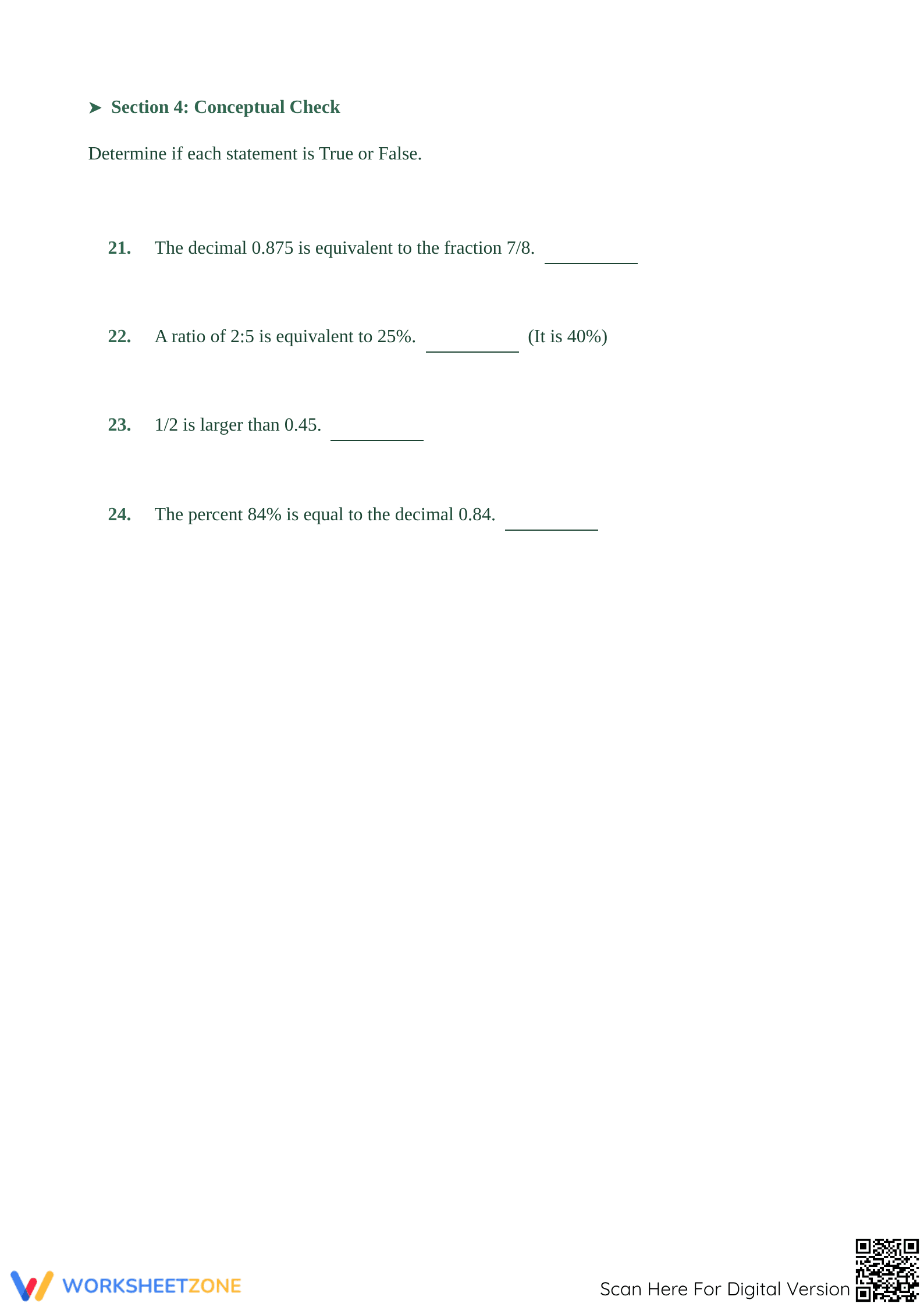
This 3-page instructional resource features four distinct sections designed to verify student mastery. It begins with structured conversion tables for fractions and ratios, followed by real-world applied scenarios that require students to extract numerical data from text. The final section provides a conceptual check with True/False statements to address common misconceptions. A complete answer key is included for immediate grading.
- Guided Practice: 10 table-based problems providing a fraction and requiring the decimal, percent, and ratio equivalents to establish a baseline of procedural fluency.
- Supported Practice: 5 problems focused on ratio-to-other-form conversions, followed by 4 applied word problems that scaffold the transition from abstract numbers to real-world contexts.
- Independent Practice: 4 conceptual true/false questions that challenge students to evaluate the validity of numerical equivalencies without the aid of a table.
This systematic approach ensures that students build confidence before tackling higher-order application tasks through a gradual release of responsibility.
This worksheet is directly aligned with CCSS.MATH.CONTENT.6.RP.A.3, which requires students to use ratio and rate reasoning to solve problems. Specifically, it addresses the sub-standard of finding percents as rates per 100 and converting rational numbers. This standard code can be copied directly into lesson plans, IEP goals, or district curriculum mapping tools.
Use this worksheet as a summative assessment after a unit on rational numbers to gauge student mastery. It also serves as an excellent formative assessment during instruction; teachers should observe if students struggle more with the ratio-to-percent conversion than the fraction-to-decimal steps. Completion usually takes 30 minutes, making it ideal for a full lesson block or a comprehensive homework assignment.
Designed for Grade 6 and Grade 7 students, this resource is perfect for general education classrooms, small group interventions, and RSP settings. It pairs naturally with a number line anchor chart or a percent of a square visual model to help students visualize the equivalencies they are calculating on the page.
The ability to fluently convert between numerical representations is a critical predictor of success in secondary mathematics. According to NAEP, students who demonstrate strong mastery of rational number equivalencies are significantly more likely to succeed in introductory algebra and statistics courses. This worksheet specifically targets the cognitive load associated with switching between discrete and continuous data representations, a skill highlighted in Fisher & Frey (2014) as essential for mathematical literacy. By practicing conversions across 23 diverse tasks—including tables, word problems, and conceptual checks—students internalize the underlying structure of proportional reasoning. This resource aligns with standard CCSS.MATH.CONTENT.6.RP.A.3, providing the rigorous practice necessary for students to meet the demands of college and career readiness. This systematic approach to numerical equivalence ensures that learners can interpret data accurately regardless of the format, fostering the deep conceptual understanding required for long-term mathematics achievement.


