


























Views
Downloads



Essential Equivalent Expressions Mastery | Grades 6-7 Math
Paste this activity's link or code into your existing LMS (Google Classroom, Canvas, Teams, Schoology, Moodle, etc.).
Students can open and work on the activity right away, with no student login required.
You'll still be able to track student progress and results from your teacher account.
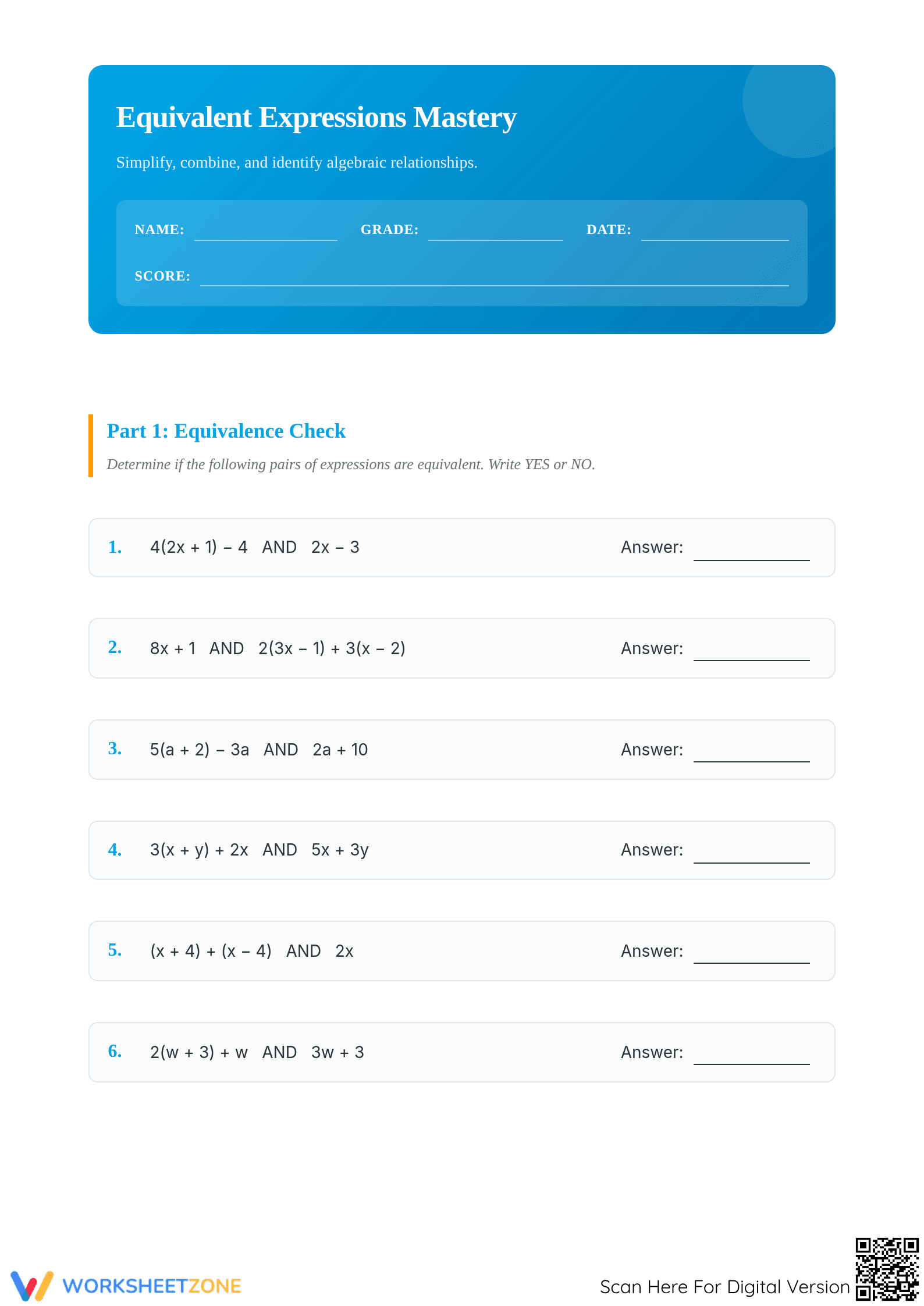
This Equivalent Expressions Mastery worksheet provides students with targeted practice in identifying, simplifying, and applying algebraic properties to confirm equivalence. Learners build the cognitive flexibility needed to recognize the same mathematical value in diverse forms, ensuring a solid foundation for more complex pre-algebra and algebra coursework.
At a Glance
- Grade: 6–7 · Subject: Math (Algebra)
- Standard:
CCSS.MATH.CONTENT.6.EE.A.4— Identify when two expressions are equivalent regardless of which value is substituted- Skill Focus: Algebraic Simplification · Distributive Property
- Format: 5 pages · 32 problems · Answer key included · PDF
- Best For: End-of-unit mastery and test preparation
- Time: 45–60 minutes
What's Inside
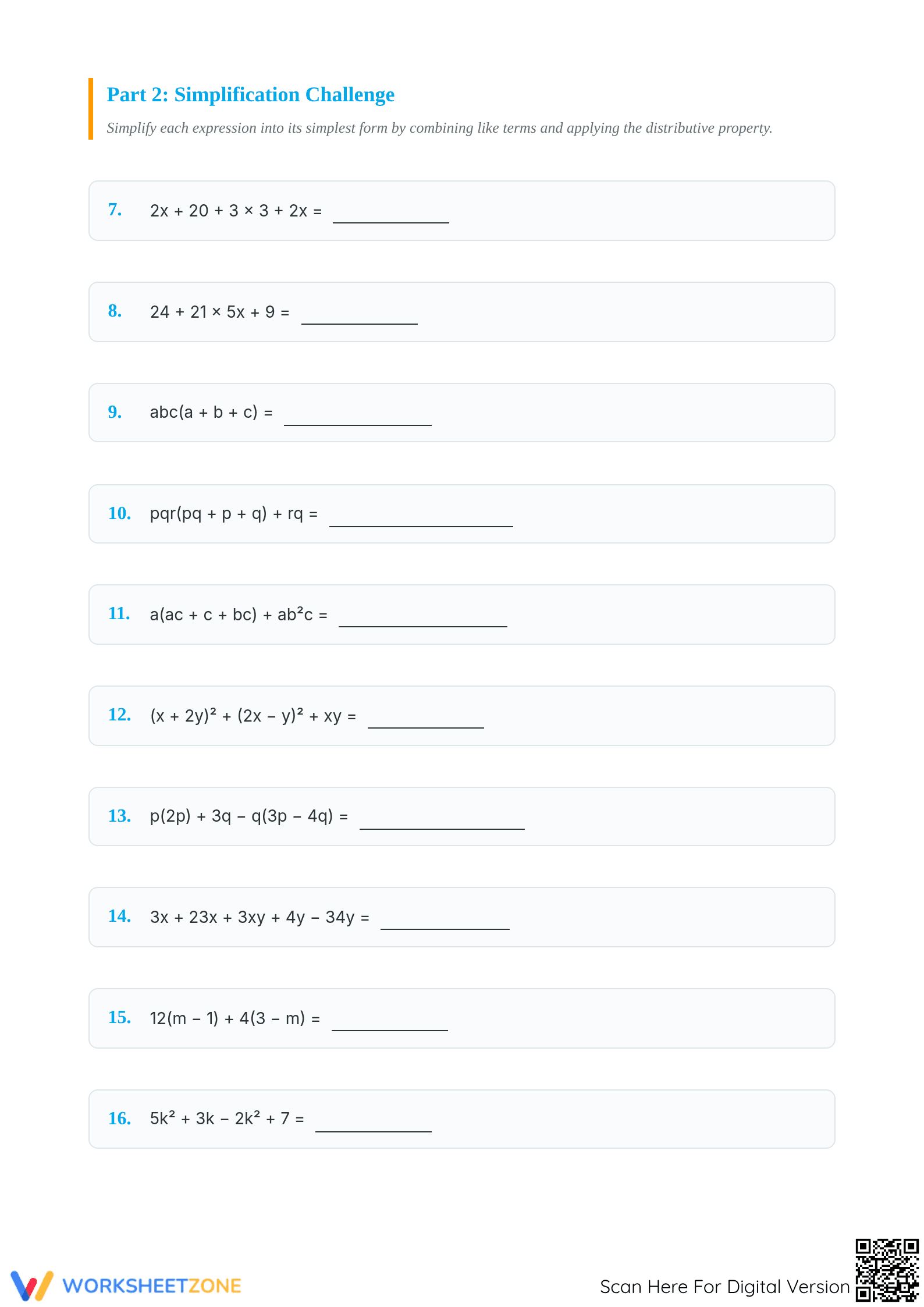
Learners encounter 32 tasks across five pages, including equivalence checks, simplification challenges, and matching exercises. The final sections focus on real-world application word problems and critical thinking via true-or-false justifications. A complete, step-by-step answer key is provided to facilitate rapid grading or student self-correction, minimizing administrative overhead while maximizing instructional time for teachers.
Skill Progression
- Guided Practice: 16 scaffolded problems in Parts 1 and 2 focus on basic equivalence verification and distributive property simplification.
- Supported Practice: 8 interactive matching and multiple-choice tasks in Parts 3 and 4 challenge students to recognize equivalent forms without direct computation.
- Independent Practice: 8 high-level application and justification problems require students to generate expressions from text or justify algebraic logic independently.
This gradual release model builds student confidence before transitioning into high-stakes application and complex algebraic reasoning.
Standards Alignment
The primary focus of this packet is `CCSS.MATH.CONTENT.6.EE.A.4`: "Identify when two expressions are equivalent (i.e., when the two expressions name the same number regardless of which value is substituted into them)." It also provides significant support for 7.EE.A.1, which involves expanding and factoring linear expressions. Both standard codes can be copied directly into lesson plans, IEP goals, or district curriculum mapping tools.
How to Use It
Use this resource as a summative assessment following a unit on algebraic properties. Distribute it as a mastery packet over two class periods to monitor progress during guided study. Alternatively, use specific sections as formative exit tickets to observe how students handle the transition from numeric expressions to those involving variables. Expected completion time ranges from 45 to 60 minutes.
Who It's For
This resource is designed for students in Grades 6 and 7 mastering algebra foundations. It serves as an effective differentiation tool for high-achieving 5th graders or as a scaffolded review for 8th-grade students requiring additional support with expression manipulation. Pair this worksheet with a visual anchor chart on the distributive property or a short instructional passage for maximum efficacy.
Algebraic fluency is a critical predictor of success in secondary mathematics. According to an EdReports 2024 analysis of middle school curriculum efficacy, materials that integrate multiple representations of expressions—such as the matching and application tasks found here—improve student retention of properties. This worksheet targets CCSS.MATH.CONTENT.6.EE.A.4 by requiring students to justify reasoning through true-or-false logic and word problem translation. Fisher & Frey (2014) emphasize that scaffolded practice is essential for moving students from procedural knowledge to conceptual mastery. By providing 32 unique opportunities to practice these skills, this resource ensures that learners can fluently identify equivalent expressions in any context, from simple variable combining to complex multi-step distributive property problems. This structured approach directly addresses the NAEP focus on algebraic reasoning by bridging the gap between basic arithmetic and formal algebra, preparing students for rigorous high school standards.


