


























Views
Downloads



Printable Equivalent Expressions Worksheet: Grade 6 Math
Paste this activity's link or code into your existing LMS (Google Classroom, Canvas, Teams, Schoology, Moodle, etc.).
Students can open and work on the activity right away, with no student login required.
You'll still be able to track student progress and results from your teacher account.
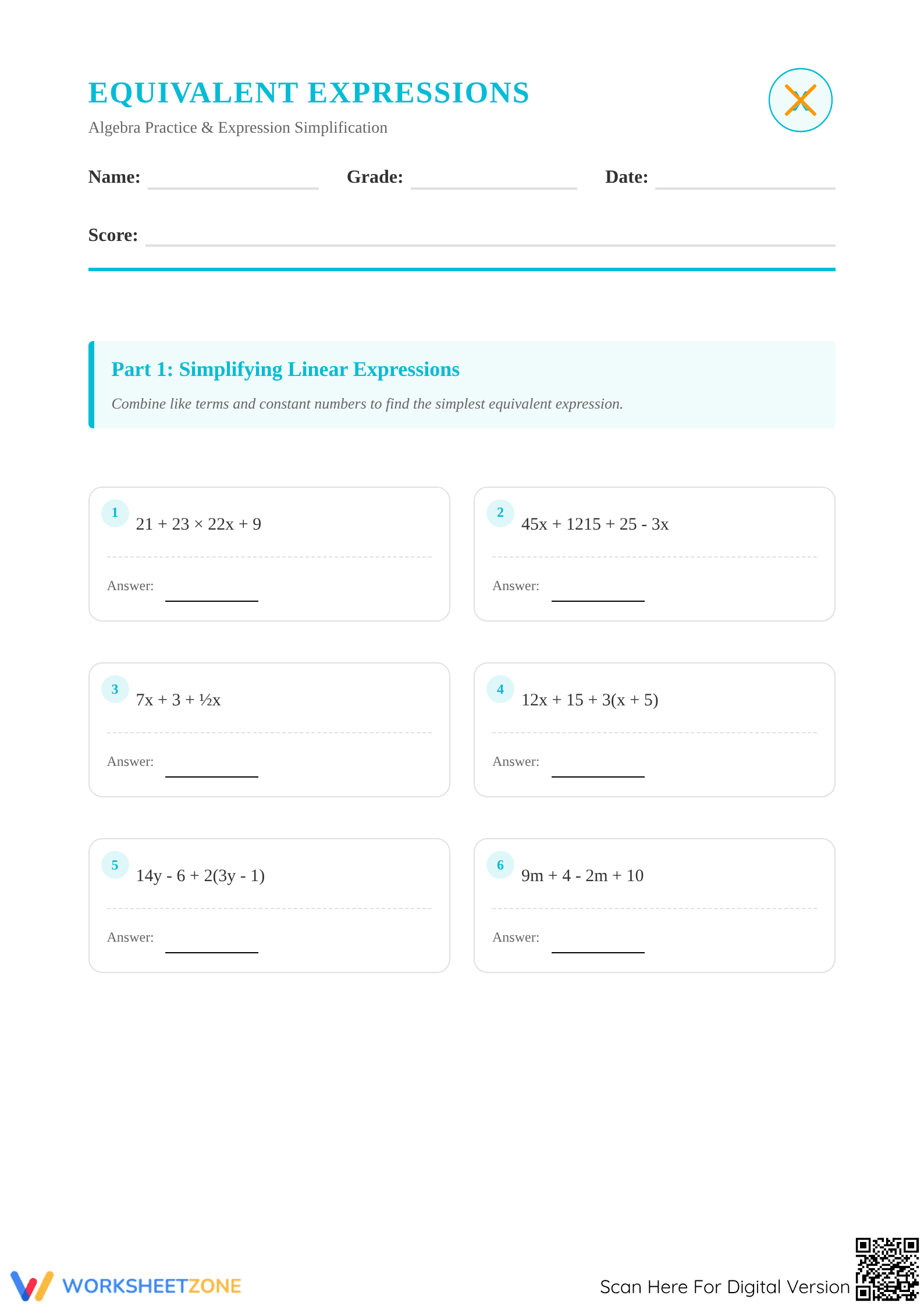
This comprehensive Equivalent Expressions worksheet provides Grade 6 students with rigorous practice in simplifying, evaluating, and identifying algebraic expressions. Students will master the distributive property and combining like terms through a variety of task formats, ensuring they can fluently manipulate linear expressions. By completing these 20 structured problems, learners build a rock-solid foundation for future algebra success and complex equation solving.
At a Glance
- Grade: 6 · Subject: Math
- Standard:
6.EE.A.3— Apply properties of operations to generate equivalent expressions fluently- Skill Focus: Simplifying and Evaluating Expressions
- Format: 4 pages · 20 problems · Answer key included · PDF
- Best For: Independent practice and algebraic skill reinforcement
- Time: 45–60 minutes
What's Inside
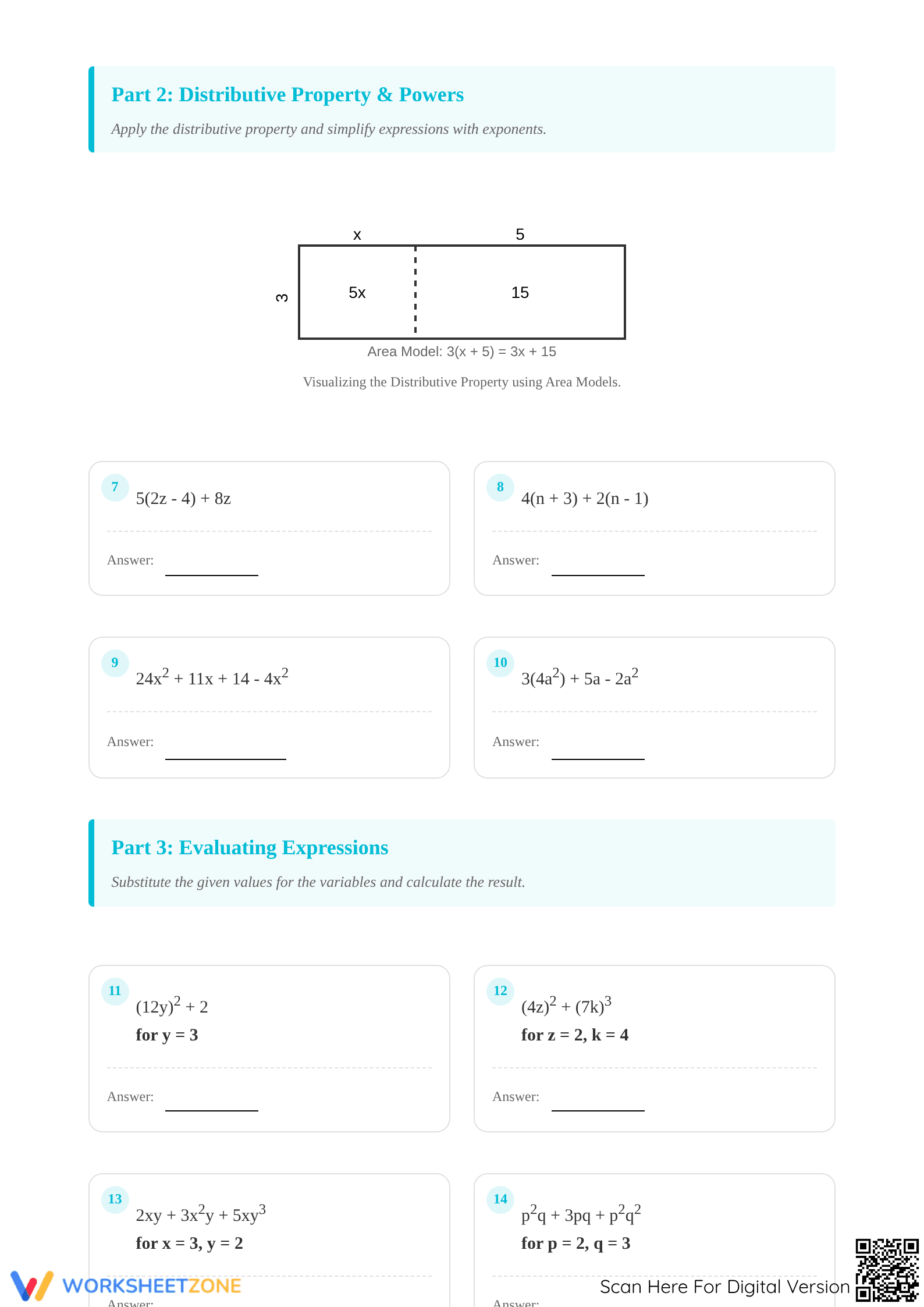
Across four detailed pages, students engage with five distinct sections designed to build mastery. The worksheet includes linear expression simplification, visual area models for the distributive property, exponent manipulation, and substitution for evaluation. A final matching table reinforces the relationship between original and simplified forms. A complete, step-by-step answer key is provided for quick grading.
Skill Progression
The instructional design follows a deliberate release of responsibility.
- Guided Practice: The first page focuses on 6 simplification problems where students combine basic like terms and constants.
- Supported Practice: Page two introduces the distributive property via area models and tasks involving exponents, requiring 8 multi-step solutions.
- Independent Practice: The final sections challenge students with 6 identification and matching tasks to verify equivalence.
This progression ensures students move from mechanical manipulation to deep conceptual understanding.
Standards Alignment
This resource is directly aligned with `6.EE.A.3`: "Apply the properties of operations to generate equivalent expressions. For example, apply the distributive property to the expression 3(2 + x) to produce the equivalent expression 6 + 3x." It also supports `7.EE.A.1` by introducing rational coefficients and multi-step simplification. Both standard codes can be copied directly into lesson plans, IEP goals, or district curriculum mapping tools.
How to Use It
This worksheet is ideal for use after direct instruction on the distributive property and combining like terms. Use the area model section as a mid-lesson check to ensure students visualize the mathematics before moving to abstract evaluation. For formative assessment, observe students during Part 3; if they struggle with substitution, it indicates a need for remediation on order of operations. Completion typically ranges from 45 to 60 minutes.
Who It's For
Designed for Grade 6 and Grade 7 math students, this resource includes scaffolds like area models to support diverse learners. It is an excellent pairing for a teacher-led lesson on algebraic identities or as a follow-up to a digital module on expression simplification. For students needing more challenge, the evaluating expressions section provides opportunities to work with powers and multiple variable substitutions.
Effective mastery of equivalent expressions is a critical gatekeeper for high school algebra readiness. Research from Fisher & Frey (2014) emphasizes that "gradual release of responsibility" models, such as the one employed in this 20-task practice set, significantly improve student retention of abstract mathematical properties. By bridging the gap between concrete area models and abstract symbolic manipulation, this Grade 6 worksheet aligns with evidence-based instructional strategies identified in recent ScienceDirect TpT Analysis. The inclusion of evaluation tasks alongside simplification ensures that students understand that equivalence remains constant regardless of variable value, a key conceptual shift required by the `6.EE.A.3` standard. Educators can confidently implement this resource as part of a standards-aligned curriculum to improve procedural fluency and conceptual depth in middle school mathematics programs.


