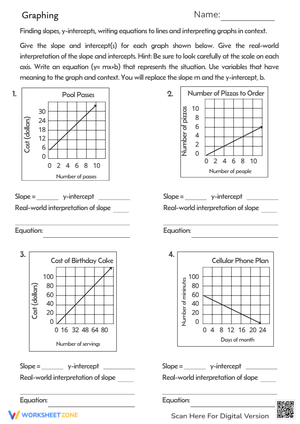
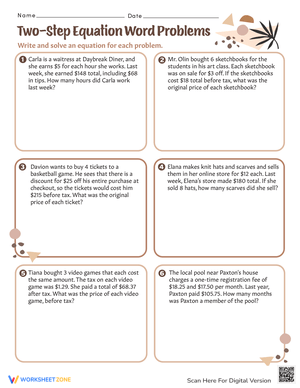
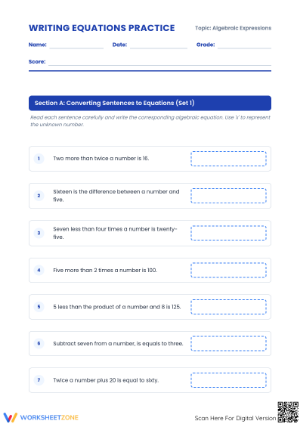
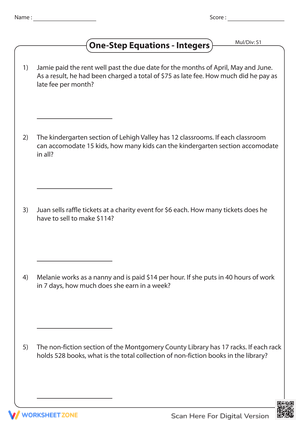
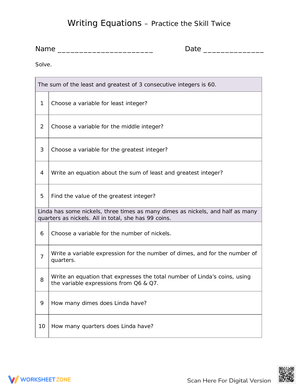
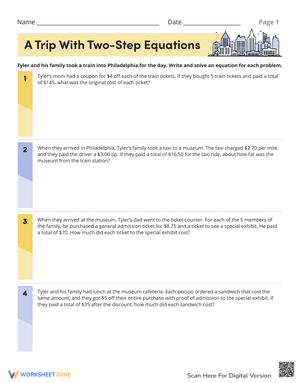
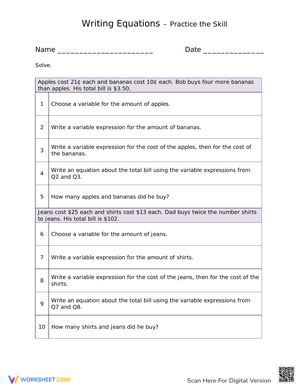
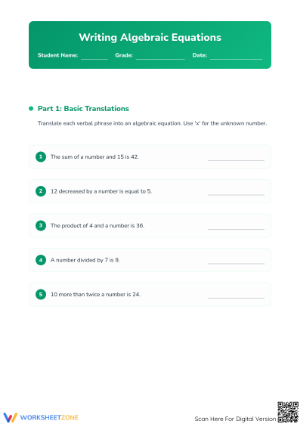
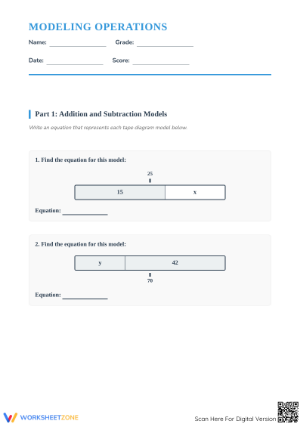
These writing equations printable worksheets for 7th grade target the moment algebra instruction gets genuinely difficult — when students stop just calculating and start representing, building an equation that captures how two quantities relate rather than simply finding a missing number. Most students need several rounds of focused practice before that translation process becomes reliable. The worksheets in this set give teachers the repetitions they need without requiring students to wade through solving before the structure is solid.
The Specific Skills Targeted
Each worksheet in the set addresses one or more of the following:
- Translating verbal phrases into one-variable equations — not just expressions
- Identifying equality language: is, the result is, has a total of
- Defining what the variable represents before writing the equation
- Distinguishing between an expression and an equation, which trips students up more reliably than almost any other concept in pre-algebra
- Writing equations from tables and input-output patterns
- Setting up one-step and two-step equations in real-world contexts
The mix of phrase-level and scenario-level tasks means students can't pattern-match on a single sentence type for an entire practice session. Money, age, distance, and number relationship contexts all appear — situations students can picture before they write, which gives them a built-in check on whether an equation makes sense before they solve it.
Translation Errors Teachers Should Anticipate and Address
Most equation-writing mistakes at this grade level are not arithmetic errors. They are translation errors — places where a student misread the language, skipped a structural requirement, or failed to notice a word carrying mathematical meaning.
The most consistent error is writing an expression when the task calls for an equation. A student reading "three more than a number is eleven" writes 3 + n and stops, apparently satisfied. The word "is" carried no weight for them. Pointing to that specific moment in class discussion — asking what "is" means in that sentence — does more work than re-explaining the expression-versus-equation distinction in the abstract.
Reversed subtraction phrasing trips up a reliable portion of students: "five less than a number" produces 5 - n on first attempt from students who hear "five" first and write it first. A quick annotation step — underline "less than," then identify what it's less than — catches this before it becomes a habit. Two more patterns worth watching: students who define a variable at the start and then silently reassign it mid-problem, and students who skip writing the equation entirely and just compute. The second group often gets correct answers, which means the misconception goes undetected unless the written equation is required as its own separate step.
Where These Worksheets Fit in a Well-Planned Unit
Short, repeatable practice spread across several days works better than one long session. Four or five minutes of equation-writing at the start of class three or four days in a row builds retention more effectively than a single 20-minute block — particularly in the first week of the unit, when students are still sorting out the difference between an expression and an equation.
Bell ringers work especially well here. Present two or three verbal phrases, give students three minutes to write the equations, then project and discuss the item that caused the most disagreement. That conversation — why n - 5 fits "five less than a number" and 5 - n doesn't — is often the most instructive three minutes of the period. For partner work, have one student read the phrase aloud while the other writes; then they swap and compare. Reading aloud surfaces interpretation issues that silent reading hides. For intervention, assign one worksheet focused on one-step contexts with obvious equality language, and hold off on two-step situations until basic translation is secure.
One practical move that consistently improves accuracy: before writing the equation, students annotate the sentence first — box the unknown, underline the operation phrase, circle the equality signal. That step slows students down in the right way and makes their translation process visible enough that a teacher can spot exactly where the thinking went sideways.
Standard Alignment
These resources align to CCSS 7.EE.B.4, which asks students to use variables to represent quantities in real-world and mathematical problems and construct simple equations to solve them. Writing equations printable worksheets for 7th grade instruction fits naturally at the opening of the expressions and equations unit — before efficient solving becomes the focus — because students who cannot yet write the equation have no foundation for solving it. Getting translation right in early fall pays off when multi-step word problems arrive later in the year and students need both skills at once.
Tiering Practice for Different Readiness Levels
Students still shaky on operation vocabulary benefit from worksheets that use short sentences, one consistent variable per problem, and obvious equality signals. A word bank with terms like sum, difference, twice, and total lowers the decoding load without removing the core thinking. For these students, the task is writing the equation only — solving comes after translation is stable.
On-level students should work with mixed formats: verbal phrases, real-world mini-scenarios, and tables in the same practice session. That variety builds transfer, which is the actual instructional target. For students who move quickly, include problems that ask them to decide first whether the situation calls for an expression or an equation before writing anything, or have them write two versions of the same equation using different variable names and confirm both are equivalent. That task separates students who understand the underlying structure from those who have memorized the steps.
The same worksheet often serves multiple readiness levels by layering the task: some students write the equation only, others write and solve, others write, solve, and explain why the result makes sense given the original problem. That approach keeps the whole class working on the same resource while preserving appropriate challenge at each level — and requires no separate prep.
Frequently Asked Questions
Should students solve the equations on these worksheets, or just write them?
That depends on the lesson target. When the goal is translation, stop at the equation — writing it is the complete task. When you want to connect representation and solution, add a solving step, but require the written equation as its own line first. Students who can only compute without first writing the equation have not yet built the skill this standard requires.
What's the most useful way to review the answer keys with students?
Show a correct equation and a common wrong version side by side and ask students what the wrong one says mathematically. A student who wrote 5 - n when the correct answer is n - 5 wrote an equation for a different problem — not a random error. Making that precise distinction explicit takes less time than re-explaining subtraction direction in general terms, and it sticks better.
Are these appropriate for students with no previous variable experience?
Writing equations printable worksheets for 7th grade are built around the 7.EE standards, which assume some prior exposure to variable notation and order of operations. Students who have never worked with variables will need direct instruction before independent practice is productive — these resources work best as practice after that initial teaching has already happened.
How much real-world context should a word problem include at this stage?
At the phrase-translation stage, minimal context works best — one sentence, one unknown, one operation. Adding a sentence of real-world framing helps students connect the variable to something meaningful, but problems embedded in a full narrative paragraph tend to overload students who are still learning to separate the mathematical relationship from the surrounding story. Save the longer scenarios for once basic translation is solid.
How many worksheets from this set make sense to assign across a unit?
Three distributed across the unit works better than massing them in a single week. One early worksheet after the initial translation lesson, one mid-unit to catch students who seemed to understand but are slipping on two-step contexts, and one before the assessment for review and self-check. Spacing the writing equations printable worksheets for 7th grade practice this way draws on retrieval over time rather than asking students to absorb everything in one concentrated sitting.













 Interactive Worksheet Maker
 Quiz Maker
 Word Search Maker
 Crossword Puzzle Maker
 Word Scramble Generator
 Sentence Scramble Generator
 Handwriting Worksheet Generator
 Name Tracing Generator
 Fill In The Blank Generator