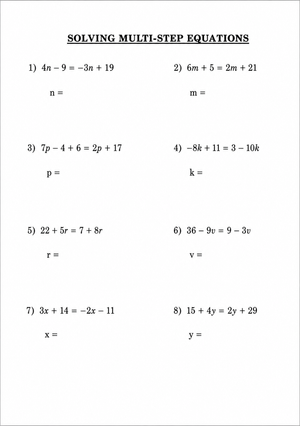
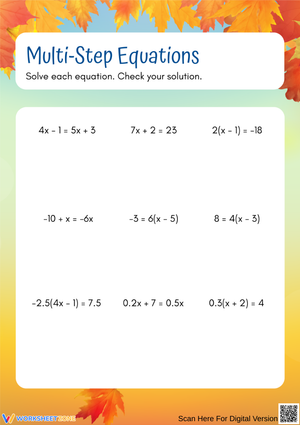
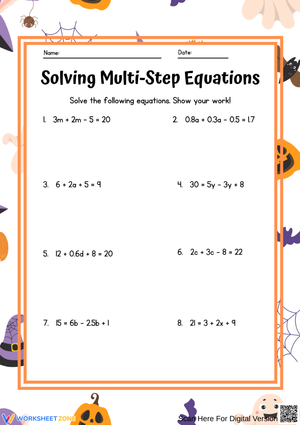
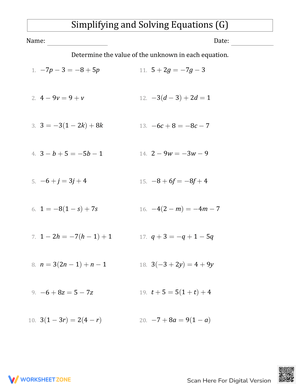
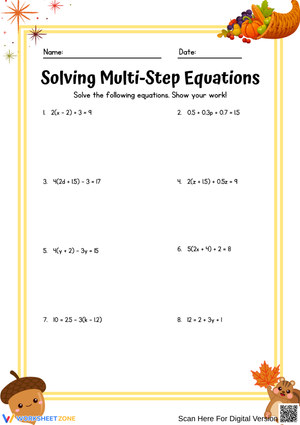
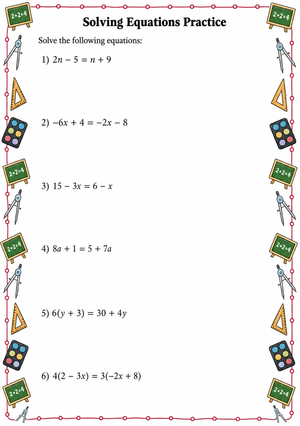
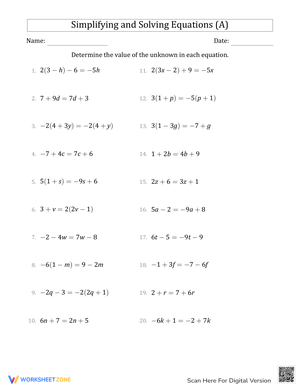
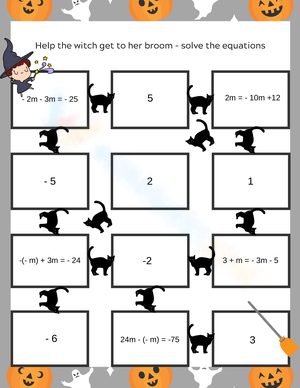
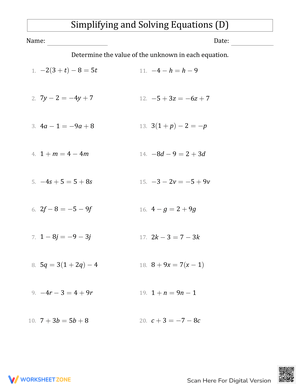
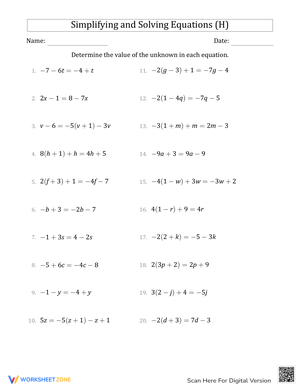
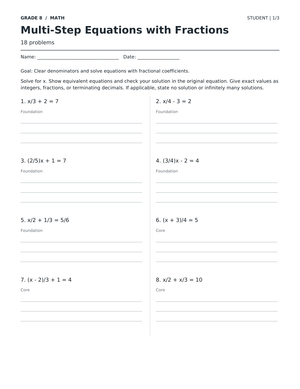
These multi step equations printable worksheets for 7th grade give teachers ready-to-use practice covering the full arc of 7th grade algebra — two-step review, combining like terms, the distributive property, rational-number coefficients, and equations with variables on both sides. Each worksheet targets a specific decision point students need to master before the next layer of complexity arrives.
What's Inside the Set
The progression matters more than the variety. Students who jump straight to variables on both sides without consolidating inverse operations tend to memorize steps rather than track logic. The worksheets move through five skill stages, and each stage has a clear purpose:
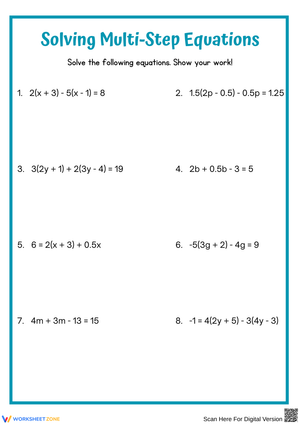
- Two-step equations with integers: equations like 2x + 5 = 17 rebuild fluency with inverse operations before the problems grow more complex.
- Combining like terms on one side: students simplify expressions like 3x + 2x - 4 = 21 before solving, reinforcing that simplification is part of solving, not a warmup before it.
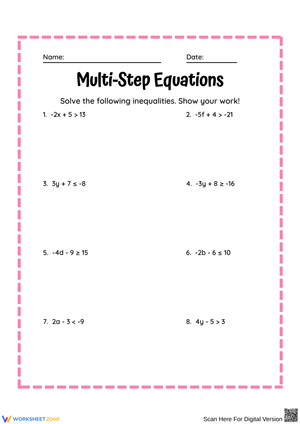
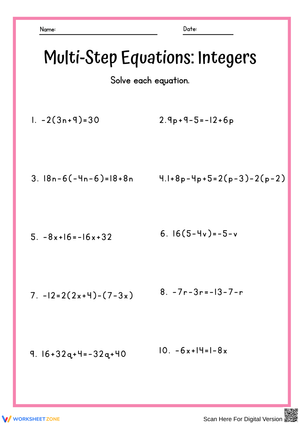
- Distributive property: equations such as 3(x + 4) = 24 and -2(x - 5) = 6 appear with enough vertical space for students to write every transformation step.
- Variables on both sides: students practice moving variable terms and constants strategically, with room on each worksheet to show the full sequence of moves.
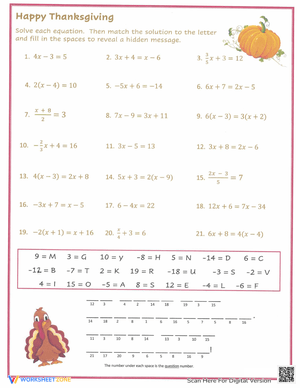
- Rational-number coefficients: fraction and decimal equations appear after students have shown confidence with integer-based forms — not before.
Several worksheets also include error-analysis items where students read a worked solution with a planted mistake and explain what went wrong. That format surfaces understanding that procedural practice alone often misses.
Mistakes Students Make That These Worksheets Help You Catch
The most persistent error at this level involves the distributive property with a negative coefficient. When students see -2(x - 5), a reliable portion of the class writes -2x - 10 rather than -2x + 10. They distribute correctly to the first term, then drop or flip the sign on the second. This is not a careless slip — it reflects a genuine misunderstanding of how a negative factor interacts with a subtraction inside parentheses. Worksheets that include enough problems of this exact type, spread across the set rather than clustered in one place, give teachers the repetition data needed to determine whether a student has actually corrected the thinking or just got lucky once.
A second error that appears consistently: students combine unlike terms. They see 3x + 4 = 19 and interpret the left side as 7x. That confusion shows they are pattern-matching on the presence of a coefficient rather than reading the terms structurally. A worksheet focused specifically on "simplify first, then solve" — where some expressions can be simplified and others cannot — makes this distinction visible fast.
A third pattern worth watching is stopping after simplification. A student reaches a fully simplified equation like 5x = 20 and writes that as the final answer, treating simplification as the endpoint rather than a step toward the solution. These worksheets include enough two-stage problems that this stopping behavior becomes apparent in student work before it becomes a test-day problem.
Standard Alignment
CCSS 7.EE.B.4 asks students to use variables to set up and solve equations, specifically those of the form px + q = r and p(x + q) = r. The multi step equations printable worksheets for 7th grade in this set extend that base standard into combining like terms, rational coefficients, and variables on both sides — the classroom extensions teachers need once students clear the 7.EE.B.4 baseline. In most pacing guides, this work lands in the second or third quarter, after students have worked with rational number operations and expression simplification earlier in the year.
How to Build These Worksheets Into Your Lesson Plans
In a 50-minute period, each worksheet works best when it serves one clear instructional role. During a mini-lesson on distribution, project two worked examples, then hand out a worksheet focused entirely on distributing before solving — 8 to 10 problems, no fractions yet, enough white space to write each step vertically. That focused use teaches better than a mixed worksheet that introduces three complications at once.
For bell ringers, pull three equations from the previous day's worksheet and put them on the board. Students who solved 4(x + 3) = 28 during Tuesday's lesson and encounter a structurally similar equation Wednesday morning begin to recognize the pattern automatically rather than approaching it fresh each time. Spaced retrieval — returning to the same skill type across multiple short sessions — builds fluency more reliably than a single long practice block, and a well-organized worksheet set makes that rotation easy to plan.
- Guided practice: work through the first four to six problems of a worksheet together, pausing to annotate each step before students continue independently.
- Self-check station: place the answer key version at a math center so students can verify their work without waiting for teacher feedback.
- Exit ticket: pull two problems from the day's worksheet — one procedural, one requiring students to substitute their answer back into the original equation to verify it.
- Reteach: for a student stuck at distribution, use a worksheet focused only on that skill type rather than a mixed review that layers on variables on both sides at the same time.
The multi step equations printable worksheets for 7th grade in this set include answer keys showing solution steps — not just final answers — which makes every format above manageable without additional prep.
Adjusting the Worksheets for a Range of Learners
For students still shaky on integer operations, start with worksheets that use small whole numbers throughout — equations like 3(x + 2) = 15 rather than -4(x - 7) = 20. The algebraic structure is identical; the arithmetic demands are lower, which gives students room to track the equation logic without getting derailed by computation. Once they solve five or six of those correctly, move them toward coefficients that require more careful integer work.
Students who finish quickly get more value from error-analysis items than from additional procedural equations. Asking a student to write a word problem that matches the equation 2(x + 5) = 30 is more demanding than handing them another equation to grind through — it asks them to think about what the equation represents, not just how to manipulate it.
Students who freeze at fractions in an equation often need one additional step before the worksheet problem, not a different worksheet. Multiplying both sides to clear the denominator turns a rational-coefficient equation into an integer problem they already know how to handle. A brief oral prompt or a margin note pointing to that first step removes the barrier without simplifying the underlying task.
Frequently Asked Questions
Do these worksheets include word problems, or only procedural equations?
Both. Most worksheets in the set focus on procedural practice, but several include word problems and error-analysis items. Word problems are placed later in each worksheet's sequence, after students have worked through the underlying equation structure in straightforward form.
How many problems does each worksheet include?
Most include 10 to 15 problems — enough repetition for meaningful practice in a single class period without running long. Shorter worksheets with 6 to 8 problems are included specifically for bell ringers, exit tickets, and reteach sessions where a narrower focus is the point.
Are answer keys included?
Yes. Each worksheet comes with a complete answer key showing solution steps, not just final answers. That makes the resources usable for student self-check, partner review, substitute coverage, and quick conferencing during independent work time.
Can these worksheets work in a math intervention class?
The multi step equations printable worksheets for 7th grade at the earlier skill levels — two-step equations and combining like terms — fit well in intervention settings. Intervention students benefit most when each worksheet focuses on one skill type rather than a mixed review, and the set is structured exactly that way.













 Interactive Worksheet Maker
 Quiz Maker
 Word Search Maker
 Crossword Puzzle Maker
 Word Scramble Generator
 Sentence Scramble Generator
 Handwriting Worksheet Generator
 Name Tracing Generator
 Fill In The Blank Generator