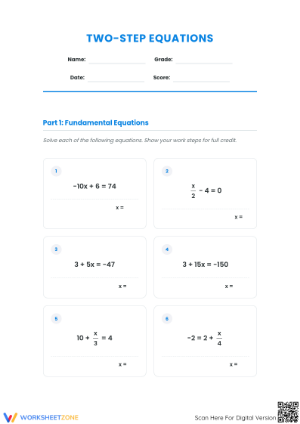
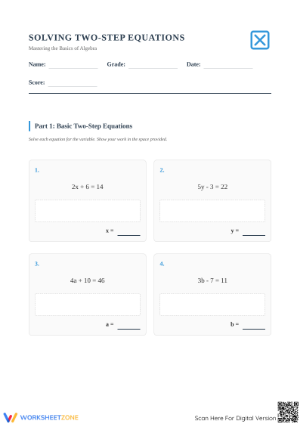
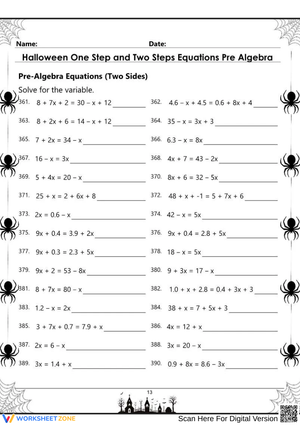
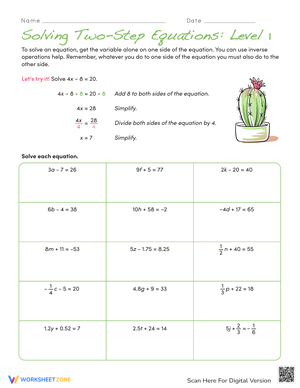
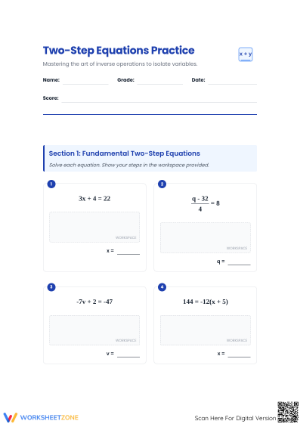
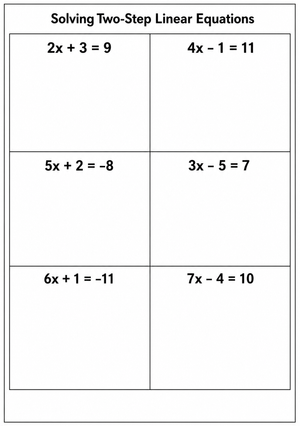
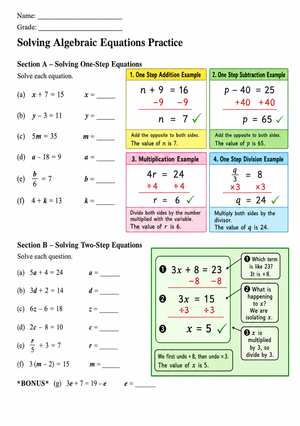
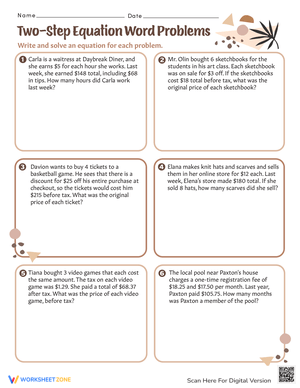
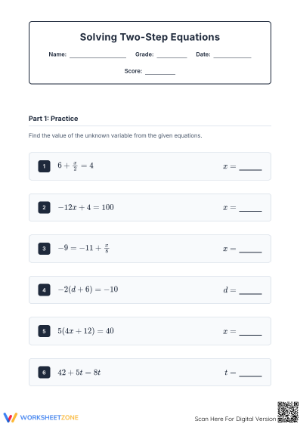
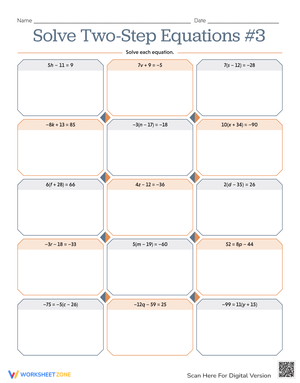
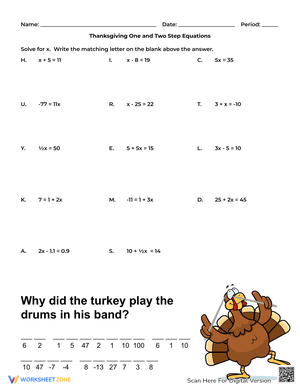
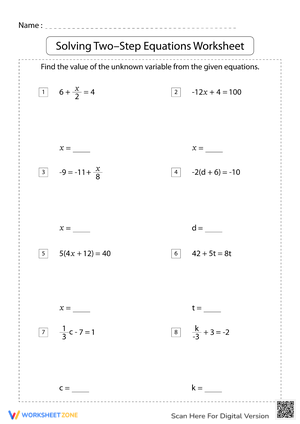
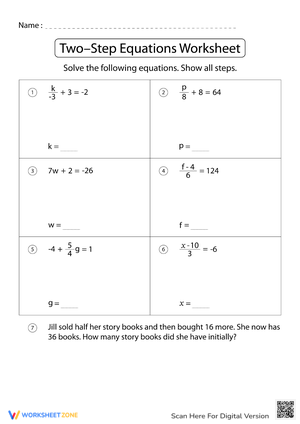
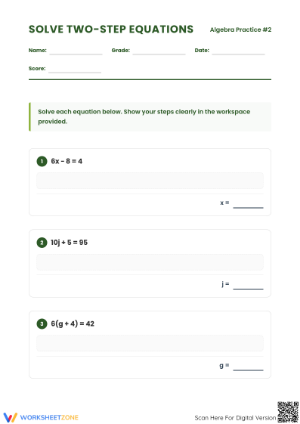
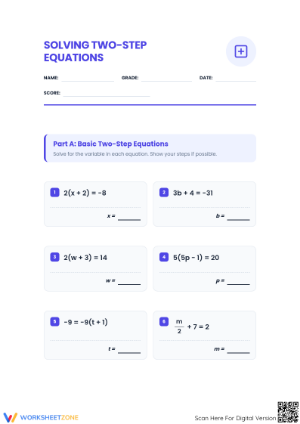
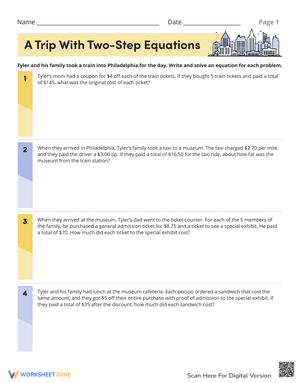
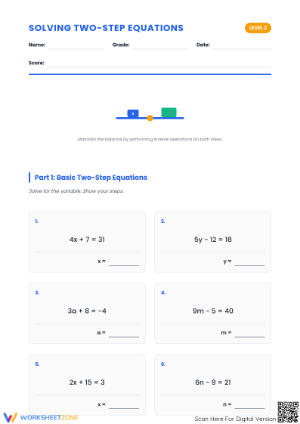
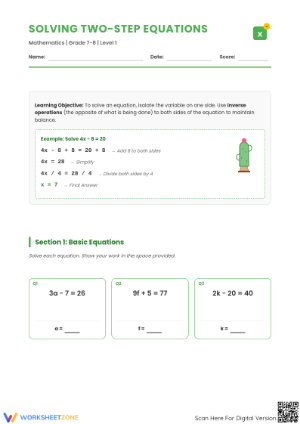
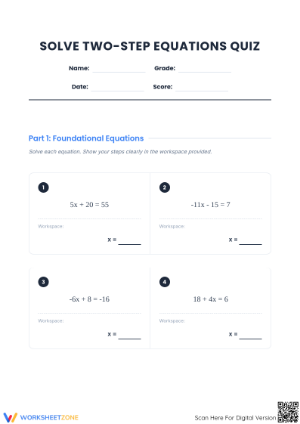
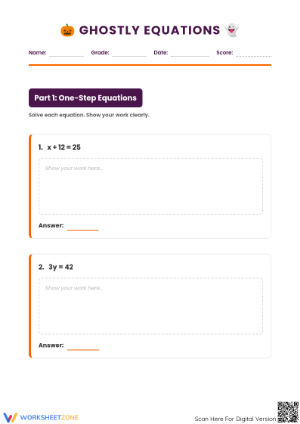
7th grade two step equations printable worksheets give teachers a repeatable structure for one of algebra's most important bridge skills — solving equations that require two inverse operations applied in the correct sequence. Each worksheet in this set puts that skill directly in front of students without extra setup, so the resources drop naturally into warm-ups, guided practice blocks, and small-group intervention sessions.
The Specific Skills Each Worksheet Targets
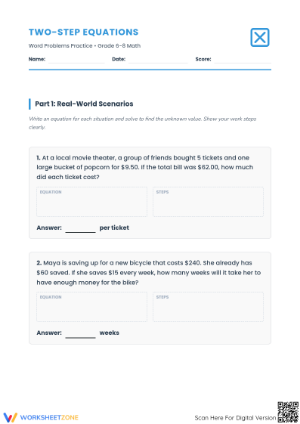
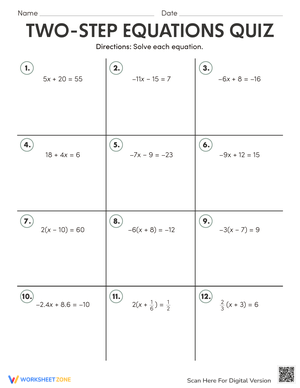
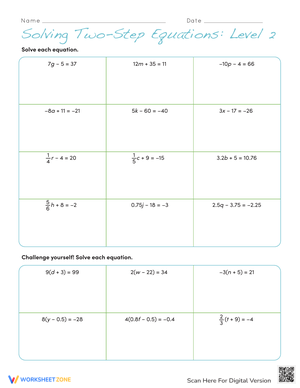
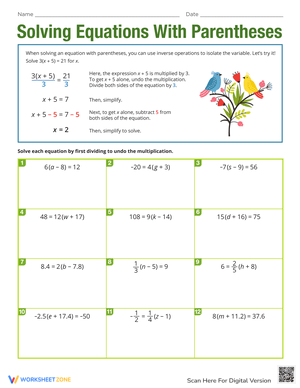
Each worksheet moves students through a deliberate progression of equation types. The simplest problems use positive integers and familiar operations — students solve something like 3x + 7 = 22 before working toward equations with negative coefficients, fractional values, or division in the first step. Word problems appear later in the sequence, requiring students to write the equation before solving rather than starting from a symbolic form.
- Integer equations with both addition/subtraction and multiplication/division steps
- Equations with negative coefficients that force careful sign tracking across both operations
- Fraction and decimal problems for students ready to apply the same structure to rational numbers
- Word problems where students build the equation from a described situation before solving
- Mixed practice sets that interrupt predictable patterns and require students to read each equation before choosing a method
Answer keys accompany each worksheet. When students are working in math centers or checking homework independently, immediate verification of a wrong answer prevents a flawed procedure from calcifying before the teacher can intervene.
Student Error Patterns Worth Watching For and Correcting
Two-step equations produce specific, predictable mistakes — and tracking them is where 7th grade two step equations printable worksheets become especially useful as a formative tool. The most common error is operation-order reversal: students subtract or add before dividing, which produces a correct-looking layout but a wrong answer. A student solving x/4 + 3 = 11 might subtract 3 correctly to get x/4 = 8 and then add 4 instead of multiplying — a sign that the student recognizes the steps exist but hasn't internalized why multiplication undoes division.
Sign errors in the second step are the other consistent trouble spot. A student who handles 2x + 5 = 17 without difficulty will often look at -3x + 6 = -9 and subtract 6 from the right side only, then divide before adjusting the sign on the result. These aren't random slips — they reveal a gap in understanding what balanced equations require. Asking students to annotate one or two problems per worksheet, writing a short phrase that names each inverse operation before executing it, surfaces those gaps quickly and tells teachers whether a student is following a procedure or understanding the structure behind it.
Fitting These Worksheets Into Weekly Lesson Plans
The most productive use of this set comes from rotating formats across the week rather than assigning the same type of practice every day. A 5-problem bell ringer on Monday reopens prior learning after the weekend. By Wednesday, students are ready for a full independent session. Friday holds a 3-item exit check — two problems pulled from an earlier worksheet and one new one — to see whether retention is holding before the next unit moves forward.
Small-group instruction benefits from one specific technique: print a worksheet, then cut two or three problems into strips. During a 10-minute pull-aside, hand a student only the problems that match the exact error pattern you observed — operation-order reversal or sign errors on negative coefficients. That precision keeps intervention short and targeted while using the same core resource. The 7th grade two step equations printable worksheets in this set work for that approach because the problem types are consistent enough to sort by skill need without rebuilding materials from scratch.
Tailoring the Set for Students at Different Readiness Levels
A Grade 7 class rarely has uniform readiness. Some students are still shaky on integer operations; others solved two-step equations in 6th grade and need rational-number problems or contextual challenges to stay engaged. This set addresses that range without requiring separate lesson plans for each group.
- Students needing extra support: Begin with integer-only worksheets where both operations use whole numbers and coefficients stay positive. Reduce the item count if volume creates anxiety before fluency builds.
- On-level students: Move through the integer set and into mixed worksheets that include negative coefficients and some fraction problems.
- Students ready for extension: Assign the word-problem worksheet first and ask them to write a second equation from the same scenario — a different starting value or a reversed unknown.
- Students with language needs: Pre-teach three terms before each worksheet: coefficient, inverse operation, and isolate. Keep those terms visible during work time.
One practical classroom move: have on-level and extension students complete the same worksheet through problem 10, then split — some students continue the worksheet while others shift to a word-problem set. The learning target stays the same; the complexity adjusts.
Standard Alignment
These worksheets align to CCSS 7.EE.B.4a, which asks students to solve word problems leading to equations of the form px + q = r and p(x + q) = r, where p, q, and r are specific rational numbers. In classroom terms, that standard sits in most Grade 7 sequences during the expressions and equations unit — the first time students are expected to move fluidly between symbolic and contextual equation work. The worksheets address both dimensions of that standard: procedural fluency with symbolic equations and the application work required by its word-problem component.
Frequently Asked Questions
Do these worksheets include answer keys?
Yes. Each worksheet includes a full answer key. For independent stations and homework review, the keys let students verify work immediately or let teachers quickly identify whether an error is procedural or computational during next-day discussion — rather than spending class time going problem by problem.
What number types appear across the set?
The set includes worksheets focused on positive integers, negative integers, fractions, and decimals. Word problems draw from all number types. The progression moves from accessible integer problems toward rational-number equations, so teachers can assign by readiness rather than by calendar date.
How many problems does each worksheet contain?
Most worksheets in the set contain 12 to 20 problems, with enough white space for students to show full work between steps. That range fits a standard 15 to 20 minute practice block. For shorter sessions, teachers can assign a portion of any worksheet rather than the full set.
Can these be used for intervention students?
The 7th grade two step equations printable worksheets in this set work well for intervention because the problem types are consistent and easy to sort by skill need. Teachers can assign specific worksheets based on a student's observed error pattern — integer operations, sign handling, or equation setup — without rebuilding practice from scratch. Pairing a targeted worksheet with a brief modeling session makes the most efficient use of limited intervention time.













 Interactive Worksheet Maker
 Quiz Maker
 Word Search Maker
 Crossword Puzzle Maker
 Word Scramble Generator
 Sentence Scramble Generator
 Handwriting Worksheet Generator
 Name Tracing Generator
 Fill In The Blank Generator