




























Views
Downloads


Writing Equations Worksheet | Grade 6-7 Essential

Paste this activity's link or code into your existing LMS (Google Classroom, Canvas, Teams, Schoology, Moodle, etc.).
Students can open and work on the activity right away, with no student login required.
You'll still be able to track student progress and results from your teacher account.
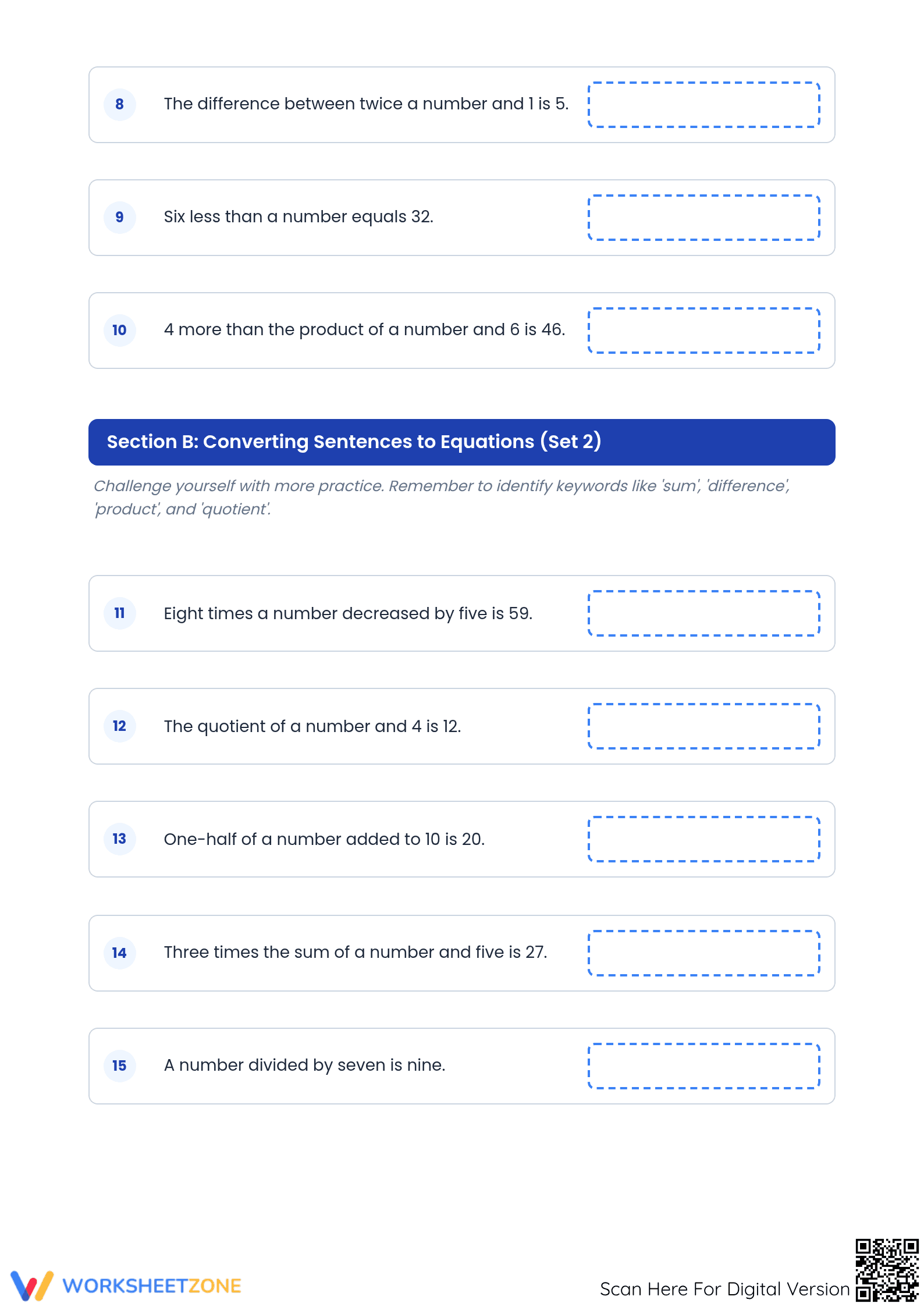
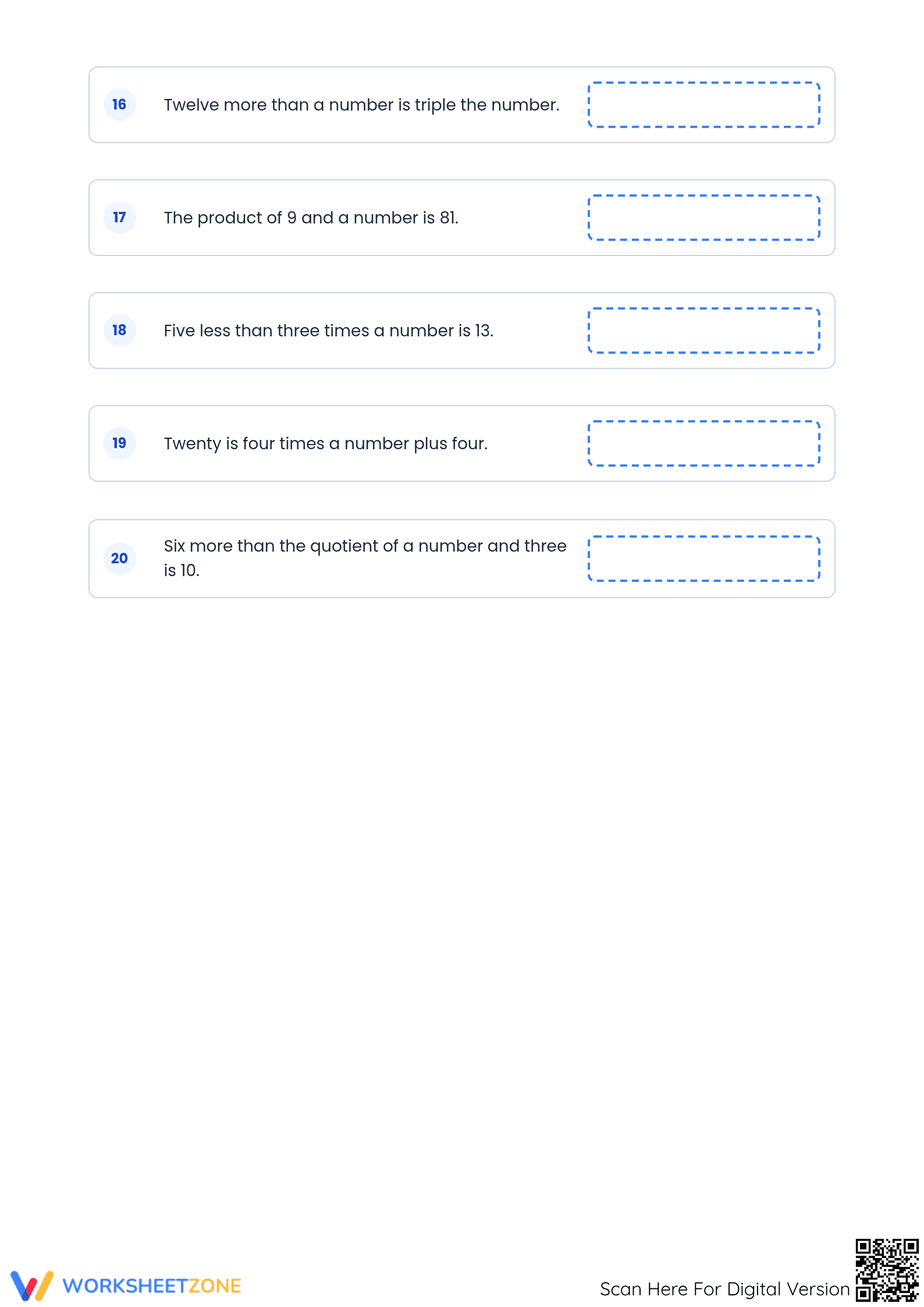
This Grade 6 and 7 math worksheet helps students translate complex verbal sentences into precise algebraic equations. By practicing the conversion of phrases like "more than" and "product of," learners develop the foundational skills necessary for solving multi-step equations and modeling real-world scenarios. It provides a structured path toward algebraic fluency.
At a Glance
- Grade: 6-7 · Subject: Math
- Standard:
CCSS.MATH.CONTENT.6.EE.B.6— Use variables to represent numbers and write expressions for mathematical problems- Skill Focus: Translating verbal phrases to equations
- Format: 3 pages · 20 problems · Answer key included · PDF
- Best For: Independent practice and skill reinforcement
- Time: 25–35 minutes
What's Inside: This comprehensive 3-page PDF contains 20 unique problems divided into two distinct sections. Section A focuses on fundamental sentence-to-equation conversion, while Section B introduces more complex vocabulary like "quotient" and "triple." A complete answer key is provided to facilitate quick grading or student self-correction.
Zero-Prep Workflow
- Print: Select the three-page document and print enough copies for your class (30 seconds).
- Distribute: Hand out the worksheets as a quiet warm-up or independent practice session (1 minute).
- Review: Use the included answer key to review results or allow students to peer-grade their work (5 minutes).
Standards Alignment: The primary focus is `CCSS.MATH.CONTENT.6.EE.B.6`, which requires students to use variables to represent numbers and write expressions when solving mathematical problems. It also supports 7.EE.B.4 by building the prerequisite skill of equation construction. Both standard codes can be copied directly into lesson plans, IEP goals, or district curriculum mapping tools.
p>How to Use It: Use this worksheet during the "You Do" phase of a gradual release lesson on algebraic expressions. It serves as an excellent formative assessment to identify students struggling with specific mathematical keywords. Alternatively, assign it as a homework packet to reinforce the connection between language and algebra. Expect students to complete the full set in approximately 30 minutes.Who It's For: This resource is tailored for Grade 6 and 7 students beginning their algebra journey. It is particularly effective for English Language Learners (ELLs) who need targeted practice with mathematical vocabulary. Pair this worksheet with a keyword anchor chart that defines terms like "sum," "difference," and "is" to provide additional support for struggling learners.
According to the RAND AIRS 2024 report on middle school mathematics, the ability to translate between natural language and symbolic algebra is a critical predictor of success in high school STEM courses. This worksheet addresses that need by providing 20 targeted opportunities for students to practice this specific cognitive shift. Research from Fisher & Frey (2014) emphasizes that structured practice with mathematical vocabulary helps bridge the gap between conceptual understanding and procedural fluency. By isolating the "writing" phase of equation solving, this resource allows students to focus on the linguistic nuances of algebra without the added cognitive load of calculation. This approach aligns with evidence-based instructional strategies that favor the decomposition of complex tasks into manageable sub-skills. Educators can use the results from these 20 tasks to pinpoint exactly where students encounter linguistic barriers, such as confusing "less than" with "subtracted from," ensuring more effective intervention.


