




























Views
Downloads



Printable Modeling Operations Worksheet | Grade 6 Aligned

Paste this activity's link or code into your existing LMS (Google Classroom, Canvas, Teams, Schoology, Moodle, etc.).
Students can open and work on the activity right away, with no student login required.
You'll still be able to track student progress and results from your teacher account.
This comprehensive Grade 6 math resource provides structured practice for students learning to translate visual models into mathematical equations. By working through tape diagrams, number lines, and real-world word problems, students build a deep conceptual understanding of how variables represent unknown quantities in addition, subtraction, multiplication, and division scenarios. This worksheet ensures students move beyond rote calculation toward algebraic reasoning and lays a strong foundation for future mathematical concepts.
At a Glance
- Grade: 6 · Subject: Math
- Standard:
CCSS.MATH.CONTENT.6.EE.B.7— Solve real-world math problems by writing and solving algebraic equations- Skill Focus: Translating tape diagrams and number lines into equations
- Format: 4 pages · 11 problems · Answer key included · PDF
- Best For: Independent practice or small group instruction
- Time: 30–45 minutes
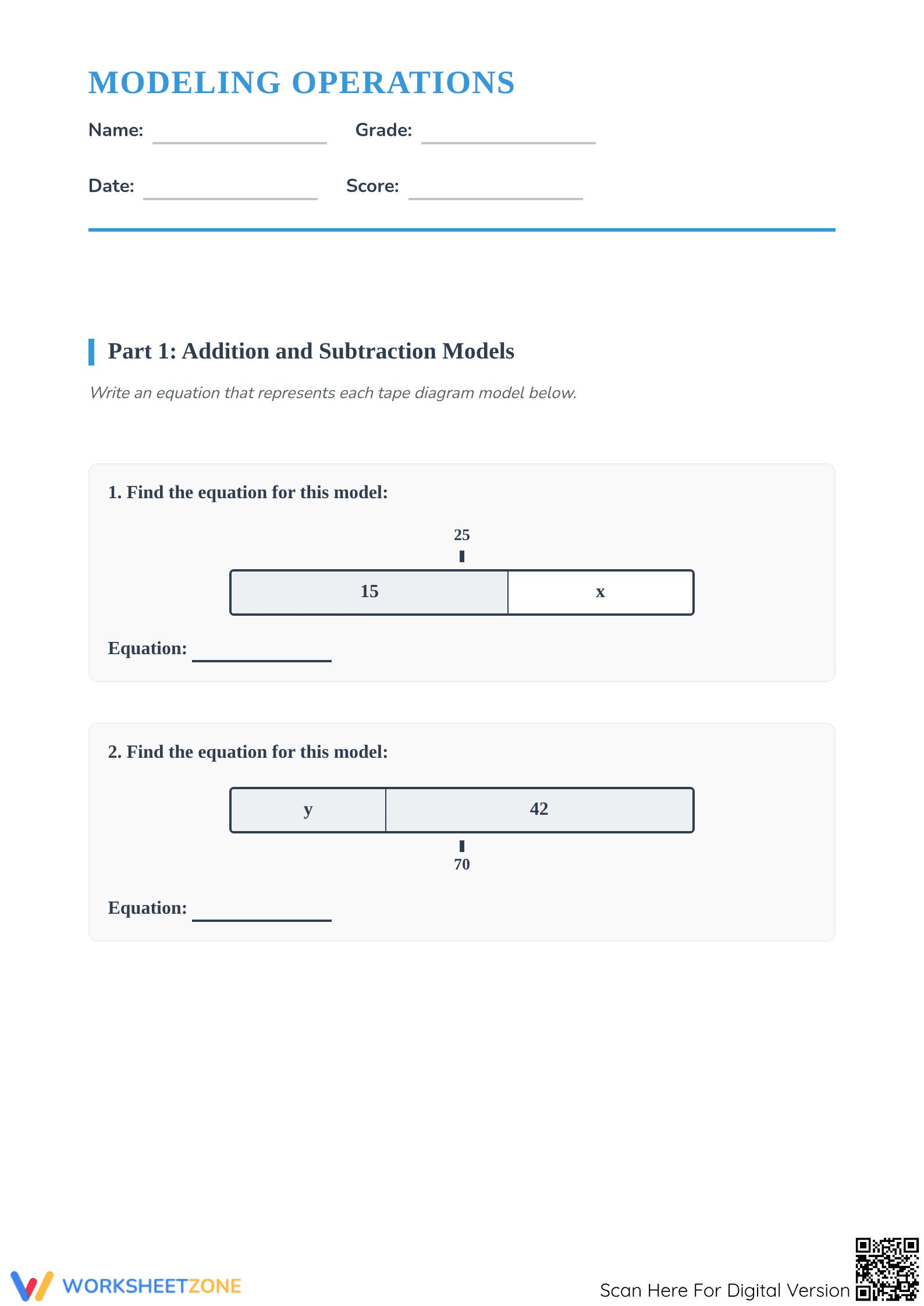
What's Inside: This four-page PDF includes four distinct sections designed to scaffold student learning. The first two pages focus on Part 1 (Addition and Subtraction Models) and Part 2 (Multiplication and Division Models), both utilizing tape diagrams to visually represent equations. Page three introduces Part 3 (Number Line Operations), where students will interpret and solve problems using number lines. The final page challenges students with Part 4 (Word Problems and Modeling), which includes a bonus creative writing task to extend their understanding. A full answer key is provided for efficient grading and quick teacher reference.
The Zero-Prep Workflow: This resource is designed for immediate classroom implementation, minimizing teacher preparation time to less than 2 minutes. The process is simple: 1. Print the four-page PDF for your class (approx. 10 seconds). 2. Distribute the packets to students at the start of the period (approx. 30 seconds). 3. Review the work using the included answer key for either a quick whole-class check or individual grading (approx. 60 seconds). Its clear, self-explanatory structure makes it an ideal choice for emergency sub plans, ensuring continuity of learning even in your absence.
Standards Alignment: This worksheet is primarily aligned to the Common Core State Standard CCSS.MATH.CONTENT.6.EE.B.7: "Solve real-world and mathematical problems by writing and solving equations of the form x + p = q and px = q for cases in which p, q and x are all nonnegative rational numbers." Additionally, it supports CCSS.MATH.CONTENT.6.EE.B.6 by effectively using variables to represent numbers in various problem-solving contexts. Both standard codes can be directly integrated into lesson plans, individualized education programs (IEPs), or district curriculum mapping tools, demonstrating clear educational objectives.
How to Use It: This worksheet serves as an excellent follow-up activity to a direct instruction lesson on tape diagrams and algebraic modeling. It fits exceptionally well during the "You Do" phase of a gradual release model, allowing students to practice independently. Teachers should circulate during Part 3 (Number Line Operations) to observe if students correctly identify the starting point and interval on the number line, providing support as needed. Most students are expected to complete all 11 tasks within a single 45-minute class period, making it suitable for a standard lesson duration.
Who It's For: This resource is specifically tailored for Grade 6 general education students, providing targeted practice in a crucial math area. It also offers excellent remediation for Grade 7 or 8 students who may struggle with foundational algebraic modeling concepts. The visual nature of the tape diagrams provides necessary support for English Language Learners (ELLs) and students with Individualized Education Programs (IEPs), making complex ideas more accessible. It pairs naturally with a math passage focusing on real-world ratios or a digital lesson exploring algebraic expressions, enhancing its versatility.
The efficacy of visual modeling in early algebra is a well-established principle in educational research. Studies, including those by Fisher & Frey (2014) and recent analyses from ScienceDirect (2024), consistently show that methods like tape diagrams and number lines are crucial bridges between concrete arithmetic and abstract algebraic thinking. By allowing students to represent mathematical relationships spatially, these tools significantly increase their ability to correctly identify operations for solving variables. This worksheet effectively applies these research-backed principles through 11 carefully structured tasks, progressing from basic addition/subtraction models to more complex multiplication/division scenarios. This multi-modal engagement is key to mastering CCSS.MATH.CONTENT.6.EE.B.7 and developing essential mathematical fluency for secondary education success.


