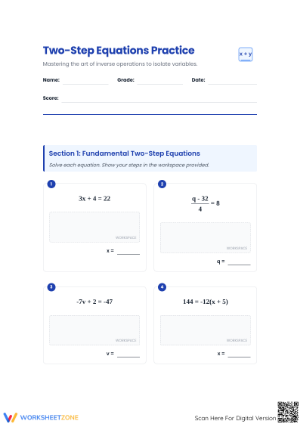
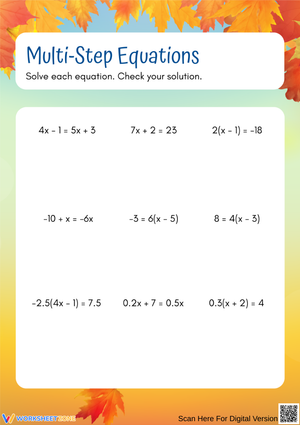
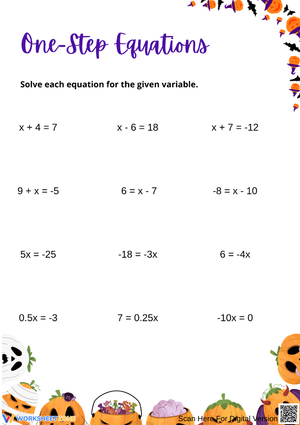
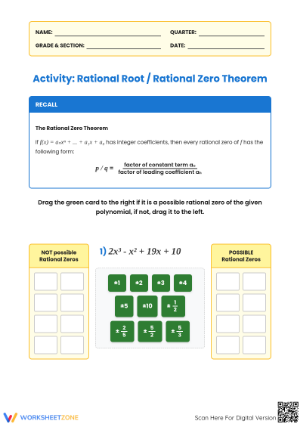
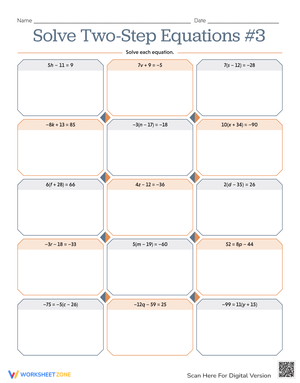
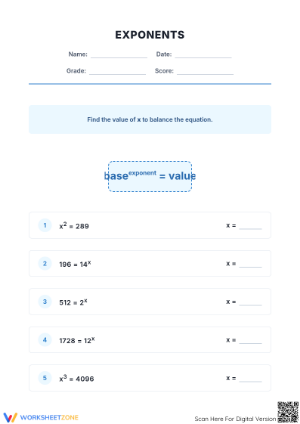
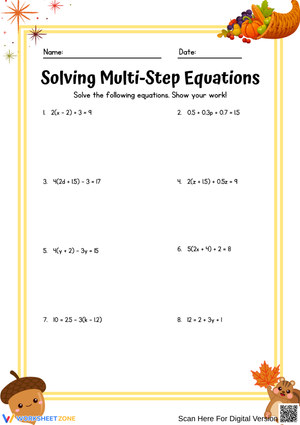
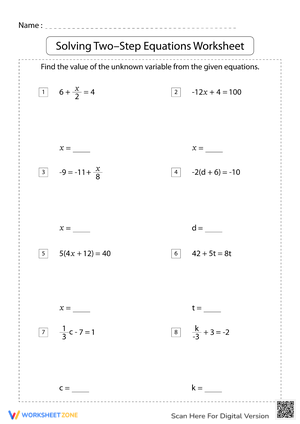
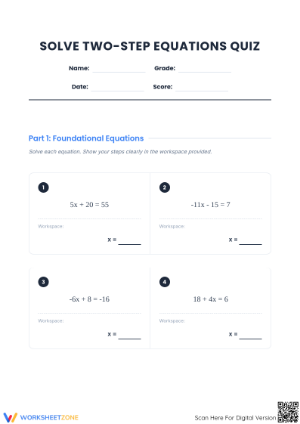
These solving equations printable worksheets for 7th grade address one of the sharpest transitions in middle school mathematics: the move from arithmetic fluency to algebraic reasoning. A student who has been operating with known numbers suddenly has to think about what a variable represents, maintain balance across the equals sign, and apply inverse operations in the right order. This set gives teachers printable, structured practice that moves from one-step equations all the way through multi-step problems with the distributive property — in a sequence students can actually follow.
The Specific Skills Targeted
Each worksheet in the set isolates or combines a defined algebraic skill, which lets teachers match the practice to where students actually are in the unit rather than assigning one catch-all worksheet.
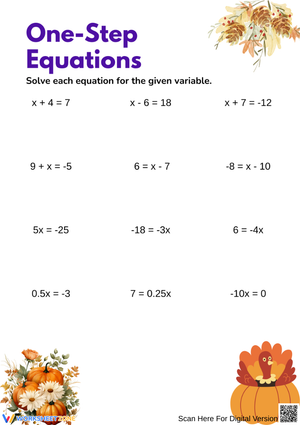
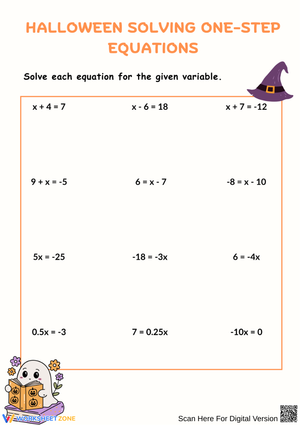
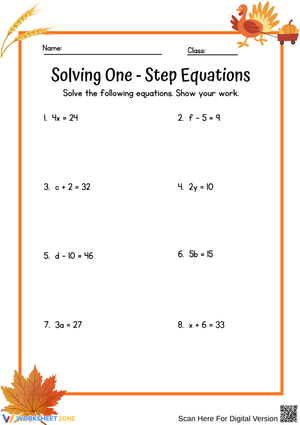
- One-step equations — addition, subtraction, multiplication, and division. These build the core habit: identify the operation, undo it on both sides, check the result.
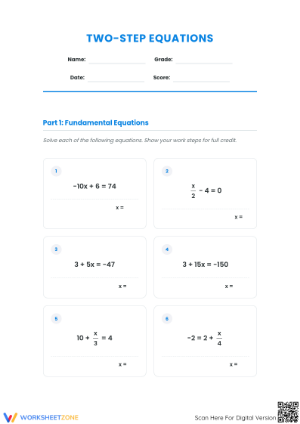
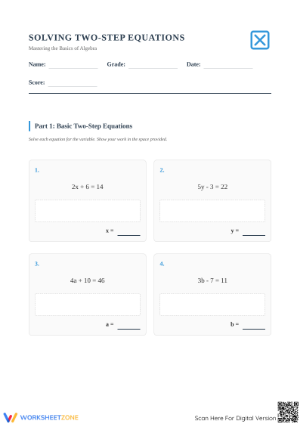
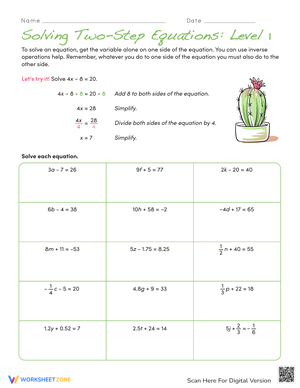
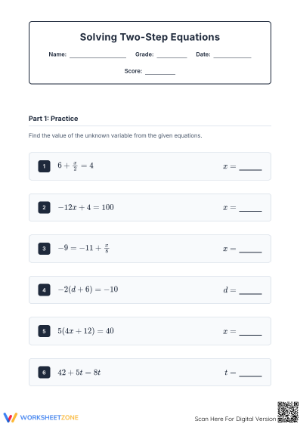
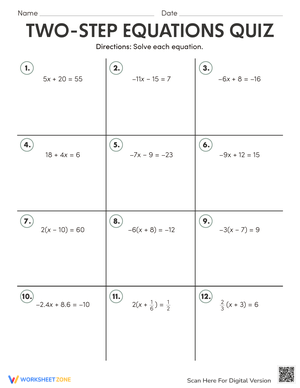
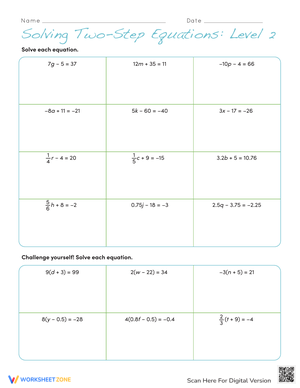
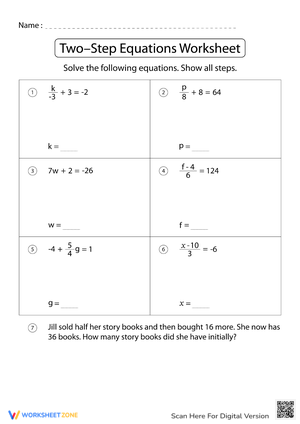
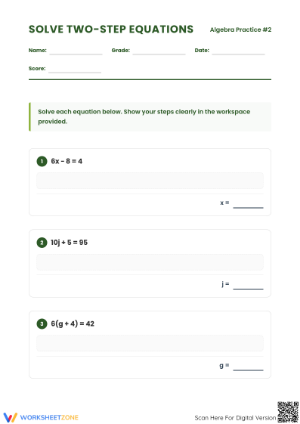
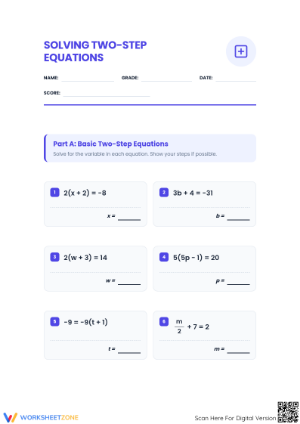
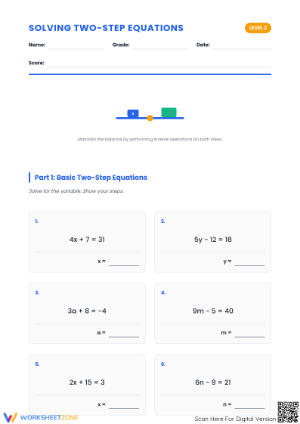
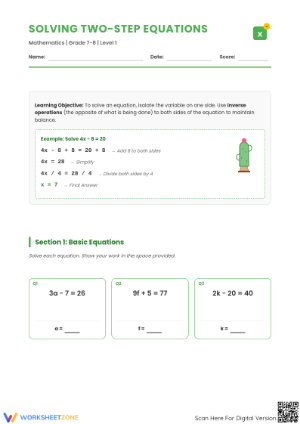
- Two-step equations — students work backward through two operations, which requires them to decide on order before they touch a pencil.
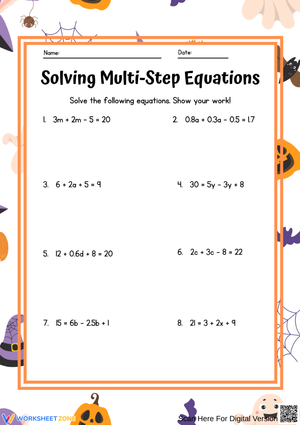
- Combining like terms — before applying inverse operations, students simplify each side. This is where x + 3x gets collapsed to 4x and left-side confusion often sets in.
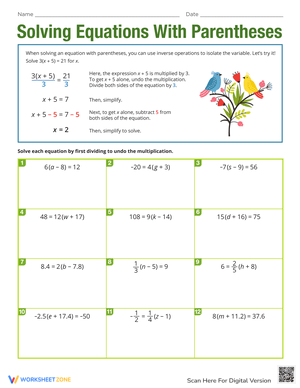
- Distributive property equations — students expand a term before solving, which demands both sign accuracy and the understanding that distribution applies to every term inside the parentheses.
- Variables on both sides — students move one variable term across the equals sign, a step that many find counterintuitive the first time they see it.
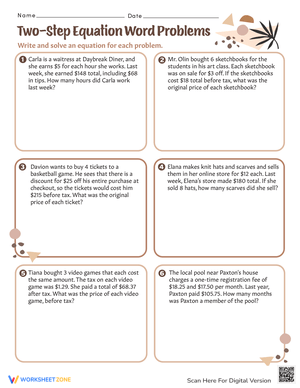
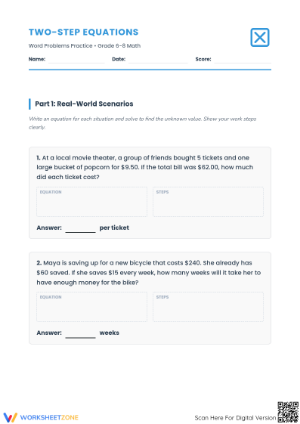
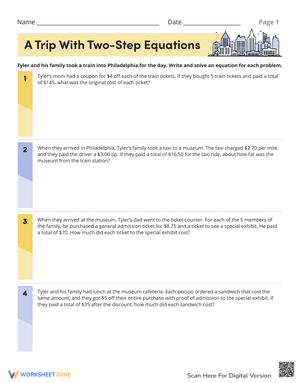
- Word problems — students translate a sentence into an equation, solve it, and interpret the result in context. The equation-writing step is often harder than the solving step.
Each worksheet type serves a different instructional moment. One-step worksheets work well at the start of a unit or after a multi-day absence. Two-step and multi-step worksheets carry most of the load during core instruction. Word-problem worksheets belong near the end of the unit, once students are no longer preoccupied with the mechanics of solving.
Frequent Student Errors Worth Watching For
Equation-solving errors in Grade 7 are predictable enough that teachers can plan for them. The most common one involves sign work during the first inverse operation. A student who correctly sets up 2x + 4 = 10 will sometimes write 2x = 14 — adding 4 to both sides instead of subtracting it. The error does not look random on paper; the arithmetic is internally consistent. What's missing is the understanding that undoing addition requires subtraction. Worksheets that ask students to label each inverse operation explicitly before executing it surface this error quickly, which makes it easier to address in a brief whole-class discussion.
Distribution errors run a close second. Students will expand 3(x + 5) as 3x + 5, multiplying the first term but leaving the second unchanged. This happens even after direct instruction, often because students are managing cognitive load — holding the equation structure in working memory while also trying to execute a new procedure. Problems that isolate distribution practice before combining it with solving help students slow down at exactly the right moment.
A third pattern worth watching: students who correctly isolate the variable term but stop too early. After reaching 4x = 20, some write "x = 20" without dividing. They have done most of the work, but the habit of treating that final step as optional persists longer than teachers expect. Building a substitution check into each worksheet gives students a reliable way to catch this on their own before the worksheet is turned in.
Lesson-Planning Ideas to Get the Most From These Worksheets
The most reliable use of these worksheets is a short targeted block, not a full-period assignment. A one-step or two-step worksheet works well as a warm-up during the first 5–8 minutes of class, before the main lesson begins. Students start thinking algebraically right away, and teachers get a fast read on where the room stands. If half the class misses the same problem, that information arrives before new content is introduced — which is exactly when it's most useful.
For reteaching, a focused worksheet — just one-step multiplication equations, for example — is more useful than a mixed-review worksheet. Small groups benefit from working through 6 to 8 targeted problems with teacher guidance, not 20 problems that vary too much for the group to build any momentum. Save the mixed-review worksheets for Fridays, spiral review days, or the week before an assessment, when the goal is retrieval across formats rather than practice on a single procedure.
One concrete weekly plan: assign a two-step worksheet as Tuesday homework after introducing two-step equations on Monday. On Wednesday, use the first 10 minutes of class to review the two or three problems that caused the most difficulty. Then distribute a new worksheet with multi-step problems as the day's independent practice. This tight alignment — using the homework worksheet as a diagnostic bridge into the next lesson — is where printable PDFs earn their keep in a planning cycle.
Standard Alignment
These worksheets align to CCSS 7.EE.B.4, which calls for students to use variables to represent quantities and construct simple equations to solve problems. In classroom terms, that standard covers one-step and two-step equations — the foundation of the set — and extends to word problems where students build an equation from a written situation rather than starting with a ready-made expression. The solving equations printable worksheets for 7th grade in this set also address 7.EE.A.1 (applying properties of operations to add, subtract, factor, and expand linear expressions) through the multi-step and distributive property worksheets, where algebraic manipulation comes before solving. Teachers working in states with standards closely modeled on the CCSS will find this alignment holds without adjustment.
Adjusting the Worksheets for a Range of Learners
In most Grade 7 classes, the readiness gap on equation solving is wider than the curriculum suggests. Some students are extending to multi-step work while others still pause when an equation involves a negative coefficient. Printable worksheets make it practical to run two or three tiers of practice simultaneously without writing separate lesson plans.
For students who need more support, begin with one-step equations and allow them to use a reference card listing the four inverse operation pairs. That small addition removes one working-memory demand and lets students focus on the balance principle rather than on procedure recall. Once they are consistent with one-step work, move them to two-step problems — same worksheet format, more operations to undo. For students ready to push further, word-problem worksheets and any worksheet that mixes equation types build the flexibility that unit tests actually measure. The solving equations printable worksheets for 7th grade are organized by skill type, which makes level-based assignment straightforward to manage without custom printing for every student.
Frequently Asked Questions
What prior knowledge do students need before starting two-step equations?
Students should be solid on integer operations — especially adding and subtracting negative numbers — before two-step equations make sense. They also need a working understanding of what it means to keep an equation balanced. A student who thinks "subtracting 3 from the left side" and "subtracting 3 from the right side" are two separate decisions will struggle with every step that follows. Strong one-step practice builds that balance understanding before the procedural complexity increases.
Can these worksheets work for students who are behind grade level?
Yes, if the teacher selects the right starting point. A student working below grade level may need the one-step worksheets with whole-number coefficients before touching anything with negatives or fractions. The set's organization by skill type lets a teacher assign appropriate practice without signaling that a student is doing "easier work" — the worksheets are visually consistent and do not label difficulty on the student-facing worksheet.
How many problems per worksheet is practical for a class period?
For guided practice during a lesson, 6 to 10 problems is usually enough. Students working through multi-step equations with distribution need time to show every step, and a worksheet that demands 20 problems of that type will either rush their work or frustrate students who process more carefully. Shorter sets — especially when paired with a verification step — produce better work quality than longer ones.
Do the worksheets include answer keys?
The solving equations printable worksheets for 7th grade in this set include answer keys, which matters practically when running stations, using worksheets as sub plans, or having students self-check before a small-group discussion. Answer keys also let students working independently at home verify solutions on their own, which keeps homework from becoming a source of undetected confusion that carries forward into the next lesson.













 Interactive Worksheet Maker
 Quiz Maker
 Word Search Maker
 Crossword Puzzle Maker
 Word Scramble Generator
 Sentence Scramble Generator
 Handwriting Worksheet Generator
 Name Tracing Generator
 Fill In The Blank Generator