


























Views
Downloads


Writing Equations Worksheet | Grade 6-7 Essential Math
Paste this activity's link or code into your existing LMS (Google Classroom, Canvas, Teams, Schoology, Moodle, etc.).
Students can open and work on the activity right away, with no student login required.
You'll still be able to track student progress and results from your teacher account.
This Grade 6-7 math worksheet empowers students to bridge the gap between verbal language and algebraic notation. By practicing with 14 diverse problems, learners develop the critical ability to translate real-world scenarios into solvable one-variable equations. This resource ensures students gain confidence in modeling mathematical relationships accurately.
At a Glance
- Grade: 6-7 · Subject: Math
- Standard:
CCSS.MATH.CONTENT.6.EE.B.6— Use variables to represent numbers and write expressions for real-world problems- Skill Focus: Writing algebraic equations
- Format: 3 pages · 14 problems · Answer key included · PDF
- Best For: Independent practice and formative assessment
- Time: 25–35 minutes
This comprehensive 3-page PDF features a structured progression of 14 tasks designed to build algebraic fluency. It includes basic translation exercises, a matching section for visual reinforcement, multiple-choice challenges, and complex real-world word problems. A full answer key is provided to facilitate quick grading or student self-correction.
Skill Progression
- Guided practice: 5 basic translation problems (Part 1) introduce students to converting simple phrases like "sum" and "product" into algebraic symbols.
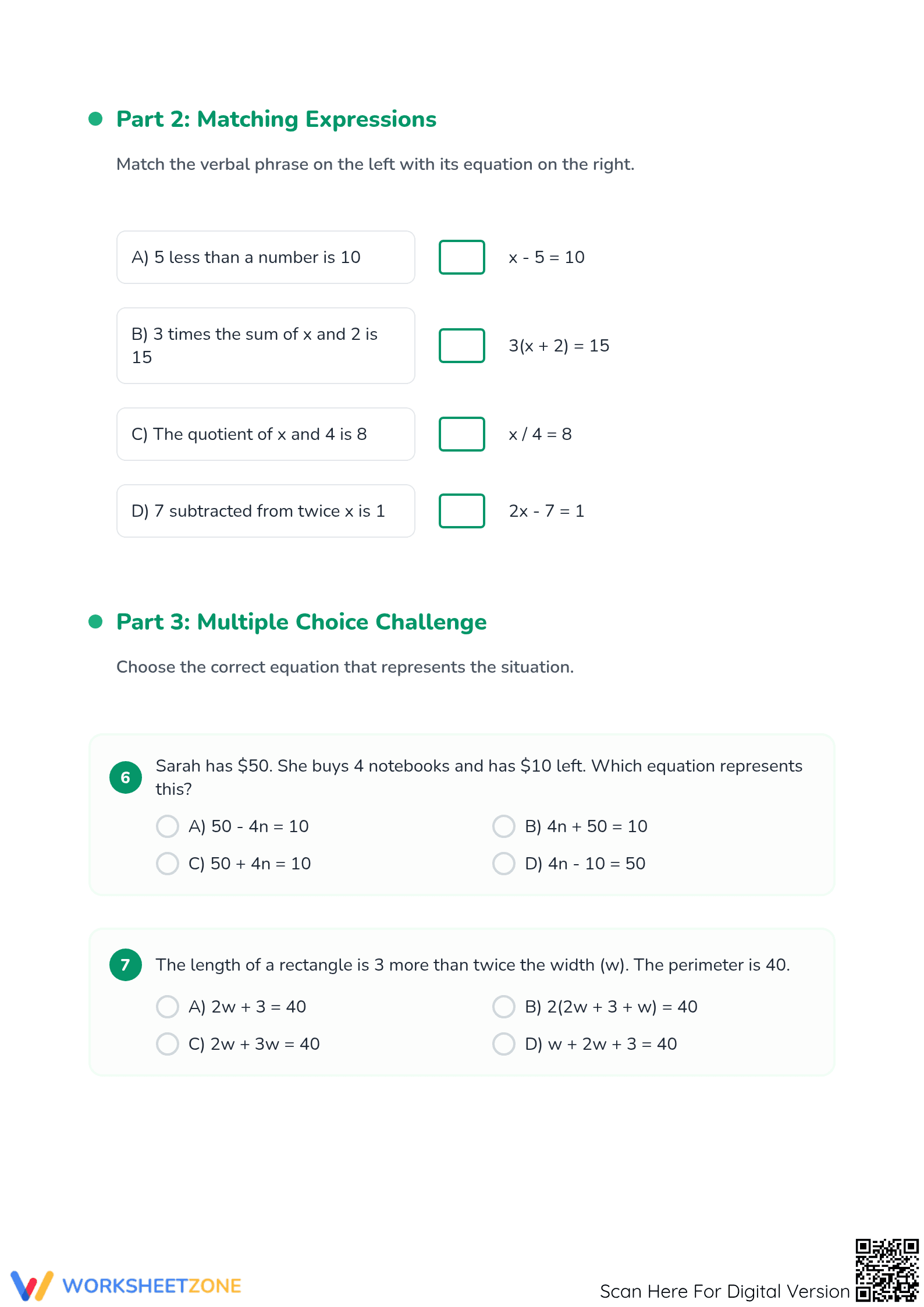
- Supported practice: 4 matching tasks and 2 multiple-choice scenarios (Parts 2 and 3) provide visual scaffolds to help students recognize correct equation structures.
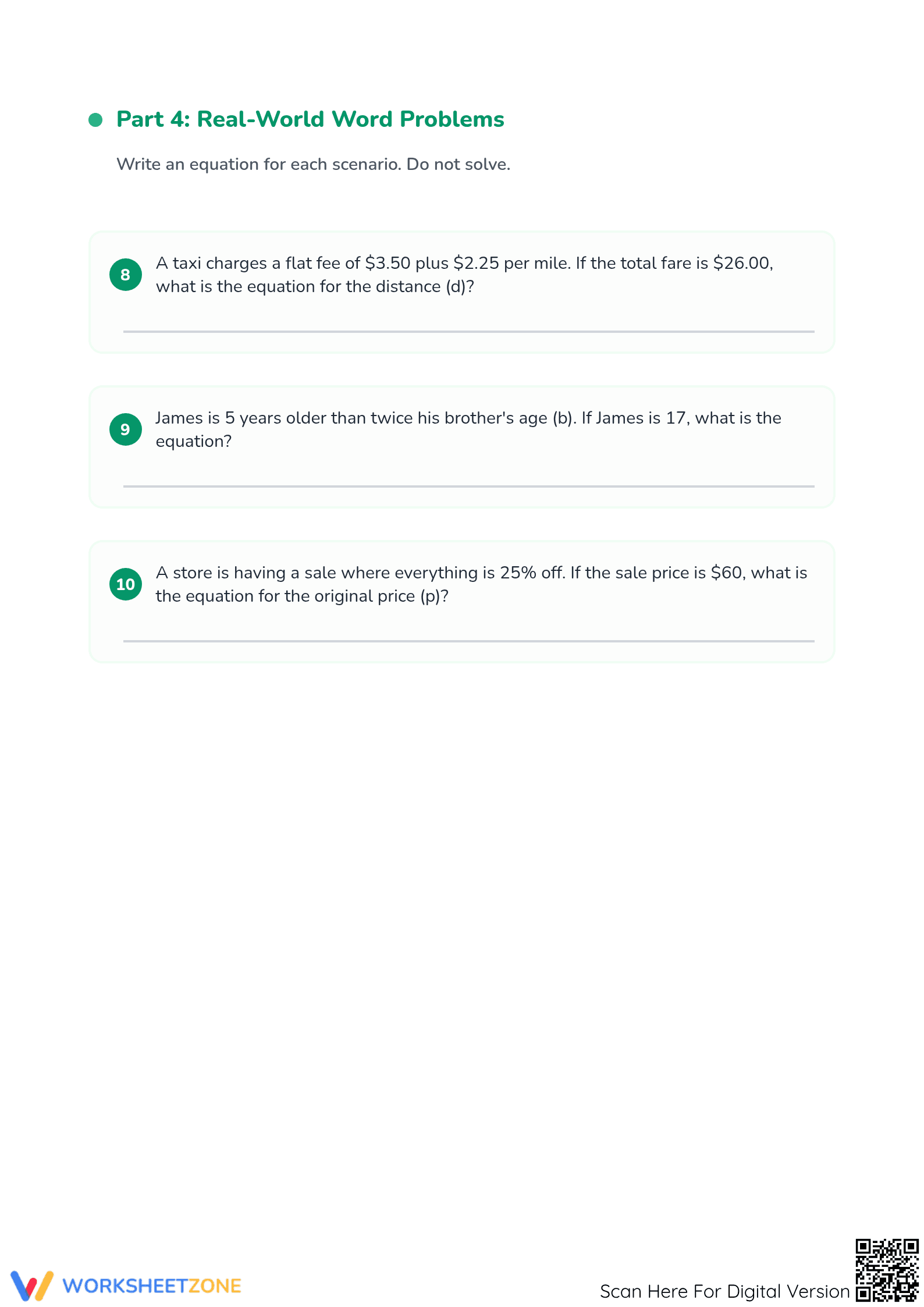
- Independent practice: 3 open-ended word problems (Part 4) require students to synthesize their learning by drafting equations for multi-step real-life situations.
The worksheet follows a gradual-release model, moving from direct translation to complex situational modeling.
Standards Alignment
The primary focus is CCSS.MATH.CONTENT.6.EE.B.6, which requires students to use variables to represent numbers and write expressions when solving real-world or mathematical problems. It also supports CCSS.MATH.CONTENT.7.EE.B.4 by laying the groundwork for solving multi-step equations. Both standard codes can be copied directly into lesson plans, IEP goals, or district curriculum mapping tools.
How to Use It
Use this worksheet during the "You Do" phase of a lesson on algebraic modeling. It serves as an excellent formative assessment tool to identify students struggling with specific keywords like "less than" or "twice." Expect students to complete the full set in 25 to 35 minutes depending on their familiarity with variable notation.
Who It's For
This resource is ideal for general education 6th and 7th-grade students, as well as 8th-grade students requiring intervention in algebraic foundations. It pairs naturally with a classroom anchor chart detailing common mathematical operation keywords and their corresponding algebraic symbols.
According to the RAND AIRS 2024 report, the ability to translate between natural language and mathematical symbols is a primary predictor of success in high school Algebra I. This worksheet targets CCSS.MATH.CONTENT.6.EE.B.6 by providing 14 scaffolded opportunities for students to practice this specific skill. Research from Fisher & Frey (2014) emphasizes that gradual-release models, like the one employed here, significantly improve student retention of abstract concepts. By moving from simple verbal phrases to complex scenarios involving taxi fares and percentage discounts, the material ensures that students are not just memorizing rules but are applying logic to variable representation. This structured approach helps bridge the gap between arithmetic and algebraic thinking, providing the necessary repetition for mastery in middle school mathematics.


