


























Views
Downloads
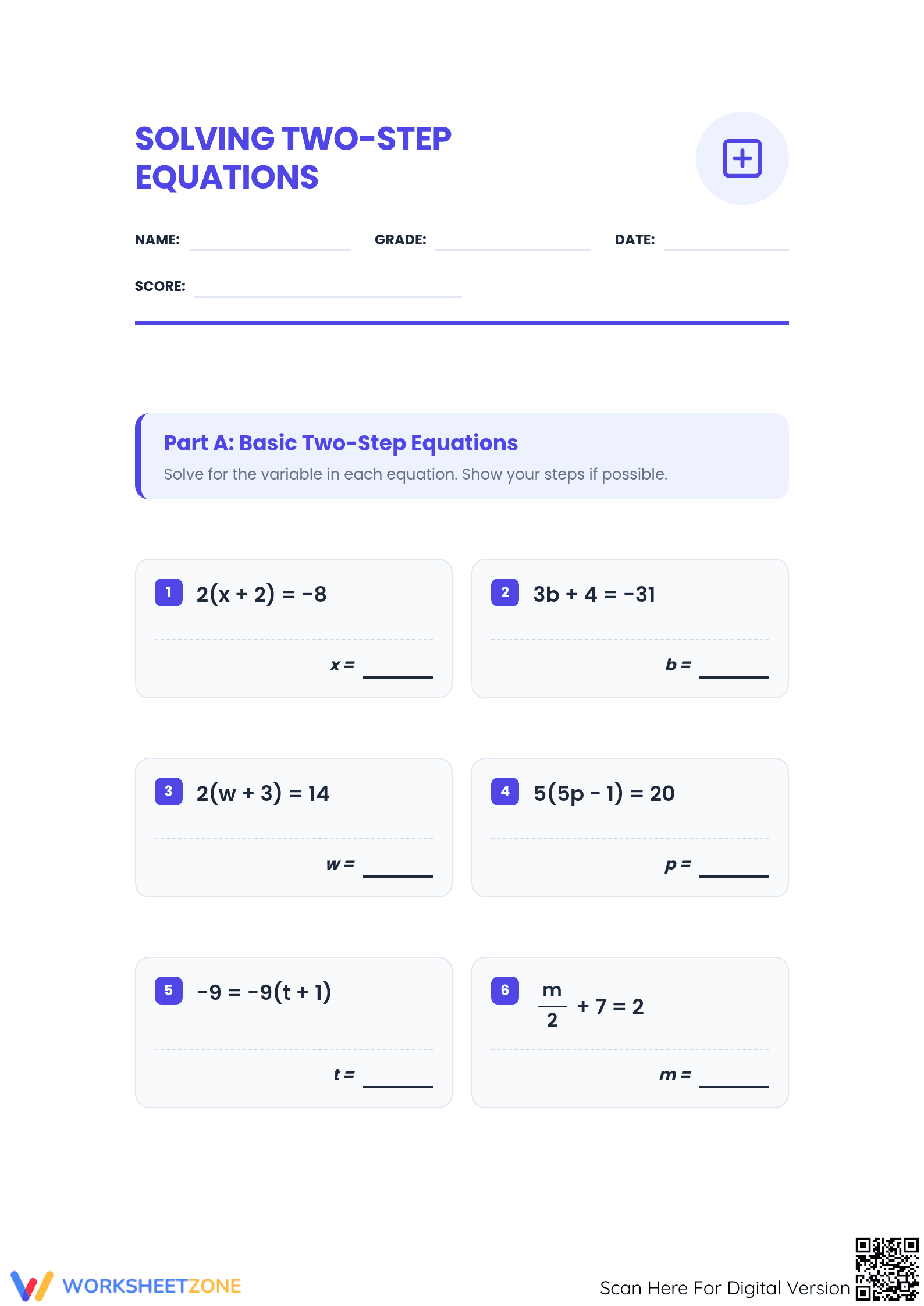


Printable Two-Step Equations Worksheet | Grade 7 Math
Paste this activity's link or code into your existing LMS (Google Classroom, Canvas, Teams, Schoology, Moodle, etc.).
Students can open and work on the activity right away, with no student login required.
You'll still be able to track student progress and results from your teacher account.
This comprehensive math worksheet helps middle school students master solving two-step equations through targeted, progressive practice. By working through these carefully structured algebraic problems, learners will build the procedural fluency required to isolate variables, handle fractions, and solve complex equations with complete confidence.
At a Glance
- Grade: 7 · Subject: Math
- Standard:
CCSS.MATH.CONTENT.7.EE.B.4— Solve two-step algebraic equations fluently- Skill Focus: Solving two-step equations
- Format: 4 pages · 30 problems · Answer key included · PDF
- Best For: Independent practice and review
- Time: 30–45 minutes
This four-page resource features 30 distinct algebraic problems divided into three progressive sections. Students begin with basic two-step equations featuring integers, move on to problems involving fractions and the distributive property, and conclude with challenge equations containing decimals and complex rational numbers. A complete, separate answer key is provided to allow for quick grading or self-assessment.
Skill Progression
- Guided Practice: Part A introduces 10 foundational problems focusing on basic integer operations and standard two-step formats to build initial confidence.
- Supported Practice: Part B presents 10 intermediate problems where students must carefully handle fractions and apply the distributive property before isolating the variable.
- Independent Practice: Part C challenges learners with 10 advanced equations incorporating decimals and negative coefficients, requiring synthesis of multiple algebraic rules.
This gradual-release structure ensures students develop a deep understanding of the "I Do, We Do, You Do" methodology as they advance toward mastery.
Standards Alignment
This resource is directly aligned to CCSS.MATH.CONTENT.7.EE.B.4, requiring students to solve equations of the forms px + q = r and p(x + q) = r fluently. It also supports foundational skills for eighth-grade linear equations. Both standard codes can be copied directly into lesson plans, IEP goals, or district curriculum mapping tools.
How to Use It
Deploy this worksheet during the independent practice phase of your lesson, immediately following direct instruction on isolating variables. It also serves as an excellent homework assignment or review packet before a unit assessment. While students work, observe their first steps to ensure they are using inverse operations correctly to remove the constant before addressing the coefficient. Most students will complete the full 30-problem set in 30 to 45 minutes.
Who It's For
This worksheet is designed primarily for seventh-grade math students, though it serves as an excellent review for eighth graders preparing for Algebra I. The progressive difficulty allows teachers to easily differentiate; struggling learners can focus exclusively on Part A, while advanced students can be challenged with Part C. Pair this activity with a visual anchor chart demonstrating the steps for solving two-step equations to maximize student success.
Mastering the ability to solve two-step algebraic equations fluently is a critical milestone in middle school mathematics. According to a recent EdReports 2024 analysis, students who achieve procedural fluency with standard CCSS.MATH.CONTENT.7.EE.B.4 are significantly more likely to succeed in high school algebra courses. This foundational skill requires learners to consistently apply inverse operations and understand the properties of equality. When students practice these specific algebraic procedures through structured, progressive problem sets, they reduce cognitive load and minimize computational errors. Providing targeted practice that gradually increases in complexity—from basic integers to rational numbers and the distributive property—ensures that all learners can build the mathematical stamina necessary for advanced coursework. By solidifying these core algebraic concepts early, educators set the stage for long-term mathematical achievement and improved problem-solving capabilities across STEM disciplines.


