


























Views
Downloads



Essential Two-Step Equations Worksheet | Grade 7-8
Paste this activity's link or code into your existing LMS (Google Classroom, Canvas, Teams, Schoology, Moodle, etc.).
Students can open and work on the activity right away, with no student login required.
You'll still be able to track student progress and results from your teacher account.
This Grade 7 and 8 math worksheet provides comprehensive practice for solving two-step equations with varying levels of complexity. Students will apply inverse operations to isolate variables across 20 distinct problems, moving from basic integer operations to more advanced structures involving parentheses and decimals. It is designed to build algebraic fluency and confidence.
At a Glance
- Grade: 7-8 · Subject: Math
- Standard:
CCSS.MATH.CONTENT.7.EE.B.4— Solve equations of the form px + q = r and p(x + q) = r fluently- Skill Focus: Two-step algebraic equations
- Format: 3 pages · 20 problems · Answer key included · PDF
- Best For: Independent practice and skill reinforcement
- Time: 30–45 minutes
What's Inside
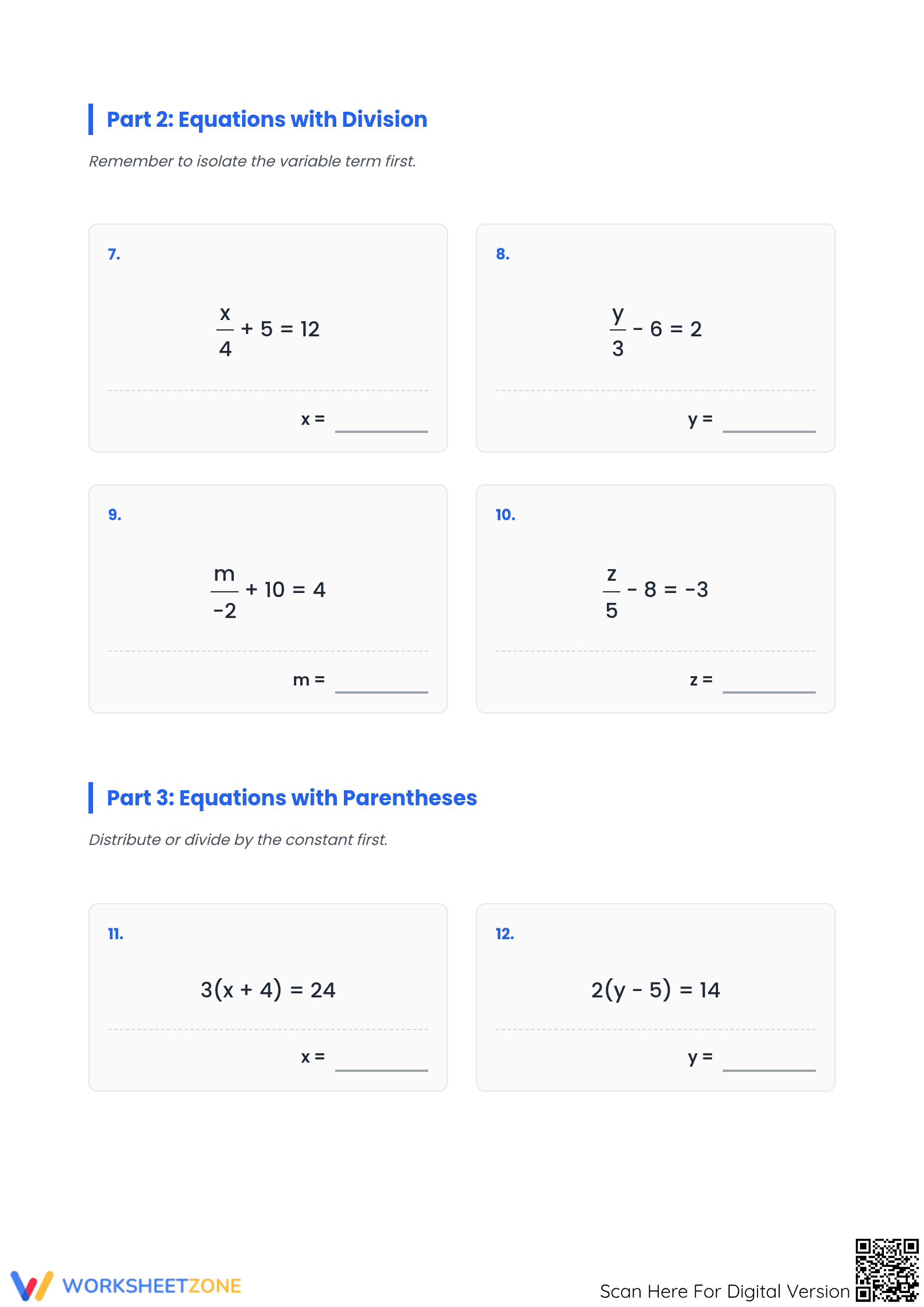
This 3-page PDF contains four structured sections. Part 1 focuses on basic two-step equations with integers. Part 2 introduces division and fractions. Part 3 covers distributive property applications with parentheses. Part 4 presents complex structures, including multi-layer fractions and decimal coefficients. A complete 3-page answer key is provided for immediate feedback and grading.
Skill Progression
- Guided Practice: The first 6 problems use whole numbers and standard addition/subtraction to establish the core rhythm of inverse operations.
- Supported Practice: Problems 7 through 14 introduce rational numbers and grouping symbols, requiring students to decide which operation to "undo" first.
- Independent Practice: The final 6 problems challenge students with multi-layer fractions and decimals, demanding high precision.
This gradual-release model ensures students master the transition from simple to complex algebraic manipulation effectively.
Standards Alignment
This resource is primarily aligned with CCSS.MATH.CONTENT.7.EE.B.4, which requires students to solve equations of the form px + q = r and p(x + q) = r fluently. It also supports 8.EE.C.7 by reinforcing the linear equation solving process. Both standard codes can be copied directly into lesson plans, IEP goals, or district curriculum mapping tools.
How to Use It
Use this worksheet during the independent practice phase of a lesson on linear equations. It works well as a mid-unit assessment to identify which specific equation structures, such as parentheses or fractions, cause student errors. Teachers should observe whether students consistently perform the same operation on both sides of the equal sign. Completion typically takes 30 to 45 minutes.
Who It's For
This resource is ideal for general education 7th and 8th-grade students, as well as high school students needing algebra remediation. It pairs naturally with a visual anchor chart demonstrating the balance scale method of solving equations or a direct instruction lesson on the distributive property.
Solving two-step equations is a foundational gateway to high school algebra. According to the RAND AIRS 2024 report, students who demonstrate early mastery of multi-step algebraic manipulation are significantly more likely to succeed in advanced STEM coursework. This worksheet addresses the specific procedural fluency required by CCSS.MATH.CONTENT.7.EE.B.4 by providing 20 targeted tasks that span integer, fractional, and decimal coefficients. Research by Fisher & Frey (2014) emphasizes that a scaffolded approach—moving from simple integer equations to complex structures involving parentheses—is essential for reducing cognitive load during the initial acquisition of algebraic skills. By isolating the variable through a consistent two-step process, students internalize the properties of equality. This resource provides the high-repetition practice necessary for students to move beyond rote memorization toward conceptual mastery of variable isolation and equation balancing.


