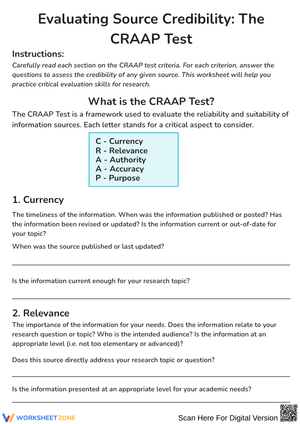
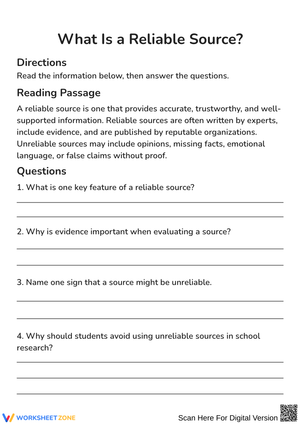
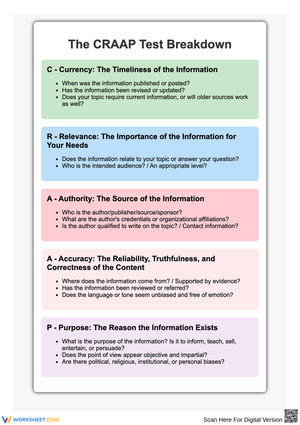
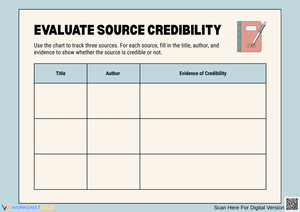
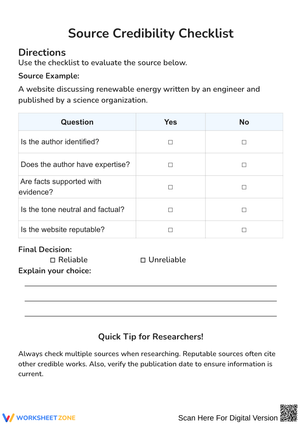
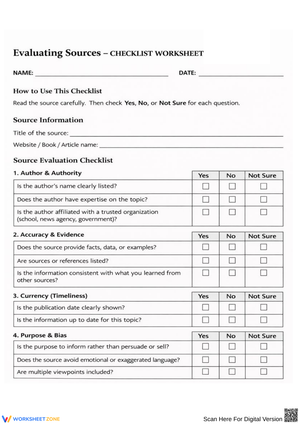
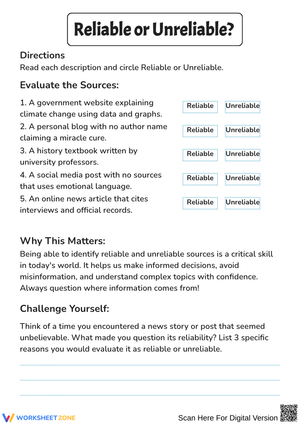
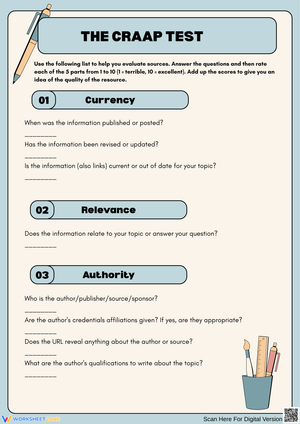
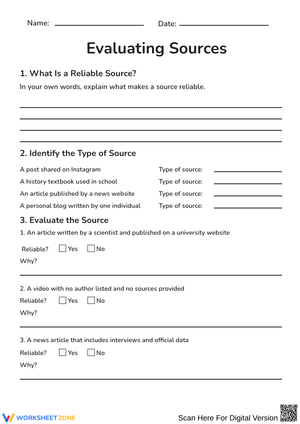
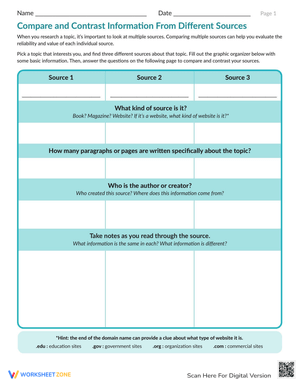
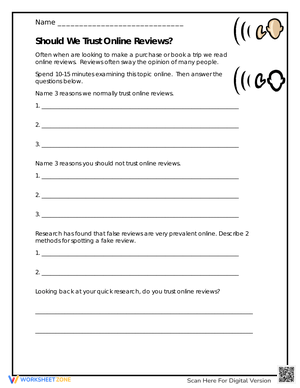
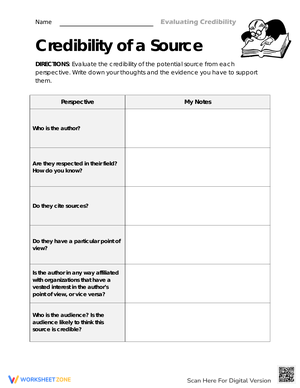
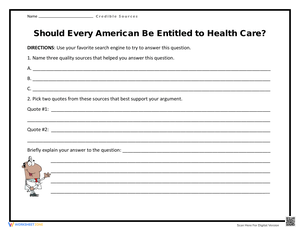
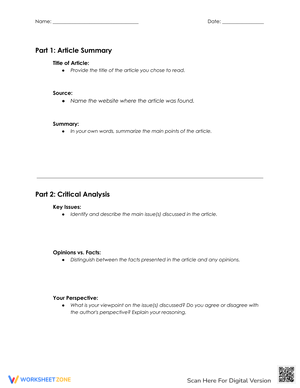
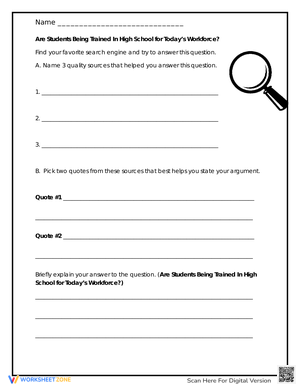
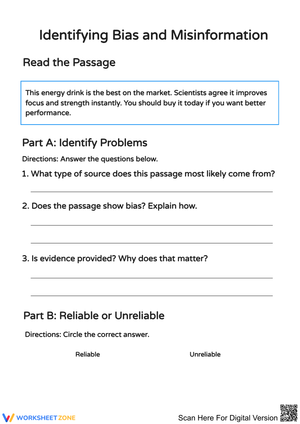
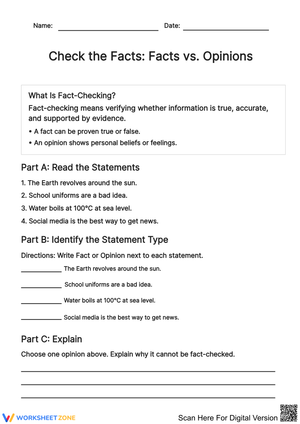
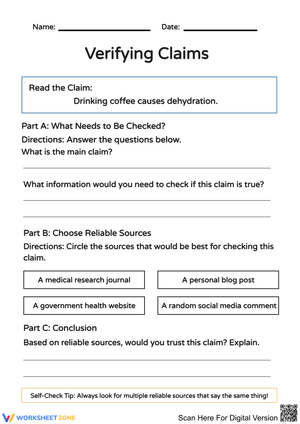
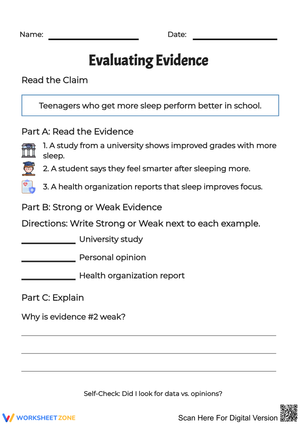
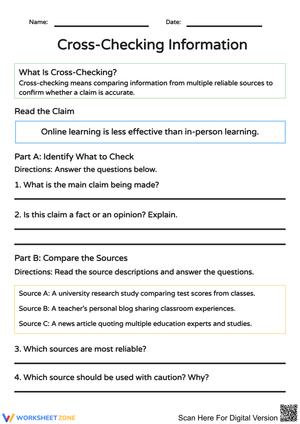
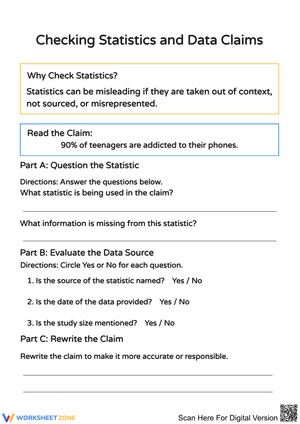
These 7th grade assessing credibility of sources printable worksheets resources give teachers a concrete tool for what is otherwise an abstract skill — getting students to slow down and actually examine a source before copying its claims into their research notes.
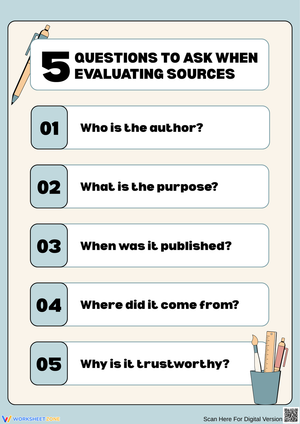
At this grade level, the standards ask students to compare sources, assess reliability, and select evidence carefully for writing tasks. Most seventh graders arrive able to find information quickly but not to question it. A well-structured worksheet interrupts the habit of accepting the first result by naming the specific features worth examining: who created the source, where it was published, how old it is, what kind of evidence it offers, and what purpose it serves.
Where Student Thinking Breaks Down Before the Writing Starts
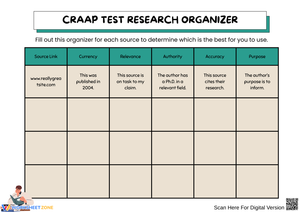
The most consistent error we see in student work at this level is misplaced trust based on appearance. A polished, fast-loading website with confident language routinely outranks a government agency report in a seventh grader's credibility assessment — not because students are careless, but because they haven't been taught to look past the surface design. That is a design literacy problem as much as a research skills problem, and worksheets that include professional-looking but unreliable source samples make the issue visible in a way that a lecture about CRAAP criteria cannot.
A second pattern: students treat length and detail as evidence of quality. Given a 200-word fact sheet from the Centers for Disease Control and a 1,500-word anonymous blog post on the same health topic, a meaningful number of seventh graders will rate the blog as more informative and therefore more trustworthy. These worksheets address that directly by asking students to assess what kind of evidence appears in a source, not simply whether it looks thorough.
Bias is where the most persistent confusion lives. Students understand the word but apply it only to obvious cases. What they consistently miss is purpose: a source that exists to sell a product or advance an agenda will still be labeled "informative" by students who haven't learned to read the frame around the content. Asking students to underline language that signals intent — phrases like "the only solution," "experts agree," or "click here to learn the truth" — makes that frame visible and teachable.
The Specific Skills Targeted Across the Set
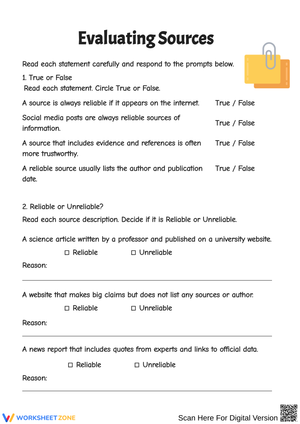
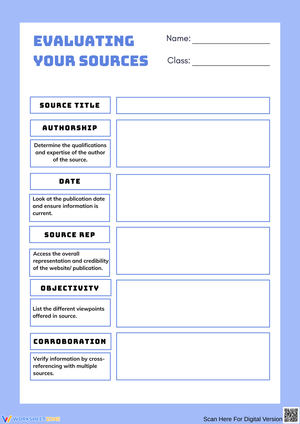
Each worksheet asks students to examine a short source sample and work through a set of evaluation criteria in a consistent order. The actions are concrete: students underline author credentials when stated, mark the publication date and note whether its age affects reliability for the topic at hand, annotate phrases that signal bias or reveal purpose, and rate evidence quality on a simple three-point scale before writing a judgment with a specific reason behind it.
- Author and authority: Who created this, and what qualifies them to speak on this topic?
- Publication context: Is this a news outlet, a government agency, an advocacy organization, a personal blog, or a sponsored platform?
- Currency: Does the publication date matter for this topic, and if so, does this source clear that bar?
- Evidence quality: Does the source cite data, peer-reviewed research, named experts, or documented events — or does it rely on sweeping claims and unnamed authorities?
- Purpose and bias: Is the source meant to inform, persuade, sell, or entertain, and how does that shape what it says and leaves out?
- Comparative ranking: Given two or three sources on the same topic, which is most trustworthy and why?
The written justification step matters as much as the checklist itself. When students have to name why a source earns a weak evidence rating — rather than just circling a score — they practice the kind of reasoning that transfers directly to note-taking, argument writing, and citation decisions.
Smart Ways to Work These Worksheets Into Your Week
Giving students one or two of these 7th grade assessing credibility of sources printable worksheets resources before they begin gathering sources for an essay creates a clear readiness check. If students are still conflating domain type with inherent credibility — treating every .gov URL as automatically reliable regardless of topic, or skipping over the author field entirely — that gap needs closing before independent research begins.
For a standard 45-minute period, a reliable sequence runs like this: five minutes reviewing the evaluation criteria together; ten minutes working through a modeled example as a class — not an obvious fake, but a borderline source that looks credible and has a specific hidden problem, such as an advocacy group presenting research it commissioned itself; then fifteen to twenty minutes of independent or partner work on two new source samples. The final ten minutes go to comparing responses across pairs. That debrief step is where the real learning concentrates, because students who reached different conclusions about the same source have to justify their reasoning out loud.
These worksheets also fill the instructional gaps that appear naturally during a research unit — the day between a mini-lesson and drafting, or the week when students are collecting sources but haven't started writing yet. Used at those moments, a single well-chosen worksheet keeps the skill active without pulling time from the main instructional sequence.
Credibility as a Spectrum, Not a Verdict
One of the most productive reframes at this grade level is moving away from the binary "credible or not credible" judgment. A source can be written by a genuine expert and still rest on thin evidence. A Wikipedia article can serve well as a background orientation tool and poorly as a citable source for an argument. A recent piece from a well-known outlet can carry significant political framing that shapes which facts it emphasizes and which it omits. When each worksheet asks students to assess individual dimensions — authority, evidence quality, currency, bias — before forming an overall judgment, their thinking becomes more precise and far more transferable to actual research decisions.
This framing also gives students language for the realistic scenario they face most often: a source that partially helps. In actual research tasks, students rarely find five ideal sources on a narrow topic. Teaching them to identify what a source does well and where it falls short builds more honest, better-supported arguments than training them to accept or reject sources in full.
Differentiating the Practice Across Readiness Levels
The core skill stays constant regardless of readiness level; what changes is how much structural support students receive while they practice it.
- Students who need additional support: Provide sentence starters — This source is weak on evidence because... and The author's credentials are unclear because... — along with a labeled checklist that briefly defines each criterion.
- On-level students: Standard source cards with the evaluation checklist and a written response section. Most students at this level can work through two sample sources in a class period without additional prompting.
- Students ready for more challenge: Assign two sources that reach opposite conclusions on the same topic. Ask students to determine which is more trustworthy, then identify what additional information they would need to feel confident in that judgment.
- Exit ticket format: One brief source snapshot with a three-sentence written response works as a quick end-of-class check on whether the evaluation habit is taking hold.
Cut-and-sort tasks work particularly well in centers. Sorting sources by purpose category or evidence strength requires students to hold multiple examples in mind simultaneously and make comparative decisions — exactly the cognitive demand that research writing places on them. Sorting produces richer thinking than circling answers on a checklist because it forces prioritization rather than isolated judgment.
Standard Alignment
These worksheets address CCSS.ELA-LITERACY.RI.7.8, which requires students to trace and evaluate arguments and specific claims in a text, assessing whether reasoning is sound and evidence is relevant and sufficient. In classroom terms, this standard surfaces in research tasks, close reading work, and argument-based writing, making it one of the most frequently taught standards at the 7th grade level and one of the clearest anchors for source credibility instruction.
They also connect to CCSS.ELA-LITERACY.W.7.8, which addresses gathering relevant information from multiple sources and assessing the credibility and accuracy of each. This is the standard most directly active when students are deciding which sources to include in an essay — and the one where the gap between student confidence and actual demonstrated ability tends to show up most plainly in finished work.
Frequently Asked Questions
Do students need devices or internet access to complete these?
No. Each worksheet includes printed source samples — short excerpts, article headers, website snapshots, or social media-style posts — so students evaluate sources without needing to look anything up. This makes the worksheets workable in classrooms where device access is limited or unreliable during the period.
How should I handle it when students disagree about whether a source is credible?
Disagreement is useful instructional material, not a grading problem. When two students evaluate the same source differently, ask each to point to the specific feature driving their conclusion. One student may have weighted the missing author credentials; the other may have focused on loaded language in the headline. Both observations can be accurate, and the conversation about how to weigh competing features is exactly the thinking the worksheets are meant to develop.
Is this a good fit for use before a research essay?
Running a short sequence of these 7th grade assessing credibility of sources printable worksheets resources before students begin gathering sources is one of the most efficient uses of the set. It shows teachers which students are ready to evaluate sources independently and which still need guided practice — before the research writing is already underway and the gaps are harder to address.
What types of sources work best as examples on these worksheets?
A range of source types produces stronger results than relying on news articles alone. Students who only practice evaluating formal journalism struggle when they encounter sponsored content, advocacy organization websites, health information from supplement companies, or social media posts presenting statistics without attribution. Worksheets that cycle through several source formats train students across the full range of what research actually looks like outside the classroom.
Can the same worksheets carry across multiple research topics during the year?
The evaluation criteria transfer across topics because questions about authority, evidence quality, bias, and purpose apply whether students are researching climate policy, a historical event, or a public health issue. Teachers who return to 7th grade assessing credibility of sources printable worksheets across several units consistently find that students internalize the process more reliably than when source evaluation gets treated as a one-time pre-research activity and then set aside.












 Interactive Worksheet Maker
 Quiz Maker
 Word Search Maker
 Crossword Puzzle Maker
 Word Scramble Generator
 Sentence Scramble Generator
 Handwriting Worksheet Generator
 Name Tracing Generator
 Fill In The Blank Generator