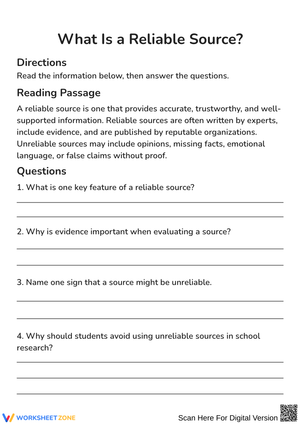
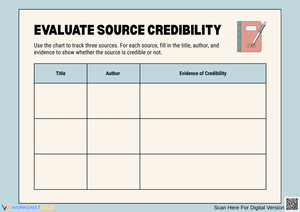
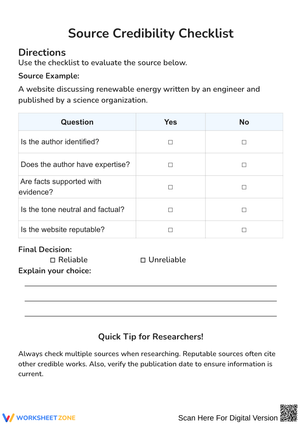
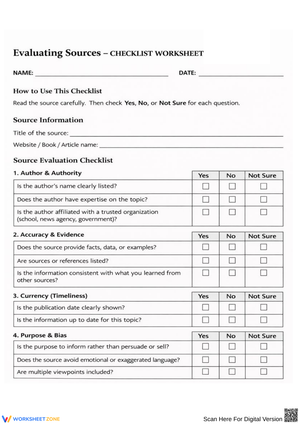
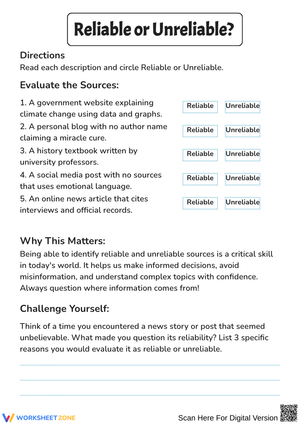
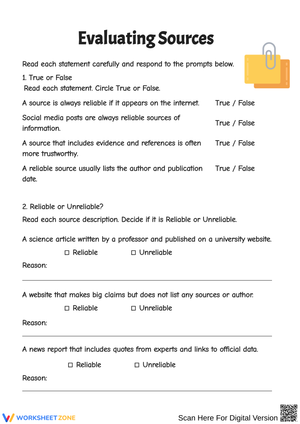
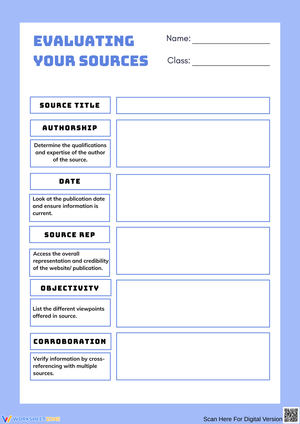
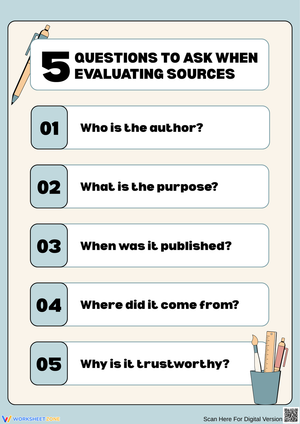
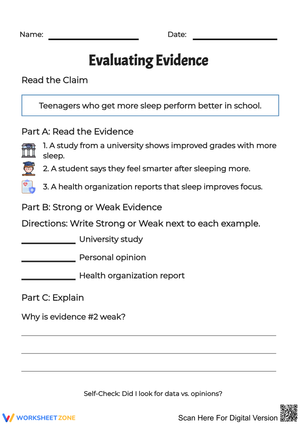
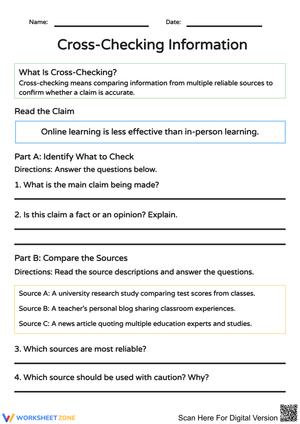
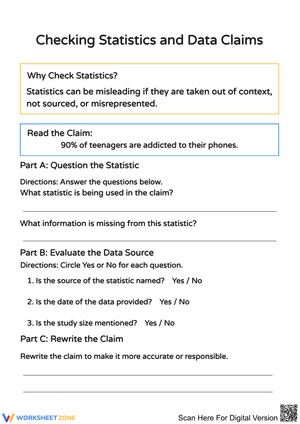
These evaluating sources worksheets for 7th grade give teachers a structured set of activities that carry students from passive research consumers to active critical readers. Seventh grade is when argumentative writing moves to the center of ELA, which means source quality suddenly carries weight it didn't in earlier grades — a flimsy source can bring down an otherwise solid argument. The set covers the full analytical sequence: checking currency, tracing author credentials, detecting bias in word choice, distinguishing primary from secondary sources, and practicing lateral reading across multiple sites.
The Specific Skills Each Worksheet Targets
Each worksheet isolates a specific evaluation skill rather than asking students to apply every criterion simultaneously. That separation matters — when students must check a publication date, research the author, identify emotional language, and trace a claim to its original source all at once, cognitive load spikes and they do none of it carefully. Building fluency one skill at a time makes the combined task manageable when students reach research essays that require it all together.
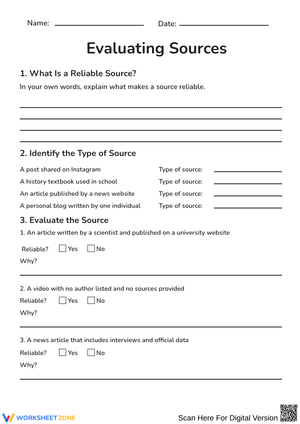
- Applying CRAAP criteria (Currency, Relevance, Authority, Accuracy, Purpose) to a specific article or URL, with actionable checklist questions for each category
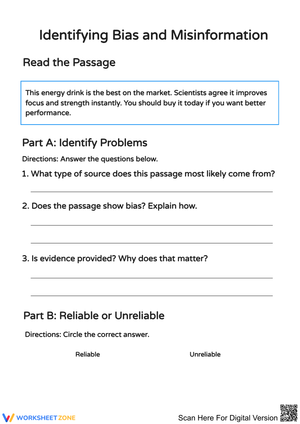
- Identifying emotionally charged language, missing perspectives, and sponsored content markers in news texts
- Sorting firsthand accounts and historical documents into primary and secondary categories, with written justification for each classification
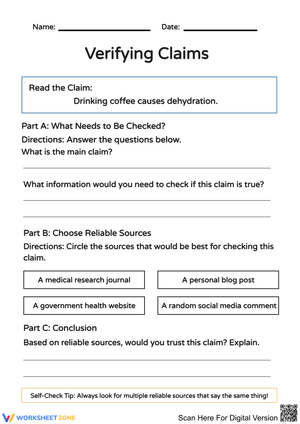
- Practicing SIFT — stopping before accepting a claim, investigating the source externally, finding better coverage from established outlets, and tracing quotes or images back to original context
- Evaluating author credentials against the specific claim being made, not just the author's general title or institutional affiliation
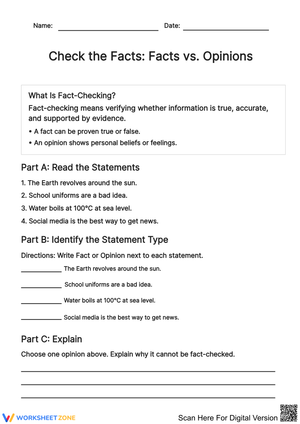
- Distinguishing fact from opinion when both appear inside the same paragraph of a news article
Two Frameworks That Serve Different Moments in Research
The worksheets draw on two complementary frameworks that do different jobs. CRAAP works well for deliberate, seated research — students use it systematically to evaluate a source they plan to cite in a formal essay. It slows them down, which is exactly what beginning source evaluators need. SIFT addresses a different scenario: the fast, real-time decision about whether a news headline or forwarded article deserves trust. Its most important component is lateral reading — opening new browser tabs to check what other sites say about a source, rather than accepting the source's own "About" page as proof of credibility. Research from the Stanford History Education Group shows that lateral reading outperforms checklist-only approaches because professionally designed websites can easily fake authority signals. Worksheets covering SIFT push students to verify reputation externally, which is a stronger evaluation move than inspecting a domain name or reading a site's self-description.
Mistakes Students Make That These Worksheets Help You Catch
The most persistent error at this grade level isn't failing to check sources at all — it's checking the wrong thing. Students learn quickly to look for author credentials, so they find that a writer holds a PhD and mark the source reliable. What they miss is that the PhD is in electrical engineering while the article is arguing about epidemiology. This credential-topic mismatch appears consistently in seventh-grade research drafts, and it's hard to surface without a worksheet that asks students to write down both the author's field and the specific subject of the article, then compare them explicitly before making a reliability judgment.
A second error is taking "About" pages at face value. Students who have been told to "check who wrote it" will read a site's self-description and accept it without looking further. A worksheet that sends them away from the page — asking them to search the organization's name in a news archive or neutral database — breaks that habit before it sets. Bias detection also surfaces a subtler issue: students who spot one emotional word in a headline will sometimes label the entire article biased when the body text is actually measured and well-documented. The worksheets address this by having students annotate specific sentences rather than render a blanket verdict on the piece.
How to Work These Worksheets Into Your Week Without Losing Instructional Time
Incorporating evaluating sources worksheets for 7th grade into the first five to eight minutes of class — three to four times a week — builds the automatic evaluation habit that later shows up in student research without you having to prompt it. Project a short article or a social media screenshot, students complete the relevant worksheet independently, then a brief debrief follows before the main lesson. Done consistently for three to four weeks, the routine becomes self-sustaining.
A more intensive option worth running once or twice per unit is a structured comparison activity: give each small group one straightforward news report and one opinion piece covering the same event. Students use the bias detection worksheet to highlight emotionally loaded language, identify unsupported assertions, and note which perspectives are absent from each text. The side-by-side format makes bias visible in a way that abstract instruction rarely achieves — students who struggled to articulate why something "felt off" can suddenly point to specific word choices and missing context. The discussion that follows almost runs itself. For research writing units, require a completed source evaluation worksheet for every citation a student plans to use. It adds time per source, but it changes research behavior: students stop grabbing the first plausible result and start making deliberate quality judgments. The finished worksheets also give teachers something concrete to address in writing conferences rather than just a bibliography listing.
Standard Alignment
The worksheets connect most directly to two CCSS standards. CCSS.ELA-LITERACY.W.7.8 requires students to "assess the credibility and accuracy of each source" when gathering information from print and digital materials — these activities give students a concrete method for doing that rather than leaving credibility assessment as an undefined expectation attached to a research assignment. CCSS.ELA-LITERACY.RI.7.8 targets tracing and evaluating arguments in texts, assessing whether reasoning is sound and evidence is sufficient. The author authority and bias detection activities map directly to that standard, since recognizing slanted evidence and unsupported claims is the practical classroom version of what RI.7.8 describes. Both standards surface most visibly during argumentative writing units — exactly when teachers reach for these activities.
Differentiating These Worksheets Across Student Levels
For students who struggle with reading stamina, swap in articles at a lower Lexile level rather than simplifying the evaluation task itself. The critical thinking stays intact; what changes is the text complexity. A student working hard to decode a dense passage has little attention left for noticing that an author biography is missing or that a funding source isn't disclosed.
Students ready for more depth can move into lateral reading extension tasks: not just completing the worksheet's evaluation, but independently locating two external references that either corroborate or contradict the source, then writing a short explanation of what the search revealed. That extension shifts the work from applying a given framework to generating an original credibility judgment — a meaningful step up in analytical demand. For English language learners, evaluating sources worksheets for 7th grade that center the CRAAP checklist tend to reduce working memory pressure while keeping the analytical expectation fully intact, because each criterion is labeled and explained in plain language rather than assumed as prior knowledge.
Frequently Asked Questions
What does CRAAP stand for, and does the name become a classroom management issue?
CRAAP stands for Currency, Relevance, Authority, Accuracy, and Purpose. Most seventh graders find the acronym memorable — which is pedagogically useful, since the goal is for students to recall these criteria independently during independent research. The name typically draws a laugh on first introduction, and then students move on. It's worth noting that CRAAP works best as an entry framework rather than a complete method; students also need lateral reading practice to verify what the checklist surface-level identifies as credible, since those authority signals can be reproduced on any professionally designed site.
How do I teach lateral reading if students don't have individual devices?
Lateral reading doesn't require one device per student. Model the process on a single projected screen, thinking aloud as you open tabs and search the organization's name alongside terms like "criticism" or "funding source." Students follow along by recording what each search reveals on their worksheet. Pair work with one shared device is also effective — one student navigates while the other annotates, then they swap roles with the next source.
How is teaching fact versus opinion different from teaching students to detect bias?
Fact-versus-opinion work asks students to classify individual sentences: is this claim verifiable, or is it a judgment? Bias detection goes a step further — it asks why certain facts were selected and others omitted, whether emotional language surrounding factual statements is doing persuasive work, and whose perspective is structurally absent from the text. A piece can be entirely accurate at the sentence level and still mislead through selection and framing. The evaluating sources worksheets for 7th grade in this set address both skills separately before combining them, because collapsing the two concepts tends to produce shallow analysis where students underline one charged word and declare the whole article biased.
Do these worksheets transfer to content areas outside ELA?
Yes, consistently. Social studies teachers find the primary-versus-secondary source worksheets directly applicable to document-based question preparation. Science teachers use the author authority activities to help students distinguish peer-reviewed findings from popular science summaries. The SIFT-based worksheets translate across any discipline where students encounter arguable claims — and at seventh grade, that includes most content areas.












 Interactive Worksheet Maker
 Quiz Maker
 Word Search Maker
 Crossword Puzzle Maker
 Word Scramble Generator
 Sentence Scramble Generator
 Handwriting Worksheet Generator
 Name Tracing Generator
 Fill In The Blank Generator