


























Views
Downloads


Essential Density Calculations Worksheet | Grade 6-7
Paste this activity's link or code into your existing LMS (Google Classroom, Canvas, Teams, Schoology, Moodle, etc.).
Students can open and work on the activity right away, with no student login required.
You'll still be able to track student progress and results from your teacher account.
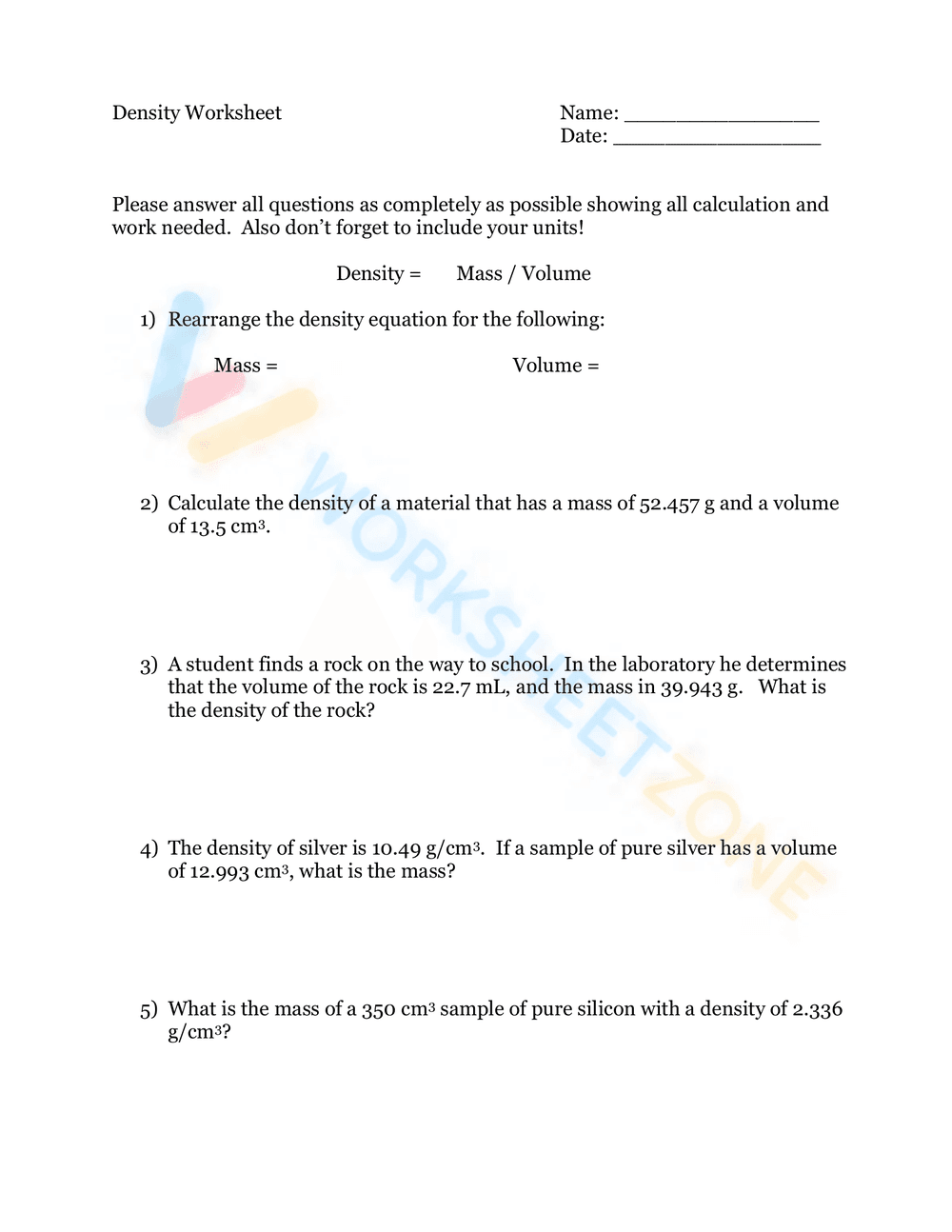
This Grade 6 science worksheet provides students with 10 structured word problems to master density calculations. By rearranging the fundamental formula and applying it to real-world materials like gold and lead, learners develop a concrete understanding of physical properties. It is designed for immediate classroom use to reinforce core physics concepts and mathematical accuracy.
At a Glance
- Grade: 6 · Subject: Science
- Standard:
MS-PS1-2— Analyze and interpret data on the properties of substances- Skill Focus: Density formula manipulation and calculation
- Format: 2 pages · 10 problems · Answer key included · PDF
- Best For: Independent practice or formative assessment
- Time: 20–30 minutes
The resource consists of a two-page PDF featuring 10 distinct tasks. It begins with a formula manipulation exercise where students must solve for mass and volume algebraically. The subsequent nine problems are word-based scenarios requiring students to extract data, show their work, and include correct units such as g/cm³ and mL. A clear header provides space for student identification and date.
This worksheet is designed for a three-step implementation. First, print the two-page document (30 seconds). Second, distribute to students as a bell-ringer or main activity (1 minute). Third, use the included answer key for rapid grading or peer-review (5 minutes). Total teacher preparation time is under 2 minutes, making it an ideal sub-plan for middle school science classrooms.
The primary focus is `MS-PS1-2`, which requires students to analyze and interpret data on the properties of substances. By calculating density, students identify characteristic physical properties that remain constant regardless of sample size. This standard code can be copied directly into lesson plans, IEP goals, or district curriculum mapping tools to ensure instructional alignment.
Assign this worksheet during the elaborate phase of a lesson cycle after students have explored mass and volume through hands-on labs. It serves as an excellent formative assessment to check for mathematical accuracy and unit usage. Expect students to complete the 10 problems within 20 to 30 minutes depending on their comfort with multi-step decimal division.
This resource is tailored for middle school science students in grades 6 and 7, though it remains accessible for advanced 5th graders. It is particularly effective for students needing repetitive practice with multi-step word problems. Pair this with a density column demonstration or a digital simulation for a comprehensive learning experience that bridges theory and practice.
According to the RAND AIRS 2024 report, structured problem-solving tasks in physical science significantly improve student retention of mathematical formulas. This worksheet addresses the MS-PS1-2 standard by requiring students to calculate density, a fundamental property of matter. By engaging with 10 specific scenarios involving various materials, students move beyond rote memorization toward procedural fluency. Research from Fisher & Frey (2014) suggests that providing clear scaffolds, such as the initial formula rearrangement task seen here, supports the gradual release of responsibility. This resource ensures that learners can accurately determine mass and volume while maintaining unit consistency. The inclusion of real-world substances like silicon and silver provides context that aids in the conceptualization of density as a characteristic property. This standalone practice tool is an essential component for any curriculum focused on the physical properties of matter.


