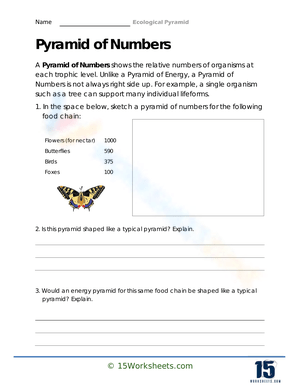
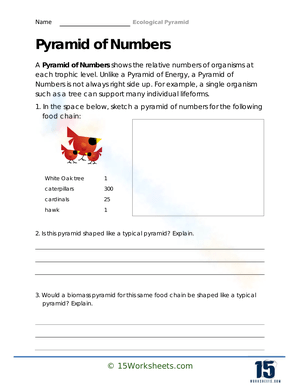
These energy pyramid pdf worksheets for 6th grade give teachers a set of printable resources that move students past labeling trophic levels into explaining why energy loss shapes entire ecosystems. Each worksheet targets a distinct entry point — diagram interpretation, proportional calculation, organism classification, and written reasoning — so the set covers the full conceptual arc of energy flow rather than repeating the same labeling task in different packaging.
What's Inside the Set
Five worksheet formats appear in the collection, and each one places different cognitive demands on students.
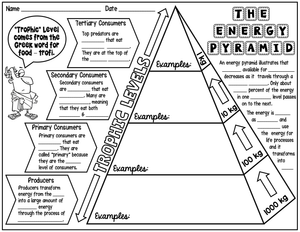
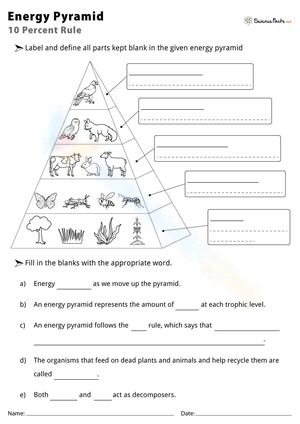
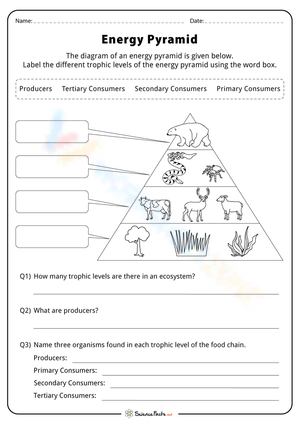
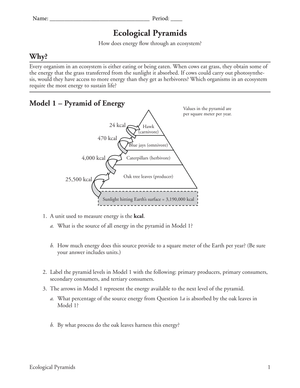
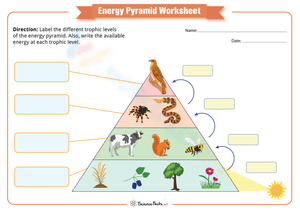
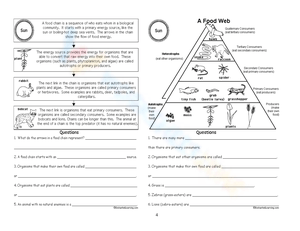
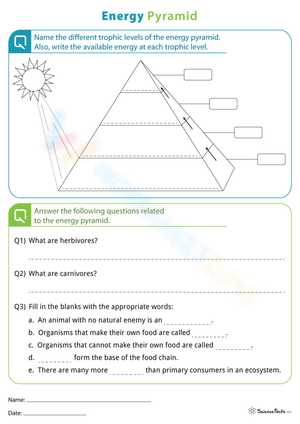
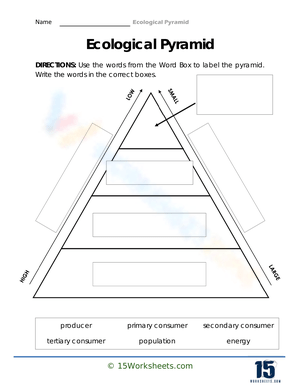
- Label-and-color diagrams: Students identify producers, primary consumers, secondary consumers, and tertiary consumers on a blank pyramid, then color each level. These work well as a warm-up, a substitute plan, or a review station because directions are self-evident and the visual structure supports developing readers.
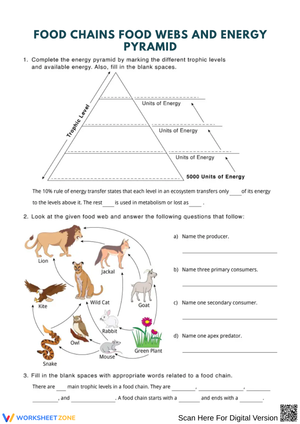
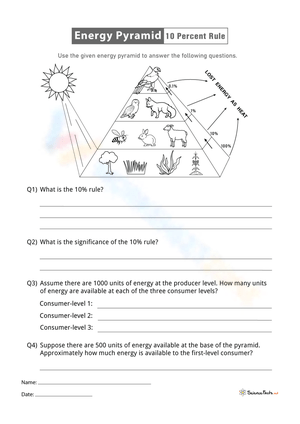
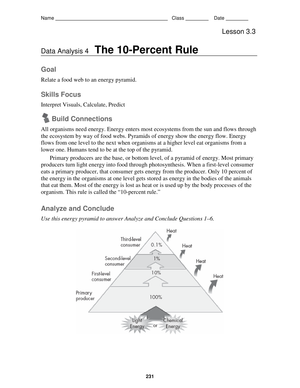
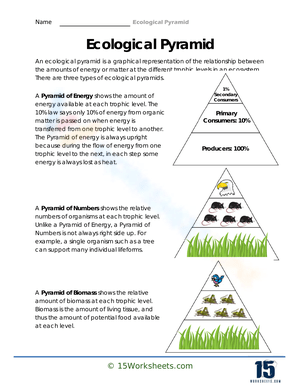
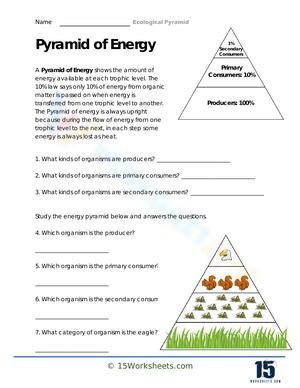
- 10% rule calculation sheets: Starting from a given energy value at the producer level — typically 10,000 kilocalories — students calculate available energy at each successive trophic level. This connects proportional reasoning to ecology without turning the lesson into a math detour.
- Organism-sorting cards: Teachers print a set of cards drawn from a specific biome — grassland, open ocean, or temperate forest — and students place each organism at the correct trophic level. Misconceptions about where omnivores or decomposers belong surface quickly with this format.
- Error-analysis tasks: Each worksheet presents an intentionally flawed energy pyramid. Students identify what is wrong, redraw or rewrite the correction, and justify their answer. Explaining why a pyramid is incorrect requires reasoning that fill-in-the-blank tasks never reach.
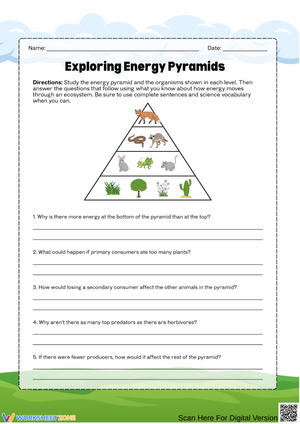
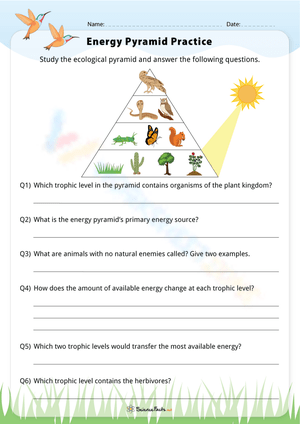
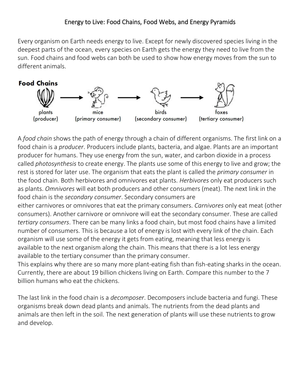
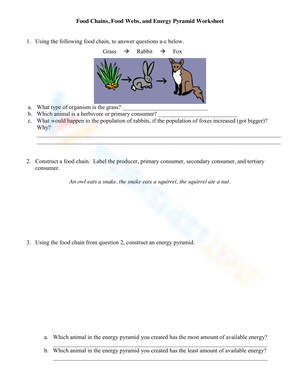
- Short reading passage with text-dependent questions: A brief informational text on energy flow precedes questions asking students to cite evidence from both the diagram and the passage, compare an energy pyramid to a food chain, and explain in their own words why producers must form the base.
Together, these formats span the range of task complexity the topic requires — from basic recall of level names to strategic reasoning about why ecosystem structure looks the way it does.
Mistakes Students Make and What They Reveal
The most persistent confusion in 6th grade energy pyramid work is conflating biological importance with energy amount. Students who correctly sequence grass → rabbit → fox → eagle on a food chain will still draw the eagle at the widest base of a pyramid because apex predators feel large and dominant. They are translating perceived status into visual size rather than following energy logic. Catching this early matters — it predicts a cluster of later mistakes about population size and why ecosystems cannot support many top predators.
A second error pattern appears reliably on calculation worksheets. When students find 10% of 5,000 energy units, they often arrive at 500 — correct — but then stack that value upward, giving the hawk more energy than the grass. The arithmetic is right; the direction of energy flow is backwards. A single prompt — "Which level captures energy directly from the sun?" — reorients most students without requiring a full reteach.
Decomposers generate a third sticking point. Many students place them at the top of the pyramid because they "eat everything," including top predators after death. Clarifying that the energy pyramid tracks energy available across living feeding levels, not the complete decomposition cycle, resolves this without opening a digression that pulls attention from the main concept.
Lesson-Planning Moves That Get the Most from This Set
Start the unit with the label-and-color worksheet. Before distributing it, build a shared pyramid on the board — grass, rabbit, snake, hawk — and ask students which level holds the most energy and why. Let two or three students share predictions, then confirm with the diagram. That brief exchange activates prior knowledge and gives the labeling task a conceptual frame instead of making it feel like busywork.
Calculation worksheets belong mid-unit, once students understand trophic sequence but need to see the energy numbers made concrete. Error-analysis worksheets work best later — close to a unit assessment — because identifying a flawed pyramid requires enough familiarity to recognize what correct looks like. Rushing students to error analysis in the first week produces guessing, not reasoning.
Not all energy pyramid pdf worksheets for 6th grade ask the same things of students, and sequencing them by cognitive demand matters more than following a fixed weekly schedule. A useful exit ticket can be built from any worksheet in the set — trim the task to one diagram and three questions: name the producer, explain why the tertiary consumer has the least available energy, and calculate energy transfer across one step. Five minutes before the end of class, that check tells you exactly who is ready to move into food web complexity.
Adjusting the Worksheets for a Mixed-Readiness Class
Offer three versions of the core diagram task. A supported version includes a word bank, labeled arrows showing energy direction, and the producer level already filled in. A standard version leaves the levels blank and provides organism names in a separate key. A challenge version adds a calculation column and a short-response prompt — something like "If a drought reduced the grass population by 60%, what would happen to hawk numbers over time and why?" The science concept stays the same across all three; only the degree of independent retrieval changes.
For mixed-readiness groups, energy pyramid pdf worksheets for 6th grade that include organism-sorting cards are particularly flexible. Students working below grade level can sort a compact set of six organisms from a familiar ecosystem — a school garden, a local pond — while students working above grade level receive a larger set from an unfamiliar biome and must decide where omnivores fit when their diet spans more than one trophic level. Both groups engage with the same question about energy flow, just with different amounts of built-in guidance.
Standard Alignment
These worksheets connect directly to NGSS MS-LS2-3, which asks students to develop a model describing the cycling of matter and flow of energy among living and nonliving parts of an ecosystem. The energy pyramid is precisely that model — and the tasks in this set ask students to interpret it, correct it, and calculate with it, all of which reflect the crosscutting concept of Energy and Matter running through the middle school life science sequence. In most NGSS-aligned pacing guides, this content appears early in a 6th grade ecosystems unit, after introductory food chain work and before instruction on food webs and population dynamics.
Teachers in states using NRC-aligned frameworks outside of NGSS will find the same instructional placement. Energy flow across trophic levels typically arrives in 6th grade because it gives students a quantitative lens on the qualitative feeding relationships they described in 4th and 5th grade — a genuine conceptual step forward, not a repeat of earlier material.
Frequently Asked Questions
What should 6th graders know about energy pyramids by the end of the unit?
Students should be able to identify trophic levels by name, explain why producers occupy the base and receive the most energy, and describe why the least energy is available at the top. They should also connect the pyramid to ecosystem balance — fewer organisms can be supported at higher trophic levels because less energy is available to sustain them. Applying the 10% rule to a simple calculation is a reasonable summative expectation at this grade.
How do you introduce the 10% rule without it turning into a math lesson?
Keep the first calculation concrete: 10,000 units of energy in grass, 1,000 in deer, 100 in wolves. Then ask students to write one sentence explaining what happened to the other 9,000 units. Most will say "it got used up" or "it disappeared," which opens the door to discussing metabolic processes and heat loss in plain language before the formal terminology arrives. The math is a vehicle for the science concept, not the destination.
What is the difference between an energy pyramid and a food web?
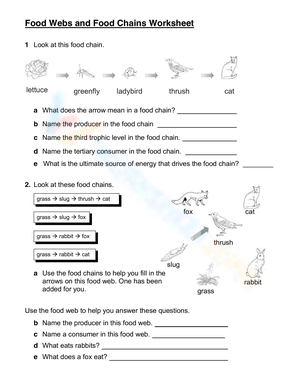
A food web shows feeding relationships — who eats whom across multiple interconnected pathways. An energy pyramid shows how much energy is available at each trophic level, regardless of the number of pathways. Students need both models: the food web answers "what eats what," and the pyramid answers "why can't there be as many hawks as there is grass." In practice, energy pyramid pdf worksheets for 6th grade work best alongside food web instruction rather than as a standalone unit, because students who encounter both models together build a more durable understanding of why ecosystems are structured the way they are.
Can these worksheets work for 7th or 8th grade review?
Yes. The label-and-color and calculation worksheets address content that NGSS places across the 6th through 8th grade band. For review at those grade levels, the error-analysis and constructed-response worksheets carry more weight because they require justification, not just recall.












 Interactive Worksheet Maker
 Quiz Maker
 Word Search Maker
 Crossword Puzzle Maker
 Word Scramble Generator
 Sentence Scramble Generator
 Handwriting Worksheet Generator
 Name Tracing Generator
 Fill In The Blank Generator




 BACK TOSCHOOL